
Blog
Overtime rules in Canada: thresholds by province, and who is exempt
Overtime rules in Canada follow the province where the employee works. Most employees earn overtime after 40 or 44 hours a week, and in several provinces after 8 hours a day, at 1.5 times their wage. A salary does not remove the right, and certain IT professionals are exempt in Ontario, British Columbia and Alberta.
Published November 16, 2026
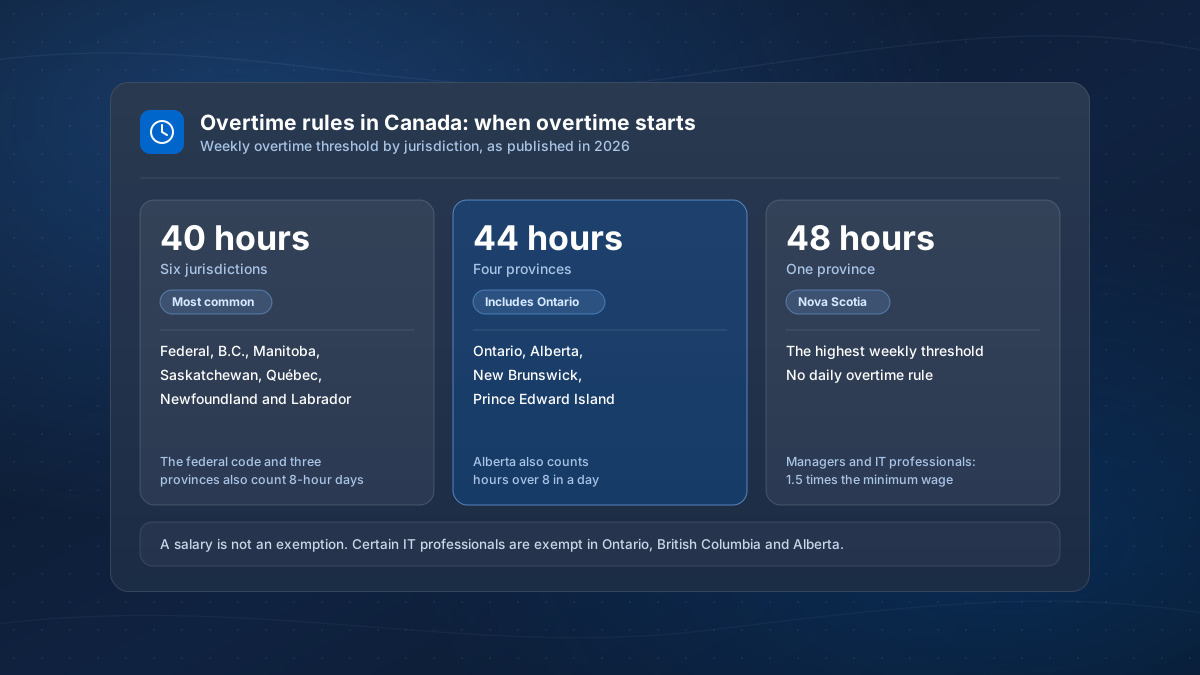
Overtime rules in Canada are set by the province where the employee works. Most employees earn overtime after 40 or 44 hours a week, and in several provinces after 8 hours a day, usually at 1.5 times their regular wage. Being paid a salary does not remove the right. Ontario, British Columbia and Alberta exempt certain IT professionals.
What are the overtime rules in Canada?
Overtime is time worked beyond the standard hours set by employment standards law, paid at a premium rate. In Canada, the standard hours and the premium come from the law of the province or territory where the employee works.
Two points surprise most U.S. employers:
- There is no national rule. The Canada Labour Code covers only federally regulated employers. Every other private employer follows the province’s employment standards law. A company in Texas with one employee in Winnipeg follows Manitoba’s rules.
- Daily overtime exists. Under the federal code and in British Columbia, Alberta, Saskatchewan and Manitoba, a long day can create overtime even when the weekly total is normal. Ontario, Québec and the Atlantic provinces count by the week.
The Canadian employment law basics page puts overtime alongside minimum wage, vacation and termination notice.
Overtime thresholds by province
Across the ten provinces and the federal code, overtime starts after 40 hours a week in six, after 44 hours in four and after 48 hours in Nova Scotia. The table sets out each jurisdiction’s threshold and minimum rate, as published by its government in November 2026.
| Jurisdiction | Overtime after | Minimum overtime rate (2026) |
|---|---|---|
| Federal (Canada Labour Code) | 8 hours a day or 40 a week | 1.5 times the regular wage |
| British Columbia | 8 hours a day or 40 a week | 1.5 times the regular wage; double after 12 hours in a day |
| Manitoba | 8 hours a day or 40 a week | 1.5 times the regular wage |
| Saskatchewan | 8 hours a day (10 on a four-day schedule) or 40 a week | 1.5 times the hourly wage |
| Québec | 40 hours a week | Regular wage plus 50% |
| Newfoundland and Labrador | 40 hours a week | At least C$24.53 an hour (1.5 times the minimum wage) |
| Alberta | 8 hours a day or 44 a week, whichever gives more | 1.5 times the wage rate |
| Ontario | 44 hours a week | 1.5 times the regular rate |
| Prince Edward Island | 44 hours a week | 1.5 times the regular wage |
| New Brunswick | 44 hours a week | At least C$23.85 an hour (1.5 times the minimum wage) |
| Nova Scotia | 48 hours a week | 1.5 times the regular wage |
Five details matter when reading the table:
- New Brunswick and Newfoundland and Labrador set a floor, not a multiple of pay. Each sets its minimum overtime rate at 1.5 times the provincial minimum wage, which gives C$23.85 an hour in New Brunswick and C$24.53 in Newfoundland and Labrador from April 1, 2026. For a well-paid professional, that floor sits far below 1.5 times their own wage.
- Prince Edward Island moved from 48 to 44 hours. The province’s hours of work page now gives a 44-hour standard week. Some older summaries still show 48.
- Saskatchewan lowers the week for public holidays. Its guide sets overtime after 32 hours in a week that contains a public holiday.
- Ontario also caps hours. Its guide sets a maximum of 8 hours a day and 48 hours a week for most employees, which can be exceeded only by an electronic or written agreement. Such an agreement does not remove the obligation to pay overtime.
- The territories set their own rules. Yukon, the Northwest Territories and Nunavut each have their own employment standards law, which this article does not cover. Check with the territory’s employment standards office.
The Canada province explorer compares the provinces on other employment standards.
Do salaried employees get overtime in Canada?
Yes. No Canadian jurisdiction exempts an employee from overtime just because they are paid a salary. The exemptions that exist depend mainly on the job, such as managers and, in a few provinces, certain IT professionals.
This is the largest difference from U.S. practice. Under the Fair Labor Standards Act, an employee paid a salary at or above the Department of Labor’s standard level can be exempt if their duties also qualify. Canada has no general salary test of that kind; Manitoba’s high-earner exemption, covered below, also requires control over one’s own hours. Ontario’s employment standards guide says a fixed salary “compensates an employee for all non-overtime hours up to and including 44 hours a week,” and that overtime is owed after that.
Ontario’s guide also says that an employer and employee “cannot agree that the employee will give up their right to overtime pay,” and that such an agreement is void. For federally regulated employers, section 168 of the Canada Labour Code says its labour standards apply “notwithstanding any other law or any custom, contract or arrangement.” A U.S. offer letter that calls a role “exempt” has no effect on a Canadian employee’s entitlement.
A worked example: one long week in each province
The figures are illustrative. A U.S. company employs a salaried customer support specialist at C$1,200 a week. In one week the specialist works five 10-hour days, 50 hours in all. The role is not managerial and is not an IT professional role. The table counts the overtime hours each jurisdiction’s rules produce for that week.
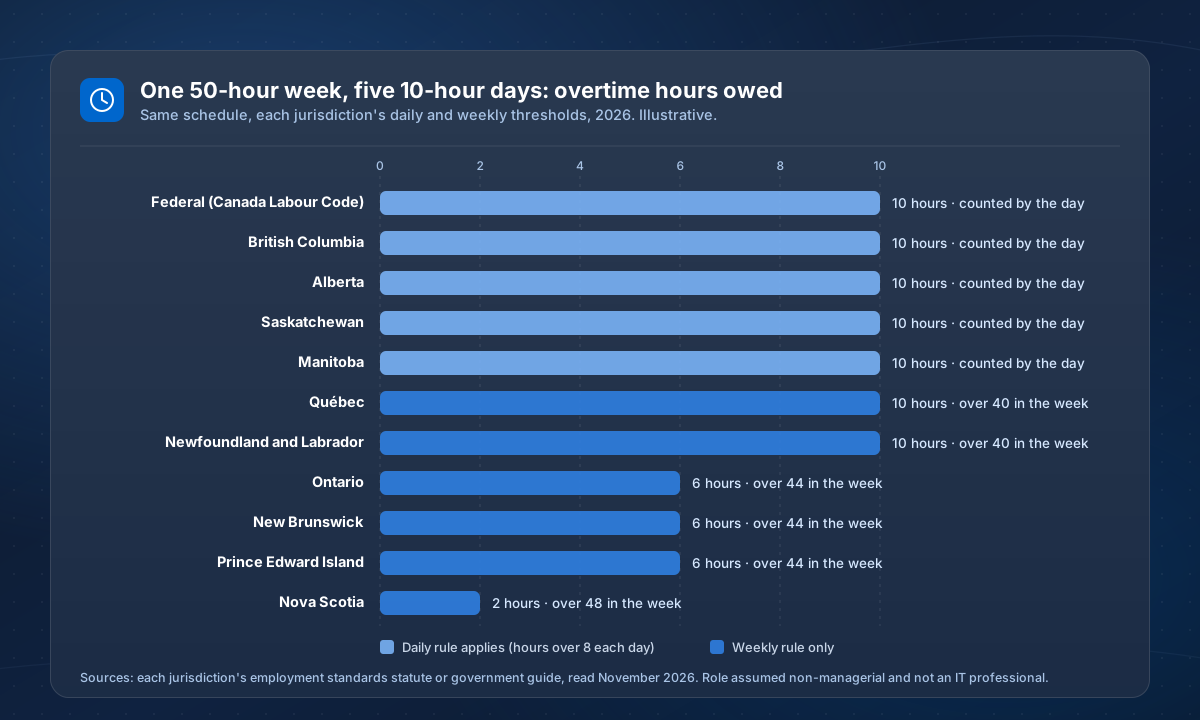
| Jurisdiction | How the 50 hours are counted | Overtime hours |
|---|---|---|
| Federal, British Columbia, Manitoba, Saskatchewan | 2 hours over 8 on each of five days | 10 |
| Alberta | Daily total (10) is greater than weekly total (6) | 10 |
| Québec, Newfoundland and Labrador | 10 hours over 40 in the week | 10 |
| Ontario, New Brunswick, Prince Edward Island | 6 hours over 44 in the week | 6 |
| Nova Scotia | 2 hours over 48 in the week | 2 |
In Ontario, the guide’s method for a fixed salary turns this into dollars:
- Find the regular rate. C$1,200 divided by 44 hours is C$27.27 an hour.
- Find the overtime rate. C$27.27 times 1.5 is C$40.91 an hour.
- Pay the overtime. Six hours at C$40.91 is C$245.46, on top of the C$1,200 salary.
The same week costs a different amount in each province, and the hours alone vary fivefold. The employer cost calculator shows the full cost of a salary by province.
Are software developers exempt from overtime in Canada?
Only in some provinces. Ontario, British Columbia and Alberta exempt certain IT professionals from overtime. Québec, Manitoba, Saskatchewan and the federal code have no IT exemption, so a developer there is owed overtime unless another exemption applies.
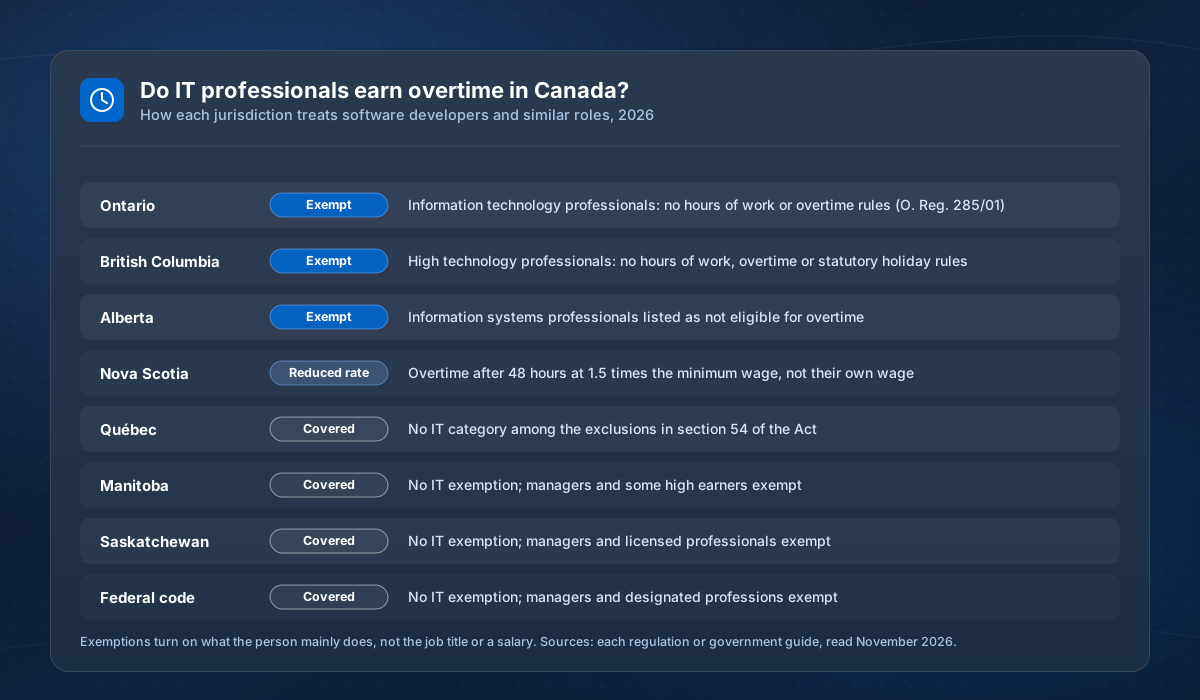
Ontario. Ontario Regulation 285/01 removes both the hours of work rules (Part VII) and overtime (Part VIII) for an “information technology professional.” The regulation defines that person as an employee “primarily engaged in the investigation, analysis, design, development, implementation, operation or management of information systems based on computer and related technologies,” through specialized knowledge and professional judgment. The test is what the person mostly does, not their title.
British Columbia. Section 37.8 of the Employment Standards Regulation excludes a “high technology professional” from Part 4 of the Act (hours of work and overtime), except the rule against excessive hours, and from Part 5 (statutory holidays). The definition covers employees who apply specialized knowledge and professional judgment to design, develop or engineer information systems, and some science, research and technical sales roles. It does not include “a person employed to provide basic operational technical support.”
Alberta. The province’s overtime page lists “information systems professionals” among the professionals who are not eligible for overtime hours and overtime pay, alongside engineers, accountants and lawyers.
Nova Scotia. IT professionals are not exempt. Nova Scotia’s overtime page places them, with managers and supervisors, in a group paid overtime at 1.5 times the minimum wage after 48 hours, rather than 1.5 times their own wage.
Québec, Manitoba, Saskatchewan and the federal code. Québec’s Act respecting labour standards lists the employees excluded from the overtime rule in section 54, and no IT category appears there. Manitoba, Saskatchewan and the Canada Labour Code exclude managers and certain professions, but not IT roles as such. A developer in Montréal or Winnipeg who works 45 hours is owed overtime.
The U.S. comparison is close but not exact. The FLSA’s computer employee exemption requires a salary at the standard level, or at least US$27.63 an hour if paid hourly, as well as qualifying duties, according to the Department of Labor’s Fact Sheet 17E. Ontario’s and British Columbia’s exemptions have no pay test, but they cover only those two provinces.
Who else is exempt from overtime in Canada?
Managers are exempt from overtime in most jurisdictions, but each defines a manager narrowly, and a job title is not enough. In Nova Scotia, managers and supervisors are not exempt: they are paid overtime at 1.5 times the minimum wage after 48 hours.
- Ontario exempts a person whose work is “supervisory or managerial in character” and who does other tasks only “on an irregular or exceptional basis.”
- British Columbia defines a manager as a person whose principal responsibilities are supervising or directing human or other resources, or a person employed in an executive capacity.
- Québec excludes “the managerial personnel of an undertaking” from the overtime rule. Senior managers, as the CNESST defines them, are covered only by the standards on retirement, psychological harassment and leave for family or parental obligations.
- Manitoba’s fact sheet says “Job titles have no impact on whether employees are exempt or not,” and that supervisory duties alone are not usually management functions. Manitoba also exempts employees who have substantial control over their hours and earn at least twice the Manitoba industrial average wage.
- Saskatchewan exempts employees who provide service of a managerial character, and professional practitioners who must be registered or licensed with a self-regulating body.
- The Canada Labour Code excludes managers, superintendents and those who exercise management functions, and professions designated by regulation.
A team lead who writes code most of the week and approves a few timesheets is unlikely to meet any of these tests.
Can overtime be averaged or banked as time off?
Yes, in most provinces, by written agreement and within limits. Averaging spreads the threshold over several weeks. Banking, often called time off in lieu, replaces overtime pay with paid time off.
| Jurisdiction | Banked time off | Main conditions |
|---|---|---|
| Ontario | 1.5 hours off per overtime hour | Agreed in writing or electronically; taken within 3 months, or 12 if agreed |
| Québec | Overtime plus 50% as paid leave | At the employee’s request; taken within 12 months or paid |
| British Columbia | Overtime wages credited to a time bank | At the employee’s written request |
| Alberta | At least 1 hour banked per overtime hour | Written overtime agreement; used within 6 months of the pay period |
| Federal | At least 1.5 hours off per overtime hour | Taken within 3 months by default, 12 at most without a collective agreement |
| New Brunswick | Not permitted | All overtime hours must be paid |
Ontario allows an overtime averaging agreement over two to four weeks, made in writing or electronically, that expires within two years. Québec allows staggered hours with CNESST authorization, or by a written individual agreement over a period of up to four weeks. The Canada vs U.S. payroll guide covers how overtime pay is then taxed and reported.
How is overtime handled through an employer of record?
The employer of record handles overtime, because it is the legal employer in Canada and runs payroll. It writes the employment agreement for the province, classifies the role against that province’s exemptions, and pays any overtime through Canadian payroll.
The hours are still yours to manage. Your managers direct the work and know when a week runs long. With InfraDev as the employer, you report or approve the hours worked, and we pay what the province requires and bill it under our agreement with you. Employer of Record sets out what InfraDev handles as the employer, and hiring an employee in Québec covers that province’s other rules.
Summary
- Overtime rules in Canada come from the province or territory where the employee works, or the Canada Labour Code for federally regulated employers.
- Weekly overtime starts after 40, 44 or 48 hours depending on the jurisdiction, and five jurisdictions also count hours over 8 in a day, as of November 2026.
- Being paid a salary does not, by itself, exempt anyone. Exemptions depend mainly on the work.
- Ontario, British Columbia and Alberta exempt certain IT professionals; Québec, Manitoba, Saskatchewan and the federal code do not.
- Overtime cannot be waived, but it can be averaged or banked as time off under each province’s conditions.
Sources
- Ontario: Your guide to the Employment Standards Act, Overtime pay (updated February 5, 2026), Hours of work and O. Reg. 285/01 (sections 4 and 8)
- British Columbia: Employment Standards Act (sections 39, 40 and 42) and Employment Standards Regulation (sections 1, 34 and 37.8)
- Alberta: Overtime hours and overtime pay
- Québec: Act respecting labour standards (sections 52 to 55), CNESST: Overtime, Staggered work hours and Senior managers
- Canada Labour Code, section 167, section 168, section 169 and section 174
- Manitoba Employment Standards: Overtime fact sheet and Overtime and managers fact sheet
- Saskatchewan: General overtime information, Overtime in a day versus overtime in a week and Overtime exemptions
- Nova Scotia: Overtime
- New Brunswick: Minimum wage, overtime and minimum pay for reporting for work
- Newfoundland and Labrador: Labour Standards Regulations (sections 5 and 9) and minimum wage increase effective April 1, 2026
- Prince Edward Island: Hours of work and wage standards and Overtime and averaging agreements
- U.S. Department of Labor: Fact Sheet 17E, computer-related occupations under the FLSA (revised August 2024)
This article is general information, not legal or tax advice. Figures are 2026 rules as published by each source in November 2026.
Frequently asked questions
Do salaried employees get overtime in Canada?
Yes, salaried employees in Canada are generally entitled to overtime, because no province exempts an employee just for being paid a salary. Exemptions depend on the job, such as managers or, in some provinces, IT professionals. Ontario's employment standards guide says a fixed salary covers the hours up to 44 a week, and overtime is owed after that.
Are software developers exempt from overtime in Canada?
Software developers are exempt from overtime in Canada only in some provinces. Ontario exempts information technology professionals, British Columbia exempts high technology professionals and Alberta lists information systems professionals among exempt professionals. Québec, Manitoba, Saskatchewan and federally regulated employers have no IT exemption, so a developer there earns overtime unless another exemption applies.
When does overtime start in Ontario?
Overtime in Ontario starts after 44 hours in a work week, at 1.5 times the employee's regular rate. Ontario has no daily overtime unless a contract or collective agreement provides it. An employer and employee can agree in writing or electronically to average hours over two to four weeks, or to take paid time off instead.
Can an employee in Canada waive overtime pay?
No, an employee in Canada cannot waive the statutory right to overtime pay. Ontario's employment standards guide says an agreement to give up overtime pay is void, and the Canada Labour Code applies notwithstanding any contract. A contract can give more than the statute but not less, whatever a U.S. offer letter says.
Can overtime be banked as time off in Canada?
Yes, most provinces in Canada allow overtime to be banked as paid time off, under rules that differ. Ontario and Québec require 1.5 hours off for each overtime hour, while Alberta's overtime agreements bank at least one hour for each overtime hour. New Brunswick's employment standards page says the banking of hours is not permitted there.
Who pays overtime when a U.S. company hires through an employer of record in Canada?
The employer of record pays overtime in Canada, because it is the legal employer and runs payroll. The U.S. company directs the work and reports or approves the hours worked. The employer of record applies the overtime rules of the province where the employee works and bills the cost back under the service agreement.
Related reading
-
Hiring an employee in Québec: what U.S. companies should know
What changes when your Canadian hire lives in Québec: French job offers and contracts, payroll through Revenu Québec, Québec labour standards, and Law 25.
Read the article -
Compliance checklist for U.S. companies employing Canadians
A one-page checklist of what a U.S. company must get right when it employs people in Canada: registrations, payroll, provincial employment standards, workers' compensation, contracts, privacy and classification.
Read the article -
Canada vs U.S. payroll: what changes for a U.S. employer
The differences a U.S. company meets when it pays employees in Canada: provincial instead of state tax, CPP and EI instead of Social Security and Medicare, TD1 and T4 instead of W-4 and W-2, and stricter remittance deadlines.
Read the article
Next steps for hiring in Canada
Hiring a salaried role in Canada?
Tell us the role and the province. We'll explain how we would employ the person, and how their agreement and payroll handle hours and overtime.