InfraDev handles
- CRA registration and account management
- Accurate deduction calculations
- Timely remittances to the CRA
- T4 slip generation and filing
- Record keeping and compliance
- Ongoing support and expertise

To employ people in Canada directly, a U.S. company needs a CRA business number and payroll account, provincial registrations, and a calendar of remittance and year-end deadlines.
Published November 22, 2025 · Updated November 3, 2026
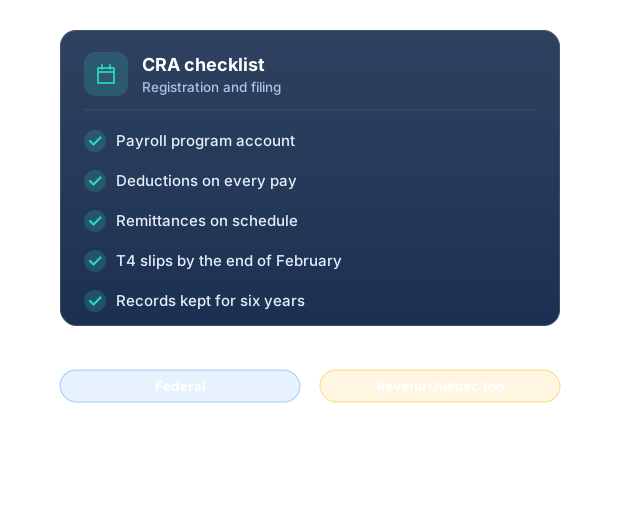
A U.S. company does not need a Canadian corporation to employ people in Canada, but if it pays them directly it becomes a Canadian employer in the CRA's eyes, with the same registration, remittance and reporting duties as a local business. In Quebec, provincial deductions go to Revenu Québec rather than the CRA. For how deductions are calculated, see our Canadian payroll guide.
A U.S. company that pays employees in Canada directly needs a CRA business number and a payroll program account before the first payday. The company also registers with the workers' compensation board in each province where people work, and in Québec opens a Revenu Québec account. No Canadian corporation is required for any of these.
Every employer needs a CRA Business Number (BN), the 9-digit identifier for all of its CRA program accounts. Non-resident employers can register without incorporating in Canada.
You must register for a payroll program account (RP account) to remit payroll deductions. This account is used for:
GST/HST registration depends on your taxable sales in Canada (more than $30,000 over four consecutive quarters), not on hiring. It is separate from your payroll account.
Register with the workers' compensation board in each province where people work (for example WSIB in Ontario, WorkSafeBC, or CNESST in Quebec). Quebec employers also open a Revenu Québec account, and some provinces add an employer health tax once payroll passes a threshold.
With an employer of record, none of these accounts are opened in your name: the EOR registers, remits and files as the employer.
Rates change every January, so use the official CRA tables. How each amount is calculated is covered in our payroll guide.
Federal and provincial income tax, based on each employee's TD1 forms and province of employment. Source: CRA payroll.
Pension contributions matched by the employer up to annual maximums, plus CPP2/QPP2 on higher earnings. Source: current CPP rates.
Employment insurance premiums; the employer pays 1.4 times the employee amount. Quebec employees pay a reduced EI rate plus QPIP. Source: current EI rates.
Most employers remit payroll deductions to the CRA by the 15th of the month after the pay date. Employers whose average monthly withholding is $25,000 or more remit two to four times a month, and small employers the CRA approves for quarterly remitting pay by the 15th after each quarter. Late remittances draw penalties of 3% to 10%.
The CRA sets your remittance frequency from your average monthly withholding amount.
| Remitter type | Average monthly withholding (CAD) | Due |
|---|---|---|
| Regular (monthly) | Under $25,000 | By the 15th of the following month |
| Quarterly | Under $3,000, with a clean compliance history; the CRA tells you if you qualify | By the 15th of the month after the quarter ends |
| Accelerated | $25,000 or more | Two to four times a month; at the highest volumes, within 3 working days of the end of each period |
Thresholds and deadlines as published by the CRA, as of November 2026.
Each year, an employer in Canada files a T4 Summary with the CRA and gives every employee a T4 slip by the last day of February, reporting earnings, income tax, CPP and EI. Québec employers also issue RL-1 slips by the same date. When someone leaves, the employer issues a Record of Employment to Service Canada.
File the T4 Summary and give employees their T4 slips by the last day of February. Quebec employers also issue RL-1 slips by the same date. The T4 reports:
When an employee stops working, issue an ROE to Service Canada, electronically within five calendar days after the end of the pay period in which their last day falls.
Keep payroll records for six years after the end of the year they relate to, including:
Through our Canadian Employer of Record service, InfraDev is the registered employer, so these accounts, remittances and filings run under our name.
How each deduction is calculated and remitted.
Minimum standards, vacation, notice, and termination.
When registering your own entity starts to pay off.
InfraDev's team reviews this page twice a year and when a rule it describes changes. General information, not legal or tax advice. How we review our guides · Report an error
InfraDev is the registered employer: we open the accounts, remit on schedule, and file year-end slips. Your hire can start in 24–48 hours.