
Hiring model comparisons
A U.S. company hiring in Canada makes two decisions: whether the person should be an employee or a contractor, and whether to employ them through an employer of record or its own Canadian entity. These comparisons answer each decision, then compare Canada with the U.S., the UK, Mexico and India.
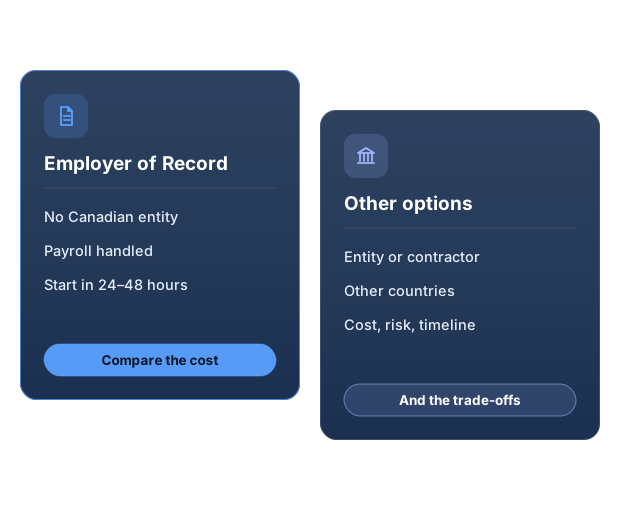
Which comparison answers your question?
Start with the decision in front of you. If you are unsure whether to employ or contract, read the contractor vs employee comparison first, because classification decides everything else. If you will employ, compare an employer of record with your own entity. The market comparisons help only if Canada itself is still in question.
| Your question | Short answer | Read |
|---|---|---|
| Employee or contractor? | Employee, if you direct the work, set the hours and supply the tools; contractor only for genuinely independent, defined projects. | Contractor vs employee in Canada |
| Employer of record or our own entity? | An employer of record for a first hire, a small team or a market test; your own entity once headcount and time horizon justify its fixed overhead. | EOR vs Canadian entity |
| How much less does a Canadian hire cost? | Typically 10–40% less than a comparable U.S. hire, counting salary, employer contributions and benefits; typical, not guaranteed. | Canada vs U.S. hiring costs |
| Canada or another market? | Canada for U.S. working hours and a familiar legal system; the UK for European reach; Mexico or India where salary cost comes first. | UK, Mexico and India comparisons |
Choosing a hiring model
-
EOR vs contractor
Employee vs independent contractor: control, tax, compliance, and risk.
-
EOR vs Canadian entity
When an Employer of Record beats opening your own Canadian company.
Comparing markets and costs
-
EOR Canada vs UK
Cross-border hiring context for Canada compared with the United Kingdom.
-
EOR Canada vs Mexico
How Canadian EOR hiring compares with Mexico for U.S. companies.
-
Canada vs U.S. hiring costs
Cost analysis for hiring developers and tech roles in Canada vs the U.S.
-
Canada vs India outsourcing
Quality, time zones, and collaboration when outsourcing to Canada vs India.
Related guides and proof
-
How U.S. companies hire in Canada
Every hiring option side by side.
-
How the EOR hiring model works
Step by step, with what you control and what we handle.
-
Case studies
How U.S. clients built and run teams in Canada with InfraDev.
Not sure which model fits?
Describe the role and where your hire lives. We'll tell you which structure fits and what it costs.