Blog

Canada vs U.S. payroll: what changes for a U.S. employer

The differences a U.S. company meets when it pays employees in Canada: provincial instead of state tax, CPP and EI instead of Social Security and Medicare, TD1 and T4 instead of W-4 and W-2, and stricter remittance deadlines.

Published November 20, 2025 · Updated November 26, 2026

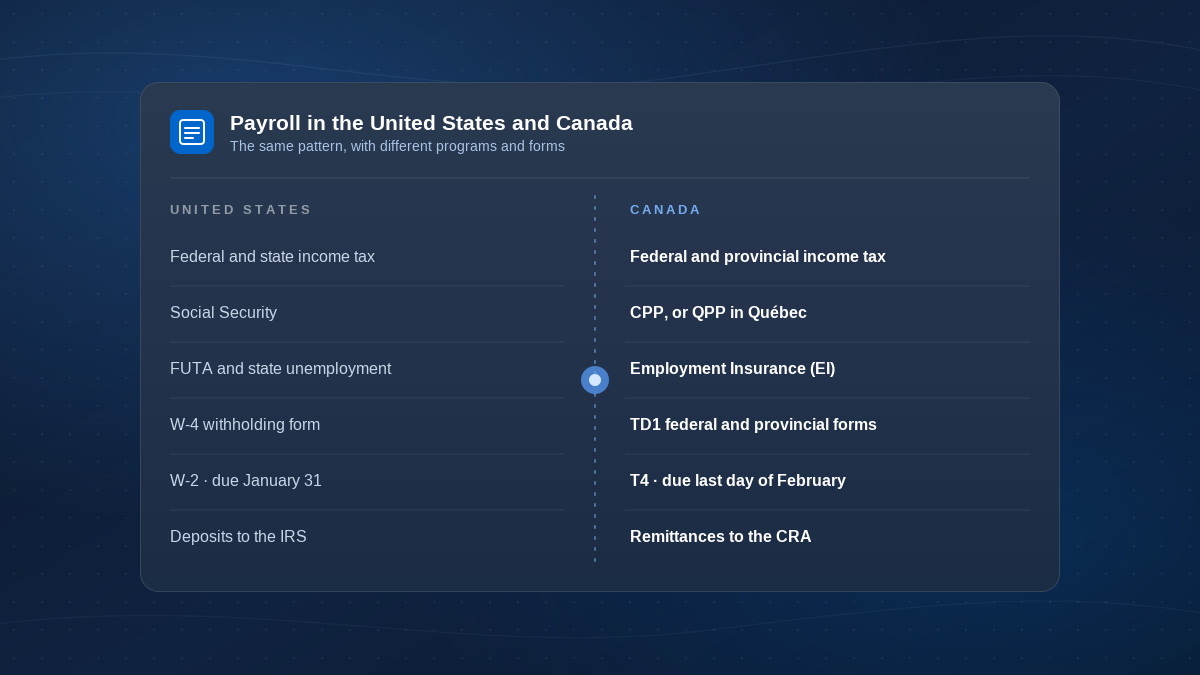
U.S. and Canadian payroll side by side: provincial tax, CPP, EI, the TD1 and the T4 in place of state tax, Social Security, FUTA, the W-4 and the W-2

Canadian payroll follows the same broad pattern as U.S. payroll: withhold income tax and social contributions from each pay, add the employer’s share, remit it to the tax authority, and report the year on a slip. The details differ at almost every step, and the differences are where U.S. employers get caught. This article compares the two systems; for how Canadian payroll runs step by step, see our Canadian payroll guide.

The deductions side by side

United StatesCanada
Income taxFederal, plus state (and sometimes local)Federal, plus provincial (Québec collects its own)
Retirement programSocial SecurityCanada Pension Plan (CPP), or Québec Pension Plan (QPP) in Québec
Health programMedicarePublic health care, funded through taxes; some provinces charge employers a payroll health tax (see employer health tax in Canada)
UnemploymentFUTA and state unemployment (employer-paid)Employment Insurance (EI), paid by employer and employee
Parental benefitsVaries by stateThrough EI; Québec runs its own plan (QPIP)
Workplace injuryState workers’ compensationProvincial workers’ compensation board

Two practical differences stand out. First, Canadian contribution rates and maximums change every January, and CPP now has a second tier of contributions on earnings above the first ceiling. Use the CRA’s current CPP and EI pages rather than last year’s figures. Second, the employer’s EI share is higher than the employee’s, unlike Social Security and Medicare, where the two shares match.

The worked example at the end of this article shows one Canadian pay, line by line, with the employer’s share and what is remitted.

Forms

PurposeUnited StatesCanada
Employee’s withholding informationW-4 (and state form)TD1 federal and provincial forms (TP-1015.3-V in Québec)
Annual employee slipW-2T4 (plus RL-1 in Québec)
Annual slip for non-employees1099-NECT4A, where it applies
Slip deadlineJanuary 31Last day of February
Record of a job endingNo federal equivalentRecord of Employment (ROE), issued to Service Canada

The Record of Employment surprises most U.S. employers: whenever an employee has an interruption of earnings (they leave, are laid off, or go on leave), the employer must issue an ROE so the employee can claim EI. We compare the slips in more detail in W-2 and 1099 vs the Canadian T4.

Remittances

U.S. employers deposit federal employment taxes on a monthly or semi-weekly schedule set by the IRS lookback rules. In Canada, the CRA assigns a remitting frequency based on the employer’s average monthly withholding: most new employers remit monthly, small employers may qualify for quarterly remitting, and larger employers remit more often. Late remittances carry penalties that start at 3% and rise to 10% of the amount due, plus interest, and the CRA can hold company directors personally liable for unremitted source deductions. Québec employers remit provincial deductions to Revenu Québec separately.

Records

The CRA expects payroll records to be kept for six years from the end of the last tax year they relate to. The IRS asks for employment tax records to be kept for at least four years. Provincial employment standards add their own requirements for hours, wages and vacation records.

Where U.S. employers go wrong

  1. Applying the wrong province. Tax and employment standards follow the province where the employee works, not your head office.
  2. Using last year’s rates. CPP, EI and tax brackets change each January.
  3. Treating vacation as a policy choice. Vacation time and vacation pay are statutory minimums in every province.
  4. Missing the ROE. It is required whenever earnings stop, not only at termination.
  5. Running Canadian payroll from U.S. software without Canadian tax tables, TD1 handling and T4 or RL-1 filing.

The Employer of Record alternative

If you would rather not register as a Canadian employer at all, an Employer of Record runs Canadian payroll as the legal employer: deductions, remittances, slips, ROEs and records. You approve the hire and direct the work, and receive one monthly invoice. See how our Employer of Record service works.

A worked example: one Canadian pay

One pay for an employee in Ontario earning $100,000 a year, paid every two weeks. Each numbered line is explained beside the stub.

Pay statement · Example

Sample employee, Ontario

Pay frequency
Every two weeks
Pays a year
26
Rates
2026
Earnings and deductions for one pay, with the full-year total
EarningsThis payFull year
Regular salary$3,846.15$100,000.00
Deductions
1Income tax, federal and Ontario −$770.17 −$20,024.35
2CPP and CPP2 contributions −$178.71 −$4,646.45
3EI premiums −$43.20 −$1,123.07
Net pay $2,854.08 $74,206.13

4Employer's share, paid on top of salary

Employer contributions for one pay, with the full-year total
CPP and CPP2, employer share $178.71 $4,646.45
EI, employer share (1.4×) $60.47 $1,572.30
5Remitted to the CRA $1,231.25 $32,012.61

Illustrative, in Canadian dollars, using 2026 rates with income tax simplified. CPP and EI stop once the yearly maximums are reached, so per-pay amounts here are averages over the year.

  1. 1

    Income tax

    Federal and provincial tax, based on the province where the employee lives, their earnings and their TD1 forms. Withheld from every pay.

    CRA payroll
  2. 2

    Canada Pension Plan

    Employee and employer pay equal shares on earnings up to the first ceiling, plus CPP2 between the first and second ceilings. Deductions stop once the yearly maximum is reached. QPP replaces CPP in Québec.

    Current CPP rates
  3. 3

    Employment Insurance

    Premiums on insurable earnings up to the yearly maximum. The employer pays 1.4 times the employee’s premium.

    Current EI rates
  4. 4

    Employer’s share

    Not deducted from the employee: the employer pays it on top of salary and remits it with the deductions.

  5. 5

    Remitted to the CRA

    Everything withheld plus the employer’s share, usually by the 15th of the following month. In Québec, part goes to Revenu Québec.

Frequently asked questions

What replaces Social Security, Medicare and FUTA when a U.S. company pays an employee in Canada?

The Canada Pension Plan, or the Québec Pension Plan in Québec, takes the place of Social Security, and Employment Insurance takes the place of FUTA and state unemployment. Employer and employee both pay CPP and EI. Health care is public and funded through taxes, and some provinces charge employers a payroll health tax.

Which Canadian forms replace the W-4 and W-2 for an employee in Canada?

The TD1 federal and provincial forms replace the W-4, and the T4 slip replaces the W-2, with an RL-1 as well in Québec. Canadian slips are due by the last day of February rather than January 31. Fees to non-employees go on a T4A where it applies, in place of the 1099-NEC.

How often does a U.S. employer remit payroll deductions in Canada?

The CRA assigns a remitting frequency from the employer's average monthly withholding. Most new employers in Canada remit monthly, small employers may qualify for quarterly remitting, and larger employers remit more often. Late remittances carry penalties that start at 3% and rise to 10% of the amount due, plus interest.

What is a Record of Employment, and when does an employer in Canada issue one?

A Record of Employment (ROE) is the form an employer in Canada issues to Service Canada whenever an employee's earnings are interrupted: they leave, are laid off or go on leave. The employee needs it to claim Employment Insurance. U.S. payroll has no federal equivalent.

How long must an employer keep payroll records in Canada?

The CRA expects payroll records in Canada to be kept for six years from the end of the last tax year they relate to, longer than the four years the IRS asks for employment tax records. Provincial employment standards add their own requirements for hours, wages and vacation records.

Next steps for hiring in Canada

  • How it works

    The steps from your chosen candidate to their first payroll, and who does what.

  • Employer of Record

    How InfraDev employs your hire in Canada so you don’t need a Canadian entity.

  • Estimate your costs

    Deductions, filings and overhead for your role and province, not only the salary.

  • Compare your options

    EOR, your own Canadian entity, or contractors: cost, timeline and risk.

  • Hiring in Canada guide

    Payroll, CRA registration and employment law for U.S. companies.

Planning a hire in Canada?

Tell us the role and province. We'll explain how employment, payroll and compliance would work for your team.