
Blog
Compliance checklist for U.S. companies employing Canadians
A one-page checklist of what a U.S. company must get right when it employs people in Canada: registrations, payroll, provincial employment standards, workers' compensation, contracts, privacy and classification.
Published November 20, 2025 · Updated November 6, 2026
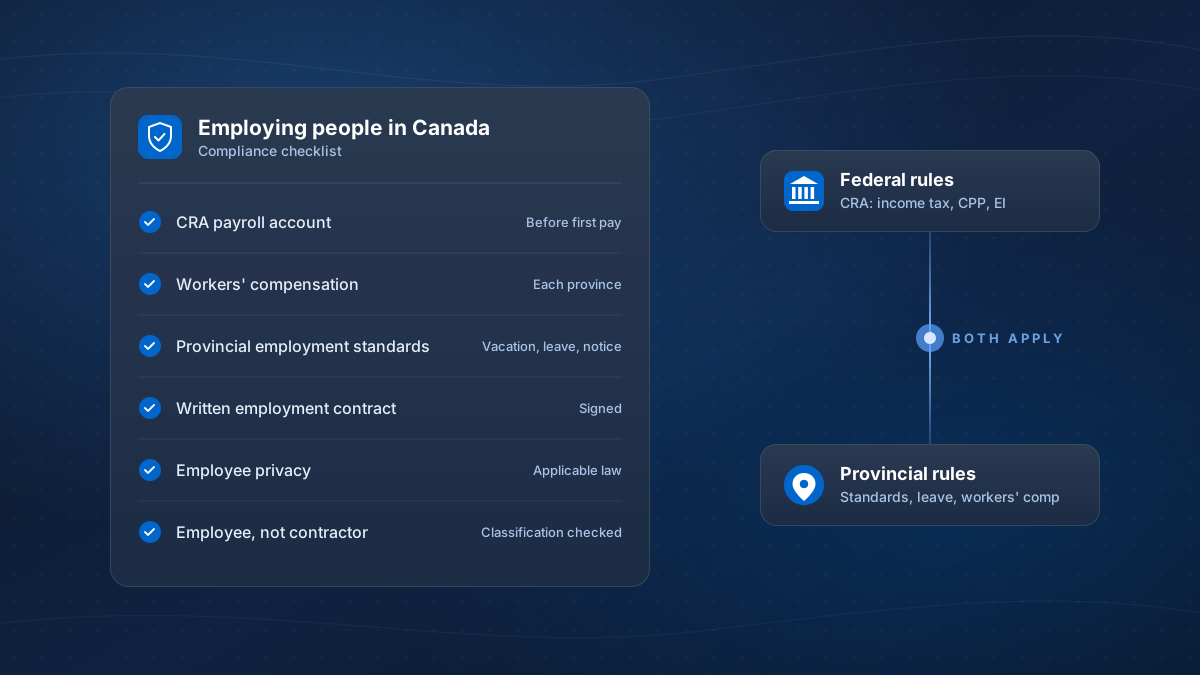
Employing people in Canada brings federal tax obligations and a second layer of provincial rules that change with the employee’s province. This checklist covers what a U.S. company has to get right, with links to the guides that explain each item and to the official sources. Rates and thresholds change, so we link to them rather than repeat them.
Which rules apply
Most private-sector employers fall under the employment standards of the province where the employee works. Federal standards (the Canada Labour Code) apply only to federally regulated industries such as banking, telecommunications and interprovincial transportation. A U.S. software company with a developer in Ontario follows Ontario’s rules; if it hires again in British Columbia, that employee follows British Columbia’s. See employment law basics and the province explorer.
The checklist
Registration
- CRA business number and payroll program account before the first pay (CRA requirements)
- Revenu Québec registration for employees in Québec
- Workers’ compensation registration in each province where people work, such as WSIB in Ontario, CNESST in Québec or WorkSafeBC
- Any provincial employer health tax registration that applies (Ontario, Québec, British Columbia, Manitoba and Newfoundland and Labrador have one)
Payroll
- Federal and provincial income tax, CPP or QPP, and EI withheld every pay, at the current CPP and EI rates
- Employer contributions added and remitted on the schedule the CRA assigns
- T4 slips (and RL-1 slips in Québec) issued and filed by the last day of February
- A Record of Employment issued whenever an employee’s earnings are interrupted
- Payroll records kept for six years
The Canadian payroll guide walks through each step.
Employment standards
- Pay at or above the provincial minimum wage for all hours worked, including for salaried staff
- Overtime thresholds and exemptions checked for the province: some provinces, such as Ontario and British Columbia, exempt certain IT professionals under specific conditions; others have no such exemption
- Vacation time and vacation pay at or above the provincial minimum
- Statutory holidays and holiday pay as the province defines them
- Statutory leaves (parental, sick, family) honoured
Contracts and termination
- A written employment contract that meets the province’s minimum standards
- A termination clause drafted carefully: a clause that falls below the statutory minimum can be unenforceable, exposing you to much longer “reasonable notice” at common law
- An understanding that Canada has no at-will employment; ending employment without cause requires notice or pay in lieu, and sometimes statutory severance
Health, safety and privacy
- Occupational health and safety obligations, including workplace violence and harassment policies, which apply to remote employees too
- Employee personal information handled under the applicable privacy law: Québec, Alberta and British Columbia have private-sector laws that cover employees; elsewhere, follow PIPEDA’s principles as good practice
Classification
- Every contractor relationship checked against the CRA’s employee or self-employed factors: control, tools, chance of profit or risk of loss, and integration. See EOR vs contractor.
Where U.S. companies most often go wrong
- Assuming U.S. defaults. At-will employment, overtime exemptions for tech roles and “unlimited PTO” do not translate.
- Treating a full-time contractor as a vendor. If the person works like an employee, the authorities will treat them as one, with back deductions and penalties.
- Using one template contract across provinces. Minimums differ, and a termination clause that fails one province’s standard can fail entirely.
- Missing provincial registrations. Workers’ compensation and employer health tax are easy to overlook when payroll is set up from the U.S.
Getting it done
You can register as a Canadian employer and run this checklist yourself, usually with a Canadian payroll provider and employment lawyer. Or an Employer of Record can be the legal employer and carry the checklist for you, while you direct the work. See how our Employer of Record service works, or read how we approach compliance.
Related reading
-
Hiring an employee in Québec: what U.S. companies should know
What changes when your Canadian hire lives in Québec: French job offers and contracts, payroll through Revenu Québec, Québec labour standards, and Law 25.
Read the article -
Canada vs U.S. payroll: what changes for a U.S. employer
The differences a U.S. company meets when it pays employees in Canada: provincial instead of state tax, CPP and EI instead of Social Security and Medicare, TD1 and T4 instead of W-4 and W-2, and stricter remittance deadlines.
Read the article -
W-2 and 1099 vs the Canadian T4 and T4A: what U.S. companies should know
How the Canadian T4 and T4A compare with the U.S. W-2 and 1099-NEC: what each slip reports, when it is due, what it says about the employment relationship, and why a 1099-style contractor in Canada is often an employee.
Read the article
Next steps for hiring in Canada
-
How it works
The steps from your chosen candidate to their first payroll, and who does what.
-
Employer of Record
How InfraDev employs your hire in Canada so you don’t need a Canadian entity.
-
Estimate your costs
Deductions, filings and overhead for your role and province, not only the salary.
-
Compare your options
EOR, your own Canadian entity, or contractors: cost, timeline and risk.
-
Hiring in Canada guide
Payroll, CRA registration and employment law for U.S. companies.
Planning a hire in Canada?
Tell us the role and province. We'll explain how employment, payroll and compliance would work for your team.