InfraDev handles
- Provincial employment standards compliance
- Proper employee classification
- Closing the employment when your engagement ends
- Workplace safety registration and compliance
- Employment contract compliance
- Updates when the rules change

Canadian employment standards are set mostly by each province: minimum wage, vacation, statutory holidays, overtime, and termination notice follow the province where the employee works. And unlike most U.S. states, Canada has no at-will employment: ending a job without cause requires notice or pay in lieu.
Published November 22, 2025 · Updated November 23, 2026
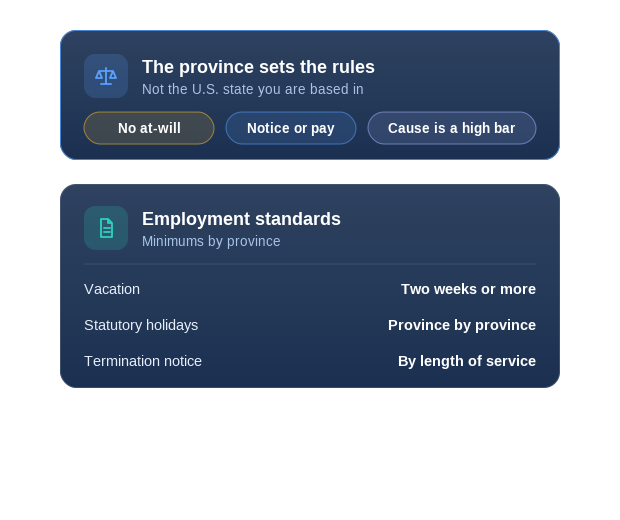
Each rule below follows the province where the employee works. The guide linked on each row covers it province by province, with sources. Hiring in Ontario, where most Canadian hires live? Start with Ontario employment standards for U.S. employers.
| Rule | What a U.S. employer should know | Full guide |
|---|---|---|
| Overtime | Weekly overtime starts after 40 hours in five provinces and federally, after 44 in Ontario, Alberta, New Brunswick and Prince Edward Island, and after 48 in Nova Scotia. A salary is not an exemption. | Overtime rules by province |
| Probation | No statute creates a probation period. What the law sets is how long someone can work before termination notice is owed: 30 days in Manitoba, about three months in most provinces, six months in New Brunswick. | Probation period by province |
| Maternity and parental leave | Unpaid by the employer and job-protected: 16 to 19 weeks of maternity leave, then parental leave, up to about 18 months in all. Employment Insurance, or Québec's own plan, pays the employee. | Maternity and parental leave |
| Benefits | CPP or QPP, EI, workers' compensation, paid vacation, public holidays and job-protected leaves are required. Health and dental plans are not, though most candidates expect one. | Employee benefits in Canada |
| Non-competes | Prohibited for employees in Ontario since October 25, 2021, except executives and a business sale. Allowed in Québec only in writing and within strict limits. Presumed unenforceable elsewhere unless shown to be reasonable. | Non-compete agreements in Canada |
| Job postings | Ontario (employers with 25 or more employees, from 2026), British Columbia and Prince Edward Island require the pay or a pay range in public job postings. Québec requires French. | Pay transparency and job postings |
| Remote employees | Employment standards follow where the work is done. For payroll, the CRA's province of employment rules decide which province's tax applies. | Province of employment for remote employees |
| Remote work policy | An employer's health and safety duties extend to an employee's home office in Ontario and Québec. In Ontario, employers with 25 or more employees need written policies on disconnecting from work and on electronic monitoring, covering work done at home. | Remote work policy in Canada |
| Québec | French-language rules, QPP and QPIP instead of CPP and part of EI, Revenu Québec payroll, and CNESST for labour standards and safety. | Hiring an employee in Québec |
Each province and territory sets its own general minimum wage, and most adjust it every year. The Government of Canada keeps current and forthcoming rates for every province and territory.
Most provinces require at least two weeks of paid vacation a year, rising to three weeks after a set length of service (for example, after five years in Ontario).
Employees are entitled to paid time off on statutory holidays. How many there are, and which days, varies by province.
Overtime is usually paid at 1.5 times the regular rate after a daily or weekly threshold set by the province: for example, after 44 hours a week in Ontario, or after 8 hours a day or 40 a week in British Columbia.
Employers must provide advance notice or pay in lieu of notice when terminating employees without cause. The required notice depends on:
Some jurisdictions also require severance pay for long-service employees, separate from notice: in Ontario, for example, after five years of service with larger employers.
Employers must issue a Record of Employment (ROE) when an employee stops working. It is required for Employment Insurance (EI) claims.
Each province has its own employment standards legislation. Key differences include:
Apply the rules of the province where your employee works. The province explorer lists the employment standards law and compensation board for each one.
Employers must register with and contribute to the provincial workers' compensation program, for example:
These programs insure workplace injuries and illnesses. Premiums are based on industry classification and payroll.
The CRA has strict rules for classifying workers as employees or independent contractors. Misclassification can result in:
Key factors the CRA considers include control over the work, ownership of tools, financial risk, and integration into the business. Learn more about contractor vs. employee classification.
With InfraDev as the employer of record, provincial employment standards are applied for each employee under our name.
Common questions from U.S. employers with people in Canada.
Canada has no at-will employment. Ending a job in Canada without cause requires advance notice or pay in lieu, and the amount depends on length of service, the province’s employment standards, the employment contract and common law, which may exceed the statutory minimums.
Employment standards in Canada follow the province where the employee does the work. Minimum wage, vacation, statutory holidays, overtime and termination notice all come from that province’s law, and each province has its own workers’ compensation board, such as WSIB in Ontario or CNESST in Québec.
A salary is not an exemption from overtime in Canada. Weekly overtime starts after 40 hours in five provinces and federally, after 44 in Ontario, Alberta, New Brunswick and Prince Edward Island, and after 48 in Nova Scotia, usually at 1.5 times the regular rate.
Most provinces in Canada require at least two weeks of paid vacation a year, rising to three weeks after a set length of service, for example after five years in Ontario. Paid statutory holidays come on top, and how many there are varies by province.
With InfraDev as the employer of record, provincial employment standards are applied for each employee under InfraDev’s name. That covers employee classification, the employment contract, workplace safety registration and updates when the rules change, in the province where the employee works.
Employment standards law and workers’ compensation board by province.
How the CRA classifies workers, and what misclassification costs.
Registration, payroll accounts, deadlines, and penalties.
InfraDev's team reviews this page twice a year and when a rule it describes changes. General information, not legal or tax advice. How we review our guides · Report an error
Tell us where your hire lives. We'll confirm which rules apply, and the cost and timing, on a short call.