
Blog
Probation period in Canada: the rules by province for U.S. employers
A probation period in Canada exists only if the employment contract creates one. No statute grants it automatically. What each province's employment standards law sets is the length of employment before termination notice is owed: 30 days in Manitoba, about three months in most of the country and six months in New Brunswick. A contract cannot make that window longer.
Published November 15, 2026
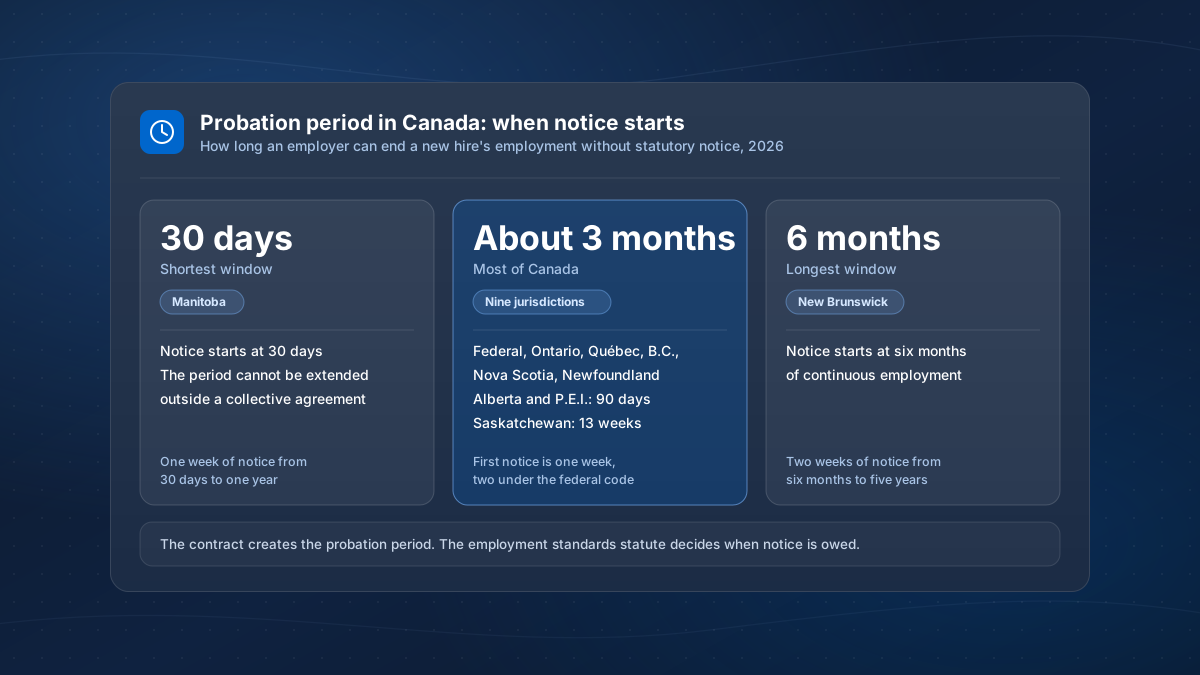
A probation period in Canada is a term of the employment contract. No statute hands one to the employer. What each province’s law does set is how long a person can be employed before termination notice is owed: 30 days in Manitoba, about three months in most of Canada and six months in New Brunswick.
What is a probation period in Canada?
A probation period is a stretch at the start of a job, set out in the employment agreement, during which the employer assesses whether the new hire is suitable and can end the employment more easily if not.
U.S. employers often read it as a short at-will window. It is narrower than that. Two separate sets of rules apply to a dismissal in the first months:
- Employment standards law. Each province’s statute says how much service an employee needs before the employer owes written notice of termination or pay in its place. Before that point, no statutory notice is owed. The statutes describe this in terms of length of employment. The government guides for Ontario, Alberta, Saskatchewan and Québec, and the federal termination page, do not mention probation at all. Prince Edward Island’s guide is the exception: it calls the first three months of employment a probationary period.
- The contract and the courts. Above the statutory minimum, an employee dismissed without cause can be owed reasonable notice under the common law, or under the Civil Code in Québec. A written probation clause is what limits that exposure in the first months.
A new hire with no probation clause in the agreement is not on probation, whatever the offer email implied.
How long is the probation period in each province?
The statutory no-notice window is three months or 90 days in most of Canada, 30 days in Manitoba and six months in New Brunswick. The table shows the threshold in each jurisdiction’s law, as read in November 2026, and the first notice an employer owes once it is passed.
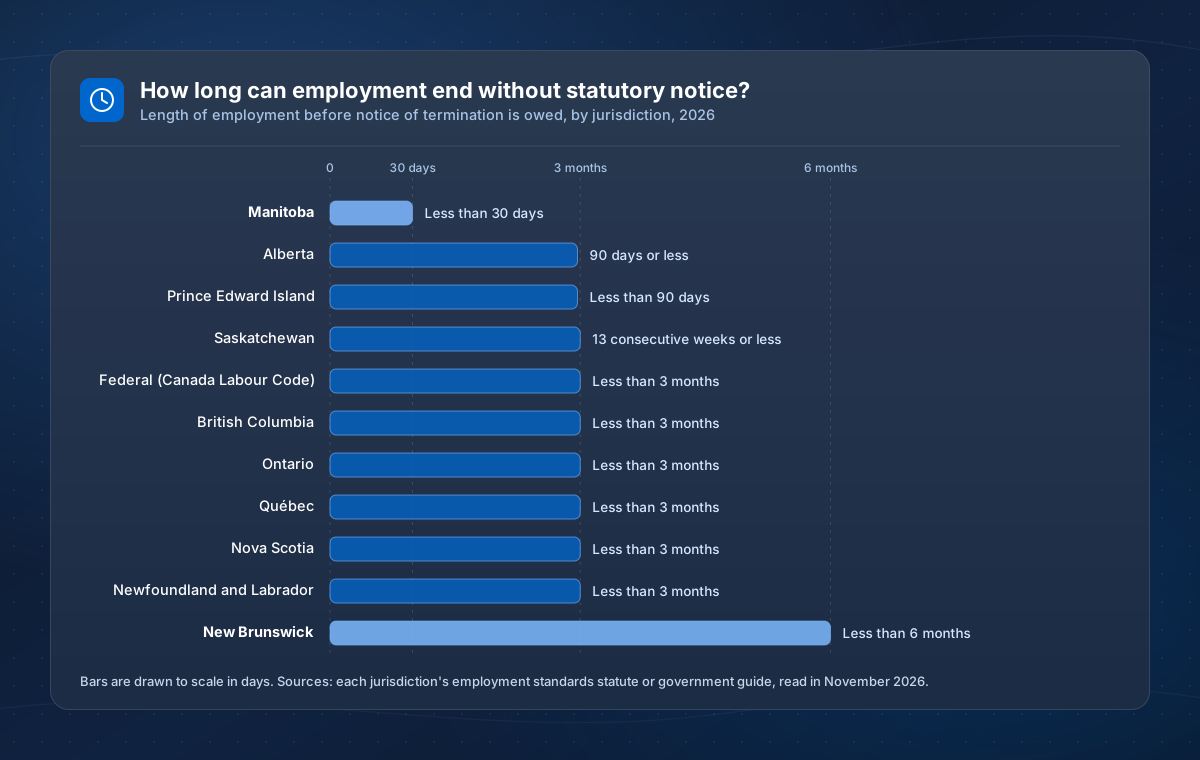
| Jurisdiction | No statutory notice if employed | First notice owed after that |
|---|---|---|
| Manitoba | Less than 30 days | 1 week (30 days to under 1 year) |
| Alberta | 90 days or less | 1 week (over 90 days to under 2 years) |
| Prince Edward Island | Less than 90 days | 1 week (90 days to under 1 year) |
| Saskatchewan | 13 consecutive weeks or less | 1 week (over 13 weeks to 1 year) |
| British Columbia | Less than 3 consecutive months | 1 week |
| Ontario | Less than 3 months | 1 week (under 1 year) |
| Québec | Less than 3 months of uninterrupted service | 1 week (3 months to 1 year) |
| Nova Scotia | Less than 3 months | 1 week (3 months to under 2 years) |
| Newfoundland and Labrador | Less than 3 months | 1 week (3 months to under 2 years) |
| New Brunswick | Less than 6 months | 2 weeks (6 months to under 5 years) |
| Federal (Canada Labour Code) | Less than 3 consecutive months | 2 weeks |
Four points about the table:
- The province is where the employee works. A company in Texas with one employee in Manitoba follows Manitoba’s 30 days. The Canada province explorer compares the provinces on other standards.
- The federal row covers few private employers. It applies only to federally regulated employers under the Canada Labour Code. Most private-sector employees fall under their province’s law.
- Check the date on Prince Edward Island figures. The province’s notice of termination guide, published June 30, 2026, sets the threshold at 90 days. Some older third-party summaries still show six months for the province.
- The territories have their own rules. In the Northwest Territories, the government’s employment standards FAQ says notice is owed once an employee has been employed 90 days or more and works 25 hours a week or more, starting at two weeks. Yukon and Nunavut set their own thresholds; check with the territory’s employment standards office.
Notice grows with service in every jurisdiction, up to eight weeks in most. Canadian employment law basics covers notice and severance after the first year.
Can you dismiss an employee without notice during probation?
Yes, inside the statutory window and under a valid probation clause, an employer can end the employment without notice. The dismissal still has to rest on a real assessment of the person, and it cannot be for a prohibited reason.
The test is suitability, assessed in good faith. In Ly v. British Columbia (Interior Health Authority), a 2017 decision of the Supreme Court of British Columbia, an employee on a six-month probation clause was dismissed after about two months. As summarized by the law firm Stewart McKelvey in April 2017, the court accepted that the clause was valid and that a probationary employee can be dismissed for unsuitability, a lower standard than just cause. It then found that the employer had not assessed him in good faith, and awarded three months of notice.
Some protections do not wait. Ontario’s guide says the Employment Standards Act does not require an employer to give a reason for a termination, and also that an employer cannot end someone’s employment if any part of the reason is that the employee asked about or exercised a right under the Act. Manitoba’s fact sheet states that employers “are not allowed to terminate employees because they have taken or requested a legislated leave,” and points to The Human Rights Code as another law that deals with ending employment. A probation clause is no answer to a dismissal made for one of those reasons.
Cause is a separate route. Ontario exempts an employee guilty of wilful misconduct from notice at any stage, and the federal, Manitoba, Québec and Prince Edward Island rules carry their own exceptions for just cause or serious fault. Probation is for the employee who is not working out, not for the one who has done something serious.
Can a contract set a longer probation period, or extend it?
A contract can name a longer period, but it cannot delay statutory notice. Once the employee passes the province’s threshold, the minimum notice is owed whatever the agreement says.
Manitoba’s fact sheet says it most directly: employers “are not allowed to extend or change this period unless it is negotiated in a collective agreement with a union,” and an agreement that gives less than the minimum “is not valid.”
A worked example
A U.S. software company employs a developer in Ontario at C$104,000 a year, or C$2,000 a week. The agreement includes a six-month probation period. The figures are illustrative.
- Dismissed in week 10. The employee has under three months of service. Ontario’s statute requires no notice and no termination pay.
- Dismissed in week 16. The employee has passed three months. Ontario’s guide gives an employee with less than one year of service one week of notice, so the employer owes one week of working notice or C$2,000 in termination pay. The six-month clause changes nothing here.
- The same facts in two other provinces. In Manitoba, the week 10 dismissal already carries one week of notice. In New Brunswick, neither dismissal carries statutory notice, because the threshold there is six months.
What the six-month clause can still do in Ontario is limit the claim to the statutory week. Without an enforceable clause, an employee dismissed without cause can ask a court for reasonable notice under the common law, which can be far longer than the statutory minimum. The award in the Ly case, discussed above, was three months.
How does probation work in Québec?
Québec has no statutory probation period. Three rules shape the first months and years of a job there.
- Written notice after three months. Section 82 of the Act respecting labour standards requires written notice before an employer ends the employment, and section 82.1 exempts an employee with less than three months of uninterrupted service. The CNESST lists one week of notice for three months to one year of service.
- Reasonable notice under the Civil Code. Article 2091 of the Civil Code of Québec lets either party end a contract for an indeterminate term by giving notice in reasonable time, having regard to the nature of the employment, its circumstances and the duration of the work. Under article 2092, an employee may not renounce the right to an indemnity where the notice is insufficient. A probation clause in Québec is read against both articles.
- Good and sufficient cause after two years. Section 124 of the Act lets an employee with two years of uninterrupted service in the same enterprise file a complaint, within 45 days, when they believe they were dismissed without good and sufficient cause.
Federally regulated employers have a similar second milestone. An employee who has completed 12 consecutive months of continuous employment can file an unjust dismissal complaint under the Canada Labour Code, within 90 days of the dismissal.
Hiring an employee in Québec covers the language, payroll and contract rules that also apply there.
What should a probation clause say?
A probation clause should state the length, the standard and what happens on dismissal, in an agreement signed before the first day. The steps below reflect the rules above. They are not a substitute for an agreement drafted for the province.
- Put it in the signed agreement. Employment lawyer Stuart Rudner, writing in Canadian HR Reporter, notes that no rule makes probation automatic and that a bare line promising a three-month probationary period can be too ambiguous for a court to enforce.
- Match the length to the province. Three months fits most of Canada. A longer period gives no extra statutory room outside New Brunswick, and in Manitoba notice starts at 30 days regardless.
- Name the standard. Say that the period is for assessing suitability for the role, and tell the employee what will be assessed.
- Say what is paid on dismissal. State that a dismissal during probation carries the minimum notice or pay required by the province’s statute, and never less.
- Assess, and keep a record. Set expectations in the first week, give feedback and note it. The Ly decision turned on the employer’s process, not on the wording of its clause.
- Do not restart probation for a known worker. A contractor who becomes an employee in the same job has already been assessed. Converting a Canadian contractor to an employee explains how earlier service is treated.
Who handles probation when you hire through an employer of record?
The employer of record does, because it is the legal employer in Canada. The agreement is its contract with the employee, written for the province where the person works, and a dismissal is carried out by the employer of record under that province’s rules.
The assessment is still yours. Your managers direct the work and are the ones who know by week six whether the hire is succeeding. With InfraDev as the employer, you tell us early when a hire is not working out, and we handle the notice or pay in lieu that provincial law requires, the final pay and the Record of Employment. Employer of Record sets out what InfraDev handles as the employer.
The cost of an early exit is usually small next to the cost of the role. The employer cost calculator shows what a salary costs in each province.
Summary
- A probation period in Canada exists only where the employment agreement creates it.
- Employment standards laws set the length of employment before termination notice is owed: 30 days in Manitoba, three months or 90 days in most jurisdictions and six months in New Brunswick, as of November 2026.
- A contract can set a longer probation period, but statutory notice still starts at the province’s threshold.
- A dismissal during probation has to follow a good-faith assessment of suitability, and cannot be a reprisal for using a statutory right or taking a protected leave.
- Québec adds reasonable notice under the Civil Code and, after two years of service, protection against dismissal without good and sufficient cause.
- Through an employer of record, the probation clause and the termination steps sit with the legal employer in Canada, and the assessment of the person stays with you.
Sources
- Government of Canada: Termination, layoff or dismissal (federally regulated employers), Canada Labour Code, section 230 and unjust dismissal eligibility and timelines
- Ontario: Your guide to the Employment Standards Act, Termination of employment
- CNESST: Notice of termination of employment and indemnity
- Québec: Act respecting labour standards (sections 82, 82.1 and 124) and Civil Code of Québec (articles 2091 and 2092)
- British Columbia: Employment Standards Act (section 63)
- Alberta: Termination and termination pay
- Saskatchewan: Individual layoff or termination
- Manitoba Employment Standards: Termination of employment fact sheet
- New Brunswick: Employment Standards Act (section 30)
- Nova Scotia: When the employer ends the employment
- Prince Edward Island: Notice of termination (June 30, 2026)
- Northwest Territories: Employment standards frequently asked questions
- Newfoundland and Labrador: Labour Standards Act (section 55)
- Canadian HR Reporter: Don’t assume all employees have probationary periods (Stuart Rudner, October 2011)
- Stewart McKelvey: Terminating without notice during the probationary period (April 2017)
This article is general information, not legal or tax advice. Figures are 2026 rules as published by each source in November 2026.
Frequently asked questions
How long is the probation period in Canada?
A probation period in Canada is usually three months, because most provinces require termination notice once an employee has three months or 90 days of service. No law sets one length for the country. The statutory window is 30 days in Manitoba and six months in New Brunswick, according to each province's employment standards law in 2026.
Is a probation period automatic for a new employee in Canada?
No, a probation period is not automatic for a new employee in Canada. Employment standards laws set when termination notice starts, and most never use the word probation. An employer that wants a probation period has to write it into the employment agreement before the person starts, with its length and the standard being assessed.
Can an employer in Canada dismiss an employee without notice during probation?
Yes, an employer in Canada can dismiss an employee without statutory notice inside the province's no-notice window, such as the first three months in Ontario. Under a written probation clause, courts also expect a good-faith assessment of the person's suitability. Ontario's guide adds that an employer cannot end employment because the employee exercised a right under the Act.
Can a U.S. company set a six-month probation period for an employee in Ontario?
Yes, a contract for an employee in Ontario can set a six-month probation period, but it does not delay statutory notice. Ontario's Employment Standards Act guide says an employee continuously employed for at least three months is entitled to notice, so a dismissal in month four carries one week of notice or termination pay.
Does Québec have a probation period for new employees?
Québec has no probation period in its Act respecting labour standards. The Act exempts an employee with less than three months of uninterrupted service from the written notice rule. Separately, article 2091 of the Civil Code of Québec requires reasonable notice to end an indeterminate contract, and protection against dismissal without good and sufficient cause begins at two years.
Can an employer extend a probation period in Canada?
An employer in Canada cannot use an extension to push back statutory notice. Once the employee passes the province's threshold, the minimum notice applies whatever the contract says. Manitoba's employment standards fact sheet states that employers are not allowed to extend or change its 30-day period outside a collective agreement.
Related reading
-
Hiring an employee in Québec: what U.S. companies should know
What changes when your Canadian hire lives in Québec: French job offers and contracts, payroll through Revenu Québec, Québec labour standards, and Law 25.
Read the article -
Compliance checklist for U.S. companies employing Canadians
A one-page checklist of what a U.S. company must get right when it employs people in Canada: registrations, payroll, provincial employment standards, workers' compensation, contracts, privacy and classification.
Read the article -
Converting a Canadian contractor to an employee: a guide for U.S. companies
A U.S. company can convert a Canadian contractor to an employee without opening a Canadian entity: an employer of record employs them, or the company registers as an employer with the CRA. The work is in six steps: review the history, set the salary, settle the service date, sign a provincial agreement, close the contract and start payroll on day one.
Read the article
Next steps for hiring in Canada
Hiring in a province you don't know?
Tell us the role and the province. We'll explain how we would employ the person in Canada, and how the agreement handles the first months.