Converting a Canadian contractor to an employee: a guide for U.S. companies
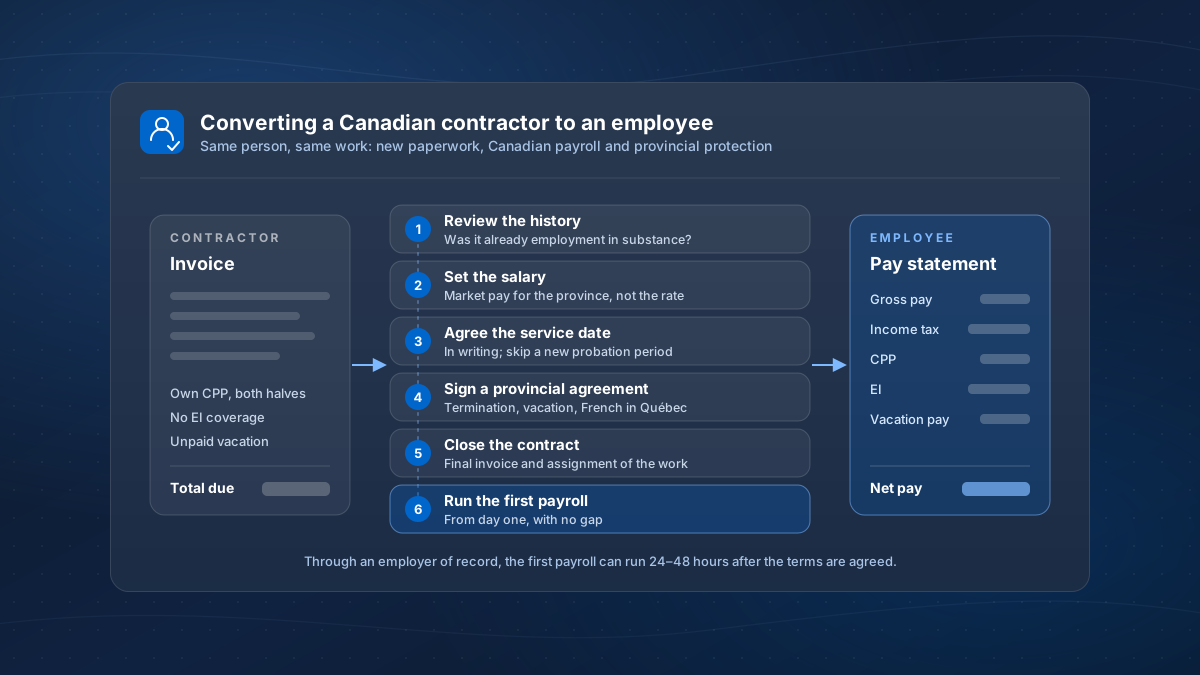
A U.S. company can convert a Canadian contractor to an employee without opening a Canadian entity: an employer of record employs them, or the company registers as an employer with the CRA. The work is in six steps: review the history, set the salary, settle the service date, sign a provincial agreement, close the contract and start payroll on day one.
Published November 9, 2026
A U.S. company can convert a Canadian contractor to an employee without opening a Canadian company. An employer of record can employ the person in Canada, or your company can register as an employer with the CRA. Either way, a good conversion changes the paperwork, not the working relationship: same person, same work, now with payroll, benefits and the protection of provincial employment law.
When a contractor should become an employee
Most conversions start for one of two reasons. Either the relationship has drifted into employment, or the company wants to keep someone and the person wants the stability of a job.
The drift is the more urgent case. The CRA decides employee or contractor from how the work is done, not from what the contract says. A contractor who works set hours, takes direction from a manager, uses your laptop and accounts, works only for you and has no end date looks like an employee, whatever the agreement is called. Québec applies a similar test under its Civil Code.
The planned case is simpler: a contractor who has proved themselves, a project that has become a permanent role, or a person who wants benefits and paid vacation. Converting is how you keep them.
Three ways to employ the person in Canada
Route
What you need
Time to the first payroll
Best when
Employer of record
A service agreement with the EOR
24–48 hours of agreeing terms, through InfraDev
One or a few people in Canada, no entity planned
Register as an employer yourself
A CRA business number and payroll account, provincial registrations, workers’ compensation, a payroll provider
Several weeks of setup
A team in Canada large enough to justify running it
Keep a contractor, held by a Canadian party
A role that is genuinely independent
Days
The work really is independent, but you would rather not hold the contract
The EOR vs Canadian entity comparison sets out the costs and the break-even headcount. The third route is not a conversion at all: consulting management suits people who remain genuinely independent. If the role is a job, employ them.
Step 1: Review the history before you change anything
Look at how the work has actually been done, and for how long. If the contractor period was employment in substance, two things follow.
First, CPP and EI contributions that an employer should have deducted were not. If the CRA later decides the person was an employee, it can assess the employer for the missed contributions, including the employee’s share, with penalties and interest. Converting does not trigger that review, but it does not erase the past either.
Second, the time can count as service. Provincial employment standards and the courts look at the real relationship, so years of contracting can count toward notice of termination, severance and vacation entitlements. Ontario’s Employment Standards Act also prohibits treating an employee as if they were not one.
For a short engagement this review takes minutes. For a long one, with set hours and a single client, ask an employment adviser before you sign anything. Either party can also ask the CRA for a ruling on form CPT1.
Step 2: Set a salary rather than copying the rate
A contractor’s rate is not a salary. It has to pay for things an employer covers once the person is on payroll, so the right salary is usually lower than the invoiced total, while your total cost stays about the same.
What the contractor’s rate had to cover
Who pays after conversion
Both the employer and employee halves of CPP
The employer pays its share; the employee’s share comes off the pay stub
No EI, so no parental or sickness benefits
Both contribute; the employee is covered
Unpaid vacation and statutory holidays
Paid by the employer, at least to the provincial minimum
Health and dental cover, bought privately
Group benefits, if you offer them
Their own laptop, software and accountant
The employer supplies equipment; payroll replaces the bookkeeping
Gaps between contracts
A salary that continues
Start from the market salary for the role in that province, then check the total. The Canadian employer cost calculator adds the deductions, contributions and overhead to a salary, and the worked example at the end of this article shows the same $100,000 paid both ways.
Talk the person through their net pay before the offer. Some contractors expect the salary to match the rate, and a side-by-side comparison of take-home pay, benefits and time off usually settles it.
Step 3: Decide the service date in writing
You can recognize the contractor period as service, starting the employment on the date of the first contract, or start fresh on the conversion date. Recognizing it is common when the work continues unchanged, because a court may count that time anyway if the contract was employment in substance. Whichever you choose, say it in the agreement.
Avoid a new probation period for someone who has done the same job for months. It is hard to justify, and in Ontario, where the employer owes no notice in the first three months of employment, it may not hold if the earlier time counts as service.
Step 4: Write the employment agreement for the province
The agreement follows the province where the person works, not where your company is. It should set out:
Pay and hours: salary, pay frequency, working hours and overtime treatment.
Vacation and holidays: at least the provincial minimum, which is two weeks a year in most provinces, rising with service.
Benefits: what is offered and when cover starts. Waiving the waiting period for someone who has already worked with you is a simple goodwill gesture.
Termination: a clause that meets the province’s minimums. In Ontario, a termination clause that falls below the Employment Standards Act can be void as a whole, which leaves the employer owing common-law reasonable notice instead.
Confidentiality and non-solicitation: Ontario has prohibited non-compete agreements with most employees since October 25, 2021, so rely on these instead.
Language: in Québec, a written employment contract is drawn up in French first. Hiring an employee in Québec covers the rules.
Step 5: Close the contractor agreement cleanly
End the contract the day before employment starts, so there is no gap and no overlap.
Final invoice: for work up to the end date, under the contract’s usual terms.
Ownership of the work: under Canada’s Copyright Act, an employer owns what an employee creates in the course of employment, but a contractor keeps copyright in their work unless they assign it in writing. Have the person sign an assignment covering everything they created as a contractor, with a waiver of moral rights, which can be waived but not assigned.
Confidentiality: the contractor agreement’s confidentiality terms should survive its end, and the employment agreement picks them up from there.
Their business: whether they keep their GST/HST registration or business accounts is their decision and their accountant’s, not yours.
Step 6: Start payroll on the first day
From the first day of employment, the person is paid through Canadian payroll:
Onboarding: their Social Insurance Number, the federal and provincial TD1 forms (in Québec, the TP-1015.3), direct deposit details and benefits enrolment.
Each pay: income tax, CPP (QPP in Québec) and EI deducted, the employer’s contributions added, and everything remitted to the CRA on schedule. The CRA requirements guide lists the deadlines.
Workers’ compensation: cover under the province’s board from the start date.
Year end: a T4 for the employment income. Their contractor income for the earlier part of the year stays on their own tax return as business income.
Tell the person what changes for them: a regular pay stub with deductions already taken, EI coverage, paid vacation and holidays, and no more quarterly instalments on their employment income.
Converting through InfraDev
When InfraDev is the employer of record, we employ the person in their province, write the agreement to provincial law with the service date you choose, collect the assignment of their earlier work, and run payroll, remittances and the T4. Onboarding takes 24–48 hours once the terms are agreed, and the person keeps working with your team as before. You direct the work; we are the employer in Canada. How it works shows who does what.
If someone on your team is genuinely independent and should stay that way, InfraDev can hold the contract instead through consulting management.
Summary
A U.S. company can convert a Canadian contractor to an employee through an employer of record, with no Canadian entity, or by registering as an employer itself.
Review the contractor history first: if it was already employment, earlier CPP and EI may be owed and the time can count as service.
Set a market salary instead of copying the rate, decide the service date in writing, and skip a new probation period.
Write the agreement to the province’s law, close the contract the day before employment starts, and have the person assign the work they created as a contractor.
Run payroll from the first day, with a T4 at year end.
A worked example: the same $100,000, paid two ways
An employee’s pay stub beside a contractor’s invoice for the same annual amount in Ontario.
Pay statement · Example
Employee, Ontario
Pay frequency
Every two weeks
Pays a year
26
Rates
2026
Earnings and deductions for one pay, with the full-year total
Earnings
This pay
Full year
Regular salary
$3,846.15
$100,000.00
Deductions
1Income tax, federal and Ontario
−$770.17
−$20,024.35
2CPP and CPP2 contributions
−$178.71
−$4,646.45
3EI premiums
−$43.20
−$1,123.07
Net pay
$2,854.08
$74,206.13
4Employer's share, paid on top of salary
Employer contributions for one pay, with the full-year total
CPP and CPP2, employer share
$178.71
$4,646.45
EI, employer share (1.4×)
$60.47
$1,572.30
5Remitted to the CRA
$1,231.25
$32,012.61
Illustrative, in Canadian dollars, using 2026 rates with income tax simplified. CPP and EI stop once the yearly maximums are reached, so per-pay amounts here are averages over the year.
Contractor invoice · Example
Self-employed contractor, Ontario
Billing
Monthly
Invoices a year
12
Rates
2026
Contractor fees for one invoice, with the full-year total
Fees
This invoice
Full year
Fees for services
$8,333.33
$100,000.00
Withheld by the client
AIncome tax, CPP and EI
$0.00
$0.00
Paid to the contractor
$8,333.33
$100,000.00
The contractor pays on their own
What the contractor pays themselves over the year
BCPP and CPP2, both shares
$774.41
$9,292.90
Income taxPaid by instalments and at tax time
Own return
CEmployment Insurance
Not covered
Illustrative, in Canadian dollars, using 2026 rates. CPP shown on the full fee amount; a contractor's actual base is net business income after expenses. GST/HST is added to the invoice if the contractor is registered.
A
Who withholds An employer withholds income tax, CPP and EI from every pay. A client withholds nothing from a contractor’s invoice.
B
Pension contributions A contractor pays both the employee and employer shares of CPP and CPP2 on their own net earnings, when they file their tax return.
C
Employment Insurance Contractors are not covered by EI by default; they can opt in to EI special benefits only.
D
Year-end slips The employee gets a T4. The contractor may get a T4A for fees over $500, and reports the income as self-employed.
Frequently asked questions
Can a U.S. company convert a Canadian contractor to an employee without a Canadian entity?
Yes. A U.S. company can employ a former contractor in Canada through an employer of record, which becomes the legal employer and runs Canadian payroll, or by registering with the CRA as a non-resident employer. Through InfraDev, onboarding takes 24–48 hours once the terms are agreed.
Does a Canadian contractor's time count as service after they become an employee?
Often, yes. If the contractor period was employment in substance, Canadian employment standards and courts can count it toward notice, severance and vacation entitlements. Recognizing the earlier start date in the employment agreement avoids a dispute and is common when the work itself does not change.
Should a converted Canadian contractor earn the same amount as their contractor rate?
Usually not the same figure. A Canadian contractor's rate has to cover both halves of CPP, unpaid vacation, benefits and equipment. As an employee, the employer pays its CPP and EI share, vacation pay and benefits, so the salary is often lower than the invoiced total while the employer's total cost stays similar.
Does converting a contractor to an employee in Canada trigger a CRA review?
No. Converting a contractor to an employee in Canada is not, on its own, a reason for a CRA review. It also does not erase the past: if the earlier arrangement was employment in substance, the CRA can still assess unpaid CPP and EI for those years, so a long arrangement is worth reviewing with an adviser.
Who owns the work a Canadian contractor created before becoming an employee?
The contractor does, unless they assigned it in writing. Under Canada's Copyright Act, an employer owns work an employee creates in the course of employment, but a contractor keeps the copyright without a written assignment. A signed assignment and moral rights waiver covering the contractor period closes the gap at conversion.
Can a converted employee in Ontario be bound by a non-compete clause?
Generally no. Ontario's Employment Standards Act has prohibited non-compete agreements with employees since October 25, 2021, with exceptions for certain executives and the sale of a business. Confidentiality and non-solicitation clauses remain available and are the usual protection for a former contractor who becomes an employee.
Payroll, CRA registration and employment law for U.S. companies.
Converting a contractor in Canada?
Tell us the role, the province and how long they've worked with you. We'll explain how the move to employment would work, from the agreement to the first pay.