
Blog
Maternity leave in Canada: what a U.S. employer owes, and what Employment Insurance pays
Maternity leave in Canada is unpaid, job-protected leave set by the province where the employee works: 16 to 19 weeks for the birth mother, then parental leave that brings the total to about 18 months. The employer holds the job and does not pay wages. Employment Insurance, or Québec's own plan, pays the employee.
Published November 17, 2026
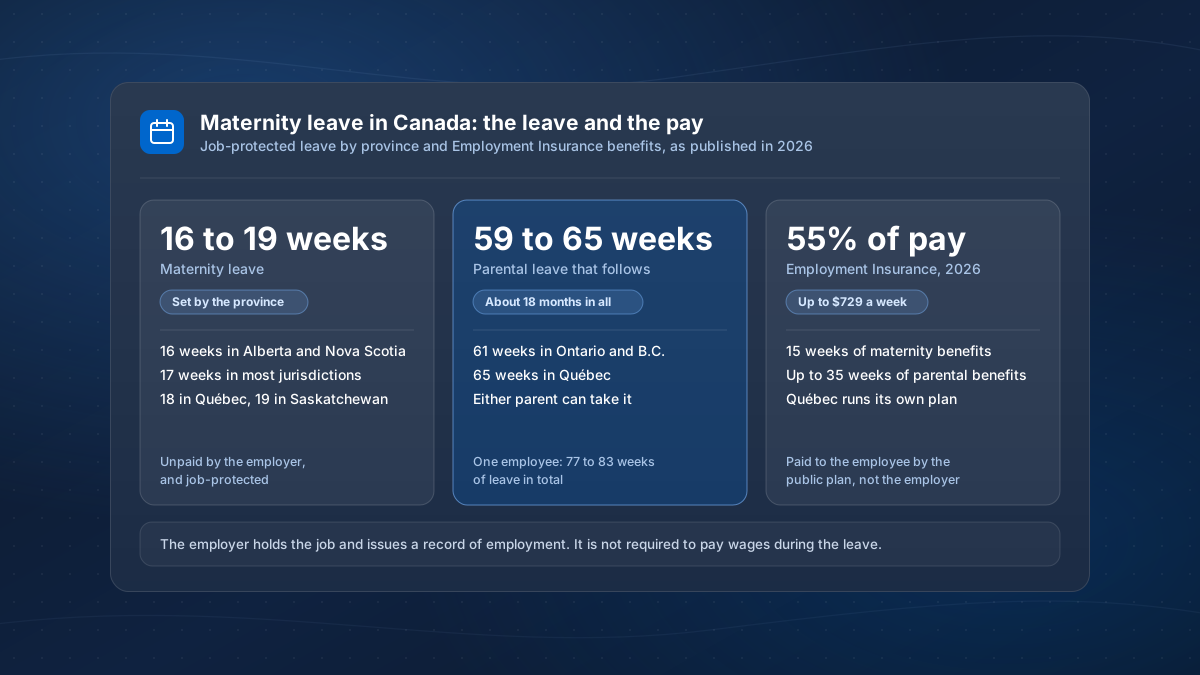
Maternity leave in Canada is unpaid, job-protected leave set by the province where the employee works: 16 to 19 weeks for the birth mother, followed by 59 to 65 weeks of parental leave. The employer holds the job and does not pay wages. Employment Insurance, or Québec’s own plan, pays the employee during the leave.
How does maternity leave in Canada work?
Maternity leave in Canada runs on two separate systems. The province’s employment standards law gives the time off and protects the job. A public insurance plan, EI or QPIP, pays the employee. The employer administers the first and contributes premiums to the second.
Three terms are used throughout:
- Maternity leave (called pregnancy leave in Ontario, Nova Scotia, Prince Edward Island, and Newfoundland and Labrador) is leave for the employee who is pregnant or has given birth.
- Parental leave is leave for either parent of a newborn or newly adopted child. New Brunswick calls it child-care leave.
- Job-protected means the employer must return the employee to the same or a comparable position when the leave ends.
For a U.S. employer, the scale is the surprise. The federal Family and Medical Leave Act gives eligible employees up to 12 workweeks of leave in a 12-month period, and covers private employers with 50 or more employees, according to the Department of Labor’s Fact Sheet 28. A company with one employee in Canada is covered by that province’s leave rules from the first hire, and the leave is measured in months.
The Canadian employment law basics page sets out the other standards that follow the province, and employee benefits in Canada places parental leave among the benefits the law requires.
How long is maternity and parental leave in each province?
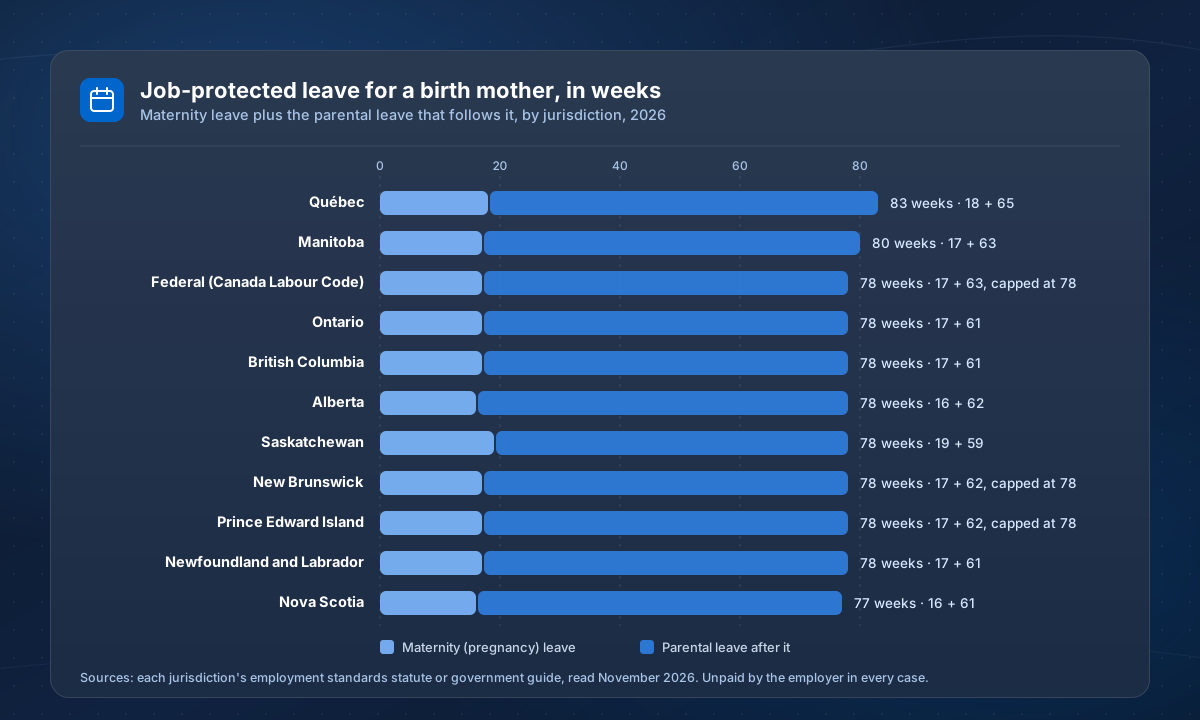
Maternity leave is 16 weeks in Alberta and Nova Scotia, 17 weeks in seven jurisdictions, 18 weeks in Québec and 19 weeks in Saskatchewan. Parental leave follows it. The table gives each jurisdiction’s figures as published by its government in November 2026.
| Jurisdiction | Maternity leave | Parental leave | Service required first |
|---|---|---|---|
| Federal (Canada Labour Code) | 17 weeks | 63 weeks; 78 weeks in total for one employee | None |
| Ontario | 17 weeks | 61 weeks after pregnancy leave; 63 otherwise | 13 weeks |
| Québec | 18 weeks | 65 weeks, plus 5 weeks of paternity leave | None for maternity or paternity leave |
| British Columbia | 17 weeks | 61 weeks after maternity leave; 62 otherwise | None in the Act |
| Alberta | 16 weeks | 62 weeks | 90 days |
| Saskatchewan | 19 weeks | 59 weeks after maternity leave; 71 otherwise | More than 13 consecutive weeks |
| Manitoba | 17 weeks | 63 weeks | 7 consecutive months |
| New Brunswick | 17 weeks | 62 weeks; 78 weeks in total | None for maternity leave |
| Nova Scotia | 16 weeks | 61 weeks after pregnancy leave; 77 otherwise | None |
| Prince Edward Island | 17 weeks | 62 weeks; 78 weeks in total | 20 weeks in the previous year |
| Newfoundland and Labrador | 17 weeks | 61 weeks | 20 consecutive weeks |
Five details matter when reading the table:
- The province is where the employee works, not where the employer is. The Canada Labour Code applies only to federally regulated employers, such as banks and airlines.
- Service rules differ widely. An employee hired two months ago qualifies in British Columbia and Québec but not yet in Alberta or Manitoba. Alberta’s page notes that an employer may still grant the leave.
- Leave and pay are separate tests. An employee can qualify for the leave and not for EI, or the reverse. EI has its own hours test, described below.
- If the pregnancy ends early, leave can still apply. In Ontario, an employee who has a miscarriage or stillbirth within the 17 weeks before the due date is eligible for pregnancy leave, which ends 17 weeks after it began or 12 weeks after the loss, whichever is later. In Alberta, an employee whose pregnancy ends within 16 weeks of the due date keeps the maternity leave but not the parental leave.
- The territories set their own rules. Yukon, the Northwest Territories and Nunavut each have their own employment standards law, which this article does not cover.
The Canada province explorer compares the provinces on other employment standards.
Does the employer pay for maternity leave in Canada?
No. An employer in Canada is not required to pay wages during maternity or parental leave. Outside Québec, Employment Insurance pays the employee directly: 55% of earnings up to $729 a week in 2026, or 33% up to $437 on the extended parental option.
| EI benefit (2026) | Maximum weeks | Rate | Weekly maximum |
|---|---|---|---|
| Maternity, for the person giving birth | 15 | 55% | $729 |
| Standard parental | 35 for one parent; 40 if shared | 55% | $729 |
| Extended parental | 61 for one parent; 69 if shared | 33% | $437 |
Service Canada’s EI maternity and parental benefits pages set three conditions that affect planning:
- 600 insured hours. The employee needs 600 insured hours of work in the 52 weeks before the claim, and weekly earnings that have dropped by more than 40%.
- A one-week waiting period. No benefit is paid for the first week, which Service Canada compares to an insurance deductible. Parents who share parental benefits serve it once.
- One choice, made once. Parents choose standard or extended parental benefits when they apply. Standard benefits must be taken within 52 weeks of the birth and extended benefits within 78 weeks. The choice cannot be changed once parental benefits have been paid.
The employer’s cost is the premium it already pays on every pay. The Canada vs U.S. payroll guide explains EI premiums, and the employer cost calculator shows them for a given salary and province.
A worked example: one salary, Ontario and Québec
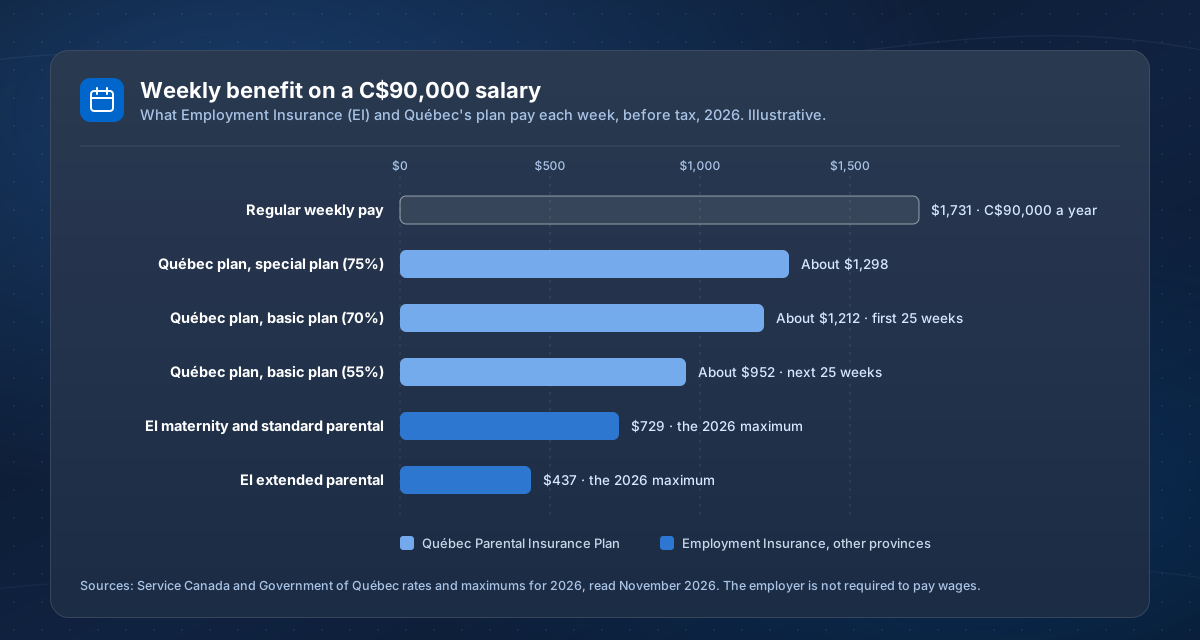
The figures are illustrative. A U.S. company employs a product manager at C$90,000 a year, which is about C$1,731 a week. She gives birth in 2026 and takes maternity leave followed by parental leave. The table shows what the public plan pays her each week, before tax, and what the law requires the employer to pay in wages.
| Ontario (EI, standard option) | Québec (QPIP, basic plan) | |
|---|---|---|
| Maternity benefits | 15 weeks at $729 | 18 weeks at about $1,212 (70%) |
| Parental benefits, one parent | 35 weeks at $729 | 7 weeks at about $1,212 (70%), then 25 weeks at about $952 (55%) |
| Paid weeks | 50 | 50 |
| Total paid by the plan | $36,450 | About $54,100 |
| Wages the employer must pay | $0 | $0 |
In Ontario, 55% of C$1,731 would be C$952, so the $729 ceiling applies. In Québec, the 2026 maximum insurable earnings are $103,000 a year, so a C$90,000 salary is covered in full. In Ontario, she can stay on leave for up to 78 weeks, although standard EI benefits end sooner.
What is a maternity leave top-up?
A top-up is money an employer chooses to pay an employee on maternity or parental leave, on top of EI or QPIP. No province requires one. Service Canada’s benefit page says only that some employers provide one and that employees should check.
Section 38 of the Employment Insurance Regulations is what makes a top-up work. A payment made because of pregnancy or for the care of a child is not deducted from the employee’s EI benefits if it meets two conditions:
- together with the weekly EI benefit, it does not exceed the employee’s normal weekly earnings from that employment; and
- it does not reduce the employee’s accumulated sick leave or vacation leave credits, severance pay or other accumulated credits.
In the Ontario example, a top-up to 80% of pay during the 15 weeks of maternity benefits would cost the employer about C$656 a week (C$1,385 less the $729 from EI), or about C$9,840 in all. That policy is an assumption for the example, not a norm. Whether to offer a top-up, to what level and for how many weeks is a benefits decision, and it belongs in a written policy before the first employee asks.
What must the employer do during maternity leave?
The employer has five duties: accept the notice, issue a record of employment, apply the province’s rules on benefit plans, keep counting service, and give the job back.
- Accept the written notice. The employee gives notice in writing before the leave starts: at least four weeks in British Columbia, Saskatchewan and Nova Scotia, and at least six weeks in Alberta. In Ontario, the employer cannot decide when the pregnancy leave begins.
- Issue a record of employment (ROE). The ROE is the form Service Canada uses to decide an EI claim, and it is also shared with Québec for QPIP. An employer on a weekly, biweekly or semi-monthly payroll that files electronically has up to five calendar days after the end of the pay period in which the earnings stop, under Service Canada’s ROE guide.
- Apply the province’s benefit plan rule. In Ontario, the employer must keep paying its share of premiums for pension, life insurance, extended health and dental plans, unless the employee states in writing that she will not pay her own share. In Québec, if the employee keeps contributing to group insurance and pension plans, the employer must do likewise. Saskatchewan requires the employer to offer continued participation, and the employee may be required to pay the premiums. Nova Scotia lets the employee keep up the plans at her own expense.
- Keep counting service. In Ontario, employees on leave continue to earn credit for length of employment, length of service and seniority. Alberta treats them as continuously employed, and Manitoba counts the leave toward the notice owed on termination and toward the length of service that sets vacation time.
- Give the job back. Ontario, British Columbia, Manitoba and the Canada Labour Code require the same position or a comparable one. Ontario adds that the employee must be paid any wage increase she would have received had she not been on leave.
Can an employer terminate an employee on maternity leave in Canada?
Not because of the pregnancy or the leave. Every jurisdiction covered here protects the job, and several say so in terms that leave little room.
- British Columbia. Section 54 of the Employment Standards Act says an employer must not, because of an employee’s pregnancy or a leave, terminate employment or change a condition of employment without the employee’s written consent.
- Alberta. The province’s page says no employer may terminate or lay off an employee who is entitled to or has started maternity or parental leave, unless the employer suspends or discontinues the business.
- Ontario. The employment standards guide says an employer cannot penalize an employee in any way for taking or planning to take a pregnancy or parental leave.
- Canada Labour Code. Section 209.3 says no employer shall dismiss, suspend, lay off, demote or discipline an employee because she is pregnant or has applied for leave.
- Manitoba. The fact sheet says employers “must show the leave has no impact on the decision to lay off or terminate the employment.”
A real restructuring can still affect a role, but the employer carries the burden of showing the leave played no part. Canada has no at-will employment, so the ordinary rules on notice apply as well. The post on the probation period in Canada explains when notice of termination starts to be owed.
What changes for maternity leave in Québec?
Québec has longer leave and its own insurance plan. Its labour standards give 18 weeks of maternity leave, 5 weeks of paternity leave and up to 65 weeks of parental leave for each parent, and QPIP pays in place of EI maternity and parental benefits.
| QPIP benefit (birth) | Basic plan | Special plan |
|---|---|---|
| Maternity | 18 weeks at 70% | 15 weeks at 75% |
| Paternity | 5 weeks at 70% | 3 weeks at 75% |
| Parental, shareable | 7 weeks at 70%, then 25 weeks at 55% | 25 weeks at 75% |
Three differences matter to the employer:
- Eligibility is by earnings, not hours. An employee needs at least $2,000 in insurable earnings in the qualifying period, regardless of hours worked.
- The ceiling is higher. QPIP calculates benefits on earnings up to $103,000 in 2026.
- There is a separate premium. The Government of Québec sets the 2026 employer rate at 0.602% of insurable earnings, to a maximum of $620.06 per employee, collected by Revenu Québec.
The CNESST’s pages state that maternity and paternity leave apply regardless of the employee’s length of service. Hiring an employee in Québec covers French-language contracts, payroll with Revenu Québec and the province’s other standards.
How does maternity leave work through an employer of record?
The employer of record handles the leave, because it is the legal employer in Canada. It receives the notice, issues the record of employment, applies the province’s rules on benefits and reinstatement, and keeps the employment file in order.
Covering the work is still your decision. Your managers know what the role needs for the next 12 to 18 months, and whether to redistribute the work or bring in someone for a fixed term. With InfraDev as the employer, we handle the leave under the law of the employee’s province and tell you what it requires at each step. Employer of Record sets out what InfraDev handles as the employer.
Summary
- Maternity leave in Canada is unpaid by the employer and job-protected. Its length comes from the province where the employee works.
- Maternity leave runs 16 to 19 weeks, and maternity plus parental leave for one employee totals 77 to 83 weeks, as of November 2026.
- Employment Insurance pays 55% of earnings up to $729 a week in 2026, or 33% up to $437 on the extended parental option. Québec’s plan pays 55% to 75% on earnings up to $103,000.
- The employer issues a record of employment, follows the province’s rule on benefit plans, keeps counting service and returns the employee to the same or a comparable job.
- A top-up is optional. Under the Employment Insurance Regulations, it must not lift the employee above normal weekly earnings.
Sources
- Government of Canada: EI maternity and parental benefits, eligibility, how much you could receive and after you apply
- Employment Insurance Regulations, section 38 and Service Canada: how to complete the record of employment
- Canada Labour Code, section 206, section 206.1, section 206.2, section 209.1 and section 209.3
- Ontario: Your guide to the Employment Standards Act, Pregnancy and parental leave
- CNESST: Maternity leave, Paternity leave and Parental leave
- Government of Québec, Québec Parental Insurance Plan: choice of plan, eligibility conditions, benefit amount and premium rates (in French)
- British Columbia: Employment Standards Act (sections 50, 51 and 54)
- Alberta: Maternity and parental leave
- Saskatchewan: Family leaves and Requirements for all leaves
- Manitoba Employment Standards: Maternity leave fact sheet and Parental leave fact sheet
- New Brunswick: Maternity leave and child-care leave
- Nova Scotia: Leaves from work and Guide to the Nova Scotia Labour Standards Code (October 2026)
- Prince Edward Island: Employment Standards Act (sections 45 to 47; consolidation current to June 30, 2026)
- Newfoundland and Labrador: Labour Standards Act (sections 40 to 43.5)
- U.S. Department of Labor: Fact Sheet 28, the Family and Medical Leave Act
This article is general information, not legal or tax advice. Figures are 2026 rules as published by each source in November 2026.
Frequently asked questions
How long is maternity leave in Canada?
Maternity leave in Canada lasts 16 to 19 weeks for the birth mother, depending on the province, and parental leave follows it. In Ontario, 17 weeks of pregnancy leave and 61 weeks of parental leave give one employee up to 78 weeks, about 18 months. Québec allows 18 weeks and then 65 weeks.
How much does Employment Insurance pay during maternity leave in Canada in 2026?
Employment Insurance pays 55% of the employee's earnings during maternity leave in Canada, up to $729 a week in 2026, for up to 15 weeks. Standard parental benefits then pay the same rate for up to 35 weeks to one parent. Extended parental benefits pay 33%, up to $437 a week, for up to 61 weeks.
Can a U.S. company terminate an employee on maternity leave in Canada?
No, a U.S. company cannot terminate an employee in Canada because of pregnancy or a maternity or parental leave. Each province's employment standards law protects the job, and the employee returns to the same or a comparable position. Manitoba's fact sheet says an employer must show the leave had no impact on a termination decision.
Does a new employee qualify for maternity leave in Canada?
A new employee in Canada qualifies for maternity leave at once in some provinces and after a set period in others. British Columbia, Québec, Nova Scotia and the Canada Labour Code set no minimum service. Ontario requires 13 weeks of employment before the due date, Alberta 90 days and Manitoba seven consecutive months.
Do fathers get parental leave in Canada?
Yes, fathers in Canada can take parental leave, which every province gives to either parent of a newborn or newly adopted child. Québec adds five weeks of paternity leave for the father or non-birthing parent. Outside Québec, Employment Insurance pays up to 40 weeks of standard parental benefits when two parents share them.
Who handles maternity leave when a U.S. company hires through an employer of record in Canada?
The employer of record handles maternity leave in Canada, because it is the legal employer. It receives the employee's written notice, issues the record of employment that Service Canada needs, applies the province's rules on benefits during the leave and reinstates the employee. The U.S. company plans how the work is covered.
Related reading
-
Employee benefits in Canada: what a U.S. employer must provide and what Canadians expect
Employee benefits in Canada come in three layers. The law requires employer contributions to the Canada Pension Plan and Employment Insurance, workers' compensation, paid vacation, paid public holidays and job-protected leaves. Public programs cover doctor and hospital care and pay parental leave. Supplementary health and dental cover, a retirement plan match and extra vacation are optional, and most candidates expect them.
Read the article -
Hiring an employee in Québec: what U.S. companies should know
What changes when your Canadian hire lives in Québec: French job offers and contracts, payroll through Revenu Québec, Québec labour standards, and Law 25.
Read the article -
Probation period in Canada: the rules by province for U.S. employers
A probation period in Canada exists only if the employment contract creates one. No statute grants it automatically. What each province's employment standards law sets is the length of employment before termination notice is owed: 30 days in Manitoba, about three months in most of the country and six months in New Brunswick. A contract cannot make that window longer.
Read the article
Next steps for hiring in Canada
An employee in Canada is expecting?
Tell us the role and the province. We'll explain how we would employ the person, and how leave, the record of employment and the return to work are handled.