
Blog
Employee benefits in Canada: what a U.S. employer must provide and what Canadians expect
Employee benefits in Canada come in three layers. The law requires employer contributions to the Canada Pension Plan and Employment Insurance, workers' compensation, paid vacation, paid public holidays and job-protected leaves. Public programs cover doctor and hospital care and pay parental leave. Supplementary health and dental cover, a retirement plan match and extra vacation are optional, and most candidates expect them.
Published November 11, 2026
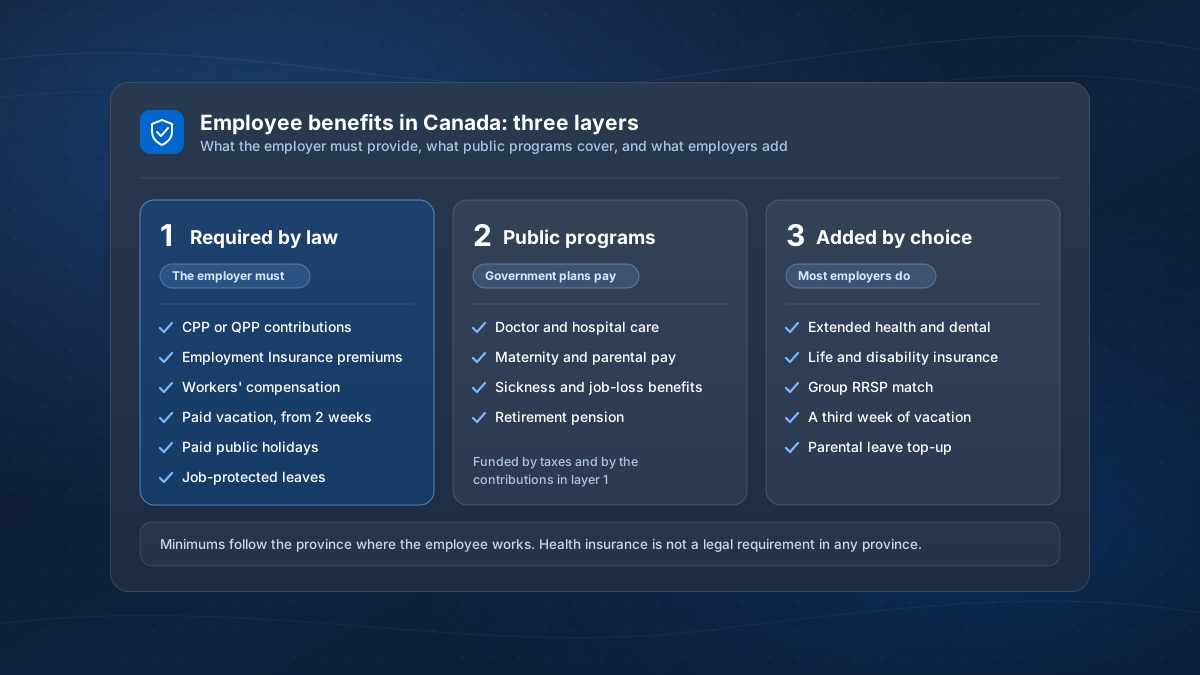
A U.S. company employing someone in Canada must provide a short list of benefits by law, and health insurance is not on it. Each province’s public plan covers doctor and hospital care for residents, and Employment Insurance pays parental leave. What the law leaves out, candidates still expect: a group health and dental plan, a retirement plan match and, often, a third week of vacation.
Three layers of benefits
Benefits in Canada are easier to plan once they are sorted into three layers:
- What the law requires. Contributions and paid time off that every employer provides. They are not negotiable and can’t be traded for a higher salary.
- What public programs cover. Health care, parental leave pay and a retirement pension, funded through taxes and the contributions in layer one.
- What employers add by choice. A group plan and other extras. Optional in law, standard in practice for professional roles.
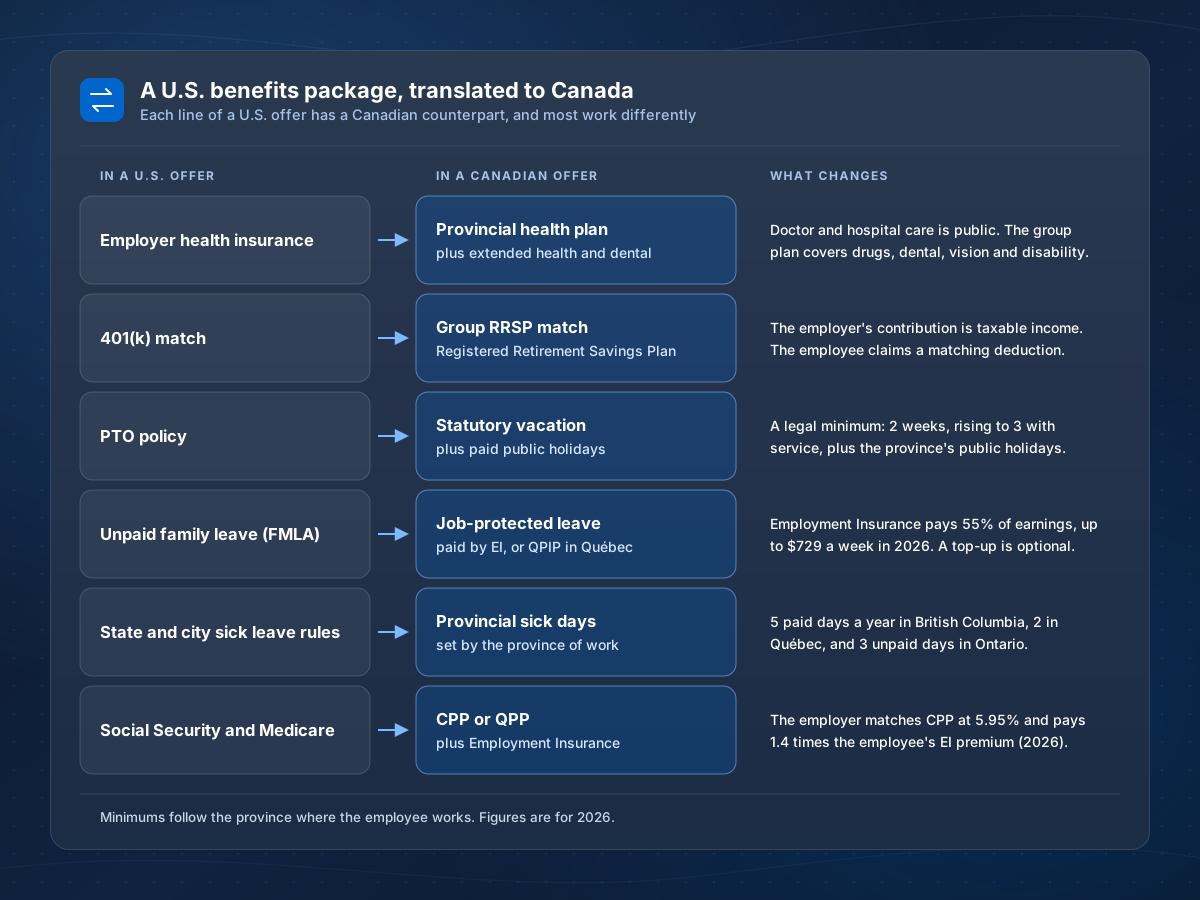
A U.S. benefits package doesn’t map one to one, so each layer is covered below, followed by a side-by-side translation.
What the law requires
| Requirement | What the employer does | 2026 figures |
|---|---|---|
| Canada Pension Plan (Québec Pension Plan in Québec) | Matches the employee’s contribution | 5.95% of earnings between $3,500 and $74,600, plus 4% up to $85,000; 6.3% in Québec |
| Employment Insurance | Pays 1.4 times the employee’s premium | 2.282% of earnings up to $68,900; lower in Québec, where employers also pay into the Québec Parental Insurance Plan |
| Workers’ compensation | Registers and pays premiums where coverage is required | Set by each provincial board by industry |
| Provincial health payroll taxes | Pays a tax on payroll in Ontario, British Columbia, Québec, Manitoba, and Newfoundland and Labrador | Ontario and B.C. exempt the first $1 million of payroll for smaller employers |
| Paid vacation | Gives time off and vacation pay | At least 2 weeks and 4% of wages |
| Paid public holidays | Gives the day off with pay, or premium pay for working it | 8 to 11 days in the four largest provinces |
| Job-protected leaves | Holds the job during maternity, parental, illness and family leaves | Mostly unpaid by the employer |
The CRA publishes the pension rates and maximums and the Employment Insurance premium rates. To see these contributions in dollars for a salary and province, use the employer cost calculator.
Vacation, holidays and sick days by province
Minimums follow the province where the employee works, not where the employer is.
| Province | Minimum vacation | Paid public holidays | Sick or personal days |
|---|---|---|---|
| Ontario | 2 weeks (4%); 3 weeks (6%) after 5 years | 9 | 3 unpaid days a year |
| Québec | 2 weeks (4%) after 1 year; 3 weeks (6%) after 3 years | 8 | 2 paid days a year, after 3 months of service |
| British Columbia | 2 weeks (4%); 3 weeks (6%) after 5 years | 11 | 5 paid days and 3 unpaid days a year, after 90 days |
| Alberta | 2 weeks (4%); 3 weeks (6%) after 5 years | 9 | 5 unpaid days a year, after 90 days |
Longer leaves for serious illness are job-protected but unpaid by the employer: up to 27 weeks in Ontario and up to 26 weeks in Québec. Canadian employment law basics covers overtime, notice and termination, which sit beside these rules.
What public programs cover
Health care. Every province runs a public health plan that covers medically necessary hospital and physician services. Residents qualify by living in the province, not by holding a job. The employer does not buy the cover, enrol anyone in it or administer it, and an employee who leaves keeps it.
Parental leave pay. Employment Insurance pays maternity benefits for up to 15 weeks and standard parental benefits for up to 40 weeks shared between two parents, at 55% of earnings up to $729 a week in 2026. An extended option spreads parental benefits over up to 69 shared weeks at 33%. In Québec, the Québec Parental Insurance Plan pays these benefits instead. The employer’s legal duty is to hold the job, not to pay salary.
Retirement. The Canada Pension Plan and Québec Pension Plan pay a retirement pension built from the contributions in the table above.
The public health plans generally do not cover prescription drugs outside a hospital, dental care, vision care or services such as physiotherapy and psychology for working-age adults. That gap is what a group plan is for.
What Canadian employees expect
More than 27 million Canadians, about 70% of the population, have workplace health benefits, according to the Canadian Life and Health Insurance Association. A candidate comparing two offers will treat a group plan as standard. A typical package for a professional role includes:
- Extended health and dental. Prescription drugs, dental, vision, and practitioners such as physiotherapists and psychologists.
- Life and disability insurance. Group life, and long-term disability cover for an illness that outlasts sick days and Employment Insurance.
- A retirement plan match. Usually a group Registered Retirement Savings Plan (RRSP), the closest counterpart to a 401(k).
- More vacation than the minimum. Offers for professional roles commonly start at three weeks.
- A parental leave top-up. Some employers add to Employment Insurance for a set number of weeks. It is optional.
Your U.S. plans generally don’t extend to a Canadian resident: a U.S. health plan is built around U.S. providers, and a 401(k) is built for U.S. taxpayers. The Canadian equivalents are separate plans, held by the Canadian employer.
How benefits are taxed
Benefits reach the employee’s pay stub differently in Canada, which matters when you compare packages:
- Health and dental premiums paid by the employer are not a taxable benefit for federal income tax. Québec taxes them as employment income for Québec income tax.
- Group life insurance premiums paid by the employer are a taxable benefit.
- Employer RRSP contributions are taxable income for the employee, who claims an RRSP deduction for the same amount. Canada Pension Plan contributions are deducted on them.
- Long-term disability. Many plans have the employee pay this premium, so that any benefit paid later is tax-free.
- Dental cover on the T4. Employers report on each year-end T4 slip whether dental cover was offered. People with access to an employer’s dental plan are not eligible for the federal Canadian Dental Care Plan.
Canada vs. U.S. payroll explains how deductions and slips differ between the two countries.
Québec’s extra rules
Québec adds four points that change how a package is built:
- Prescription drug insurance is compulsory. A resident under 65 who has access to a private group plan must join it for drug cover, and cover their spouse and children. Any group plan offered in Québec must include at least basic drug cover.
- Health premiums are taxable for Québec income tax, as noted above.
- Retirement savings. An employer above the headcount threshold in Québec’s rules must offer a Voluntary Retirement Savings Plan, unless it already offers all employees a workplace savings plan such as a group RRSP. Employer contributions are optional.
- Parental benefits come from the Québec Parental Insurance Plan, with its own premiums and benefit rates.
Hiring an employee in Québec covers the French employment contract and the province’s other differences.
Benefits continue during leave and notice
Two rules surprise employers used to at-will employment. In Ontario, an employer must keep paying its share of benefit plan premiums while an employee is on pregnancy or parental leave. On termination, the employer must also keep up its benefit plan contributions through the statutory notice period, including when it pays termination pay instead of working notice. Plan the cost of benefits to the end of the notice period, not to the last day worked.
How benefits work through an employer of record
When an employer of record employs your hire, it is the legal employer in Canada. The statutory layer is its responsibility: registering with the CRA and the province, remitting pension and Employment Insurance contributions, carrying workers’ compensation, and applying the right vacation, holidays and leaves. Group benefits come through the employer of record’s own plan, because a group plan belongs to the employer.
Through InfraDev, group benefits are optional: you decide whether your hire’s package includes them. Employer of Record explains what InfraDev handles as the employer, and what stays with you.
A Canadian offer in six decisions
- Province of work. It sets vacation, holidays, sick days and the payroll taxes.
- Vacation. The statutory minimum, or the three weeks many candidates expect.
- Health and dental. Whether to include a group plan, and the share of the premium the employee pays.
- Disability and life. Whether long-term disability is included, and who pays its premium.
- Retirement. Whether to match RRSP contributions, and to what percentage of salary.
- Parental top-up. Whether to add to Employment Insurance, and for how many weeks.
Write each choice into the offer in Canadian dollars. The employment agreement then records them under the law of the province where the person works.
Summary
- Employers in Canada must provide pension and Employment Insurance contributions, workers’ compensation, paid vacation, paid public holidays and job-protected leaves.
- Health insurance is not required: public plans cover doctor and hospital care, and a group plan covers drugs, dental, vision and disability.
- Vacation starts at two weeks and 4% of wages and rises to three weeks, after five years in Ontario, British Columbia and Alberta and after three in Québec.
- Maternity and parental leave pay comes from Employment Insurance or the Québec Parental Insurance Plan, at 55% of earnings up to $729 a week in 2026.
- A group RRSP match is the counterpart to a 401(k) match, and it is taxed differently.
- Through an employer of record, the statutory layer is handled by the employer in Canada and group benefits come through its plan.
Sources
- CRA: T4130 Employers’ Guide, Taxable Benefits and Allowances
- Government of Canada: EI maternity and parental benefits
- Health Canada: About Canada’s health care system
- Government of Canada: Canadian Dental Care Plan, who qualifies
- Ontario, Your guide to the Employment Standards Act: vacation, public holidays, sick leave, pregnancy and parental leave and termination of employment
- Ontario: Employer Health Tax
- British Columbia: vacation, paid sick leave and employer health tax
- Québec, CNESST: annual vacation and non-work-related accident or illness
- Québec, RAMQ: prescription drug insurance and private plans
- Retraite Québec: Voluntary Retirement Savings Plans
- Alberta: vacation pay, general holidays and personal and family responsibility leave
- Canadian Life and Health Insurance Association: workplace health benefits (August 2026)
This article is general information, not legal or tax advice. Figures are 2026 rates and rules as published by each government in November 2026.
Frequently asked questions
What employee benefits are mandatory in Canada?
Employers in Canada must contribute to the Canada Pension Plan (or the Québec Pension Plan) and Employment Insurance, carry workers' compensation where the province requires it, and give paid vacation, paid public holidays and job-protected leaves. Health and dental insurance, retirement plan matching and bonuses are not required by law.
Does a U.S. company have to provide health insurance to employees in Canada?
No. Employers in Canada are not required to provide health insurance, because each province's public plan covers medically necessary doctor and hospital care for residents. Most employers still offer a group plan for prescription drugs, dental, vision and disability, which the public plans generally do not cover for working-age adults.
How much paid vacation do employees get in Canada?
At least two weeks a year in most provinces, paid at 4% of wages. The minimum rises to three weeks and 6% after five years of employment in Ontario, British Columbia and Alberta, and after three years in Québec. Paid public holidays are separate, from eight in Québec to eleven in British Columbia.
Do employers in Canada pay for maternity and parental leave?
No. In Canada, maternity and parental leave pay comes from Employment Insurance, or from the Québec Parental Insurance Plan in Québec, not from the employer. In 2026, Employment Insurance pays 55% of earnings up to $729 a week. The employer must hold the job, and may add an optional top-up.
What is the Canadian equivalent of a 401(k)?
A group Registered Retirement Savings Plan (RRSP) is the closest Canadian equivalent of a 401(k). Employees contribute by payroll deduction and the employer can match. Unlike a 401(k) match, an employer's RRSP contribution is taxable income for the employee, who then claims an RRSP deduction for it.
Are employer-paid health and dental premiums taxable for employees in Canada?
Not for federal income tax. In Canada, an employer's premiums for a private health and dental plan are not a taxable benefit federally, but Québec taxes them as employment income for Québec income tax. Employer-paid group life insurance premiums are a taxable benefit across Canada.
How do benefits work when an employer of record employs a hire in Canada?
An employer of record is the legal employer in Canada, so the statutory benefits are its job: pension and Employment Insurance contributions, workers' compensation, vacation, public holidays and leaves. Group health and dental cover comes through the employer of record's plan. Through InfraDev, group benefits are optional and the U.S. client decides whether to include them.
Related reading
-
Canada vs U.S. payroll: what changes for a U.S. employer
The differences a U.S. company meets when it pays employees in Canada: provincial instead of state tax, CPP and EI instead of Social Security and Medicare, TD1 and T4 instead of W-4 and W-2, and stricter remittance deadlines.
Read the article -
Hiring an employee in Québec: what U.S. companies should know
What changes when your Canadian hire lives in Québec: French job offers and contracts, payroll through Revenu Québec, Québec labour standards, and Law 25.
Read the article -
What hiring a Canadian developer really costs compared with a U.S. hire
How to compare the cost of a Canadian developer with a U.S. hire on a fully loaded basis: salary, employer contributions, benefits, exchange rate and the Employer of Record fee, and why savings of 10–40% are typical rather than guaranteed.
Read the article
Next steps for hiring in Canada
Putting together an offer for a hire in Canada?
Tell us the role and province. We'll set out the statutory minimums, the benefits a candidate will expect, and how we would employ your hire in Canada.