
Blog
Province of employment for remote employees in Canada: what a U.S. employer applies
The province of employment for remote employees in Canada is set by the CRA's payroll rules, not by where the person lives. A fully remote employee takes the province of the employer's establishment they are attached to, or the one that pays them. Employment standards follow the province where the work is done, so the two can differ.
Published November 19, 2026
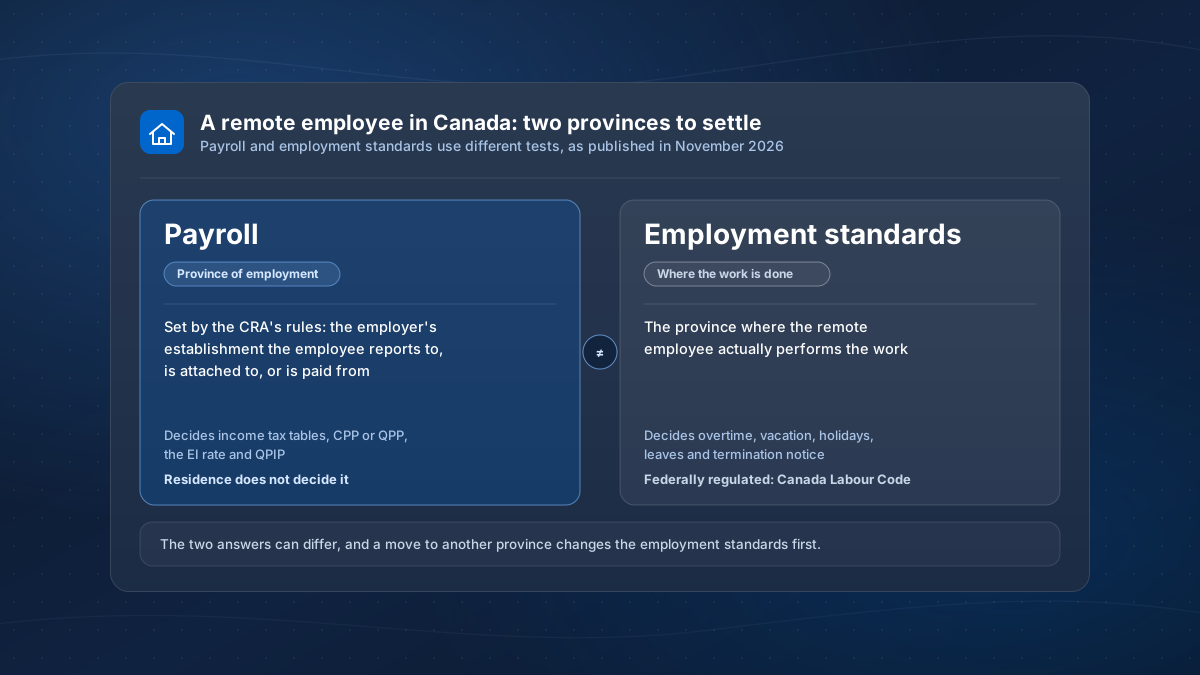
The province of employment for remote employees in Canada comes from the Canada Revenue Agency’s payroll rules, not the employee’s home address. A fully remote employee takes the province of the employer’s establishment they are attached to, or else the one that pays them. Employment standards follow where the work is done, so the two can differ.
Why does a remote employee in Canada have two provinces to check?
A remote employee in Canada has two provinces to check because Canadian payroll and Canadian employment law use different tests. Payroll deductions depend on the province of employment, a CRA concept tied to the employer’s establishments. Employment standards depend on where the employee actually performs the work.
The province of employment is the province or territory whose income tax tables, and in Québec whose pension and parental insurance plans, an employer uses for an employee’s source deductions. The CRA’s page on determining the province of employment says it depends on the type of income, the employee’s residency status and the employer’s establishment where the employee reports for work.
An establishment, for this purpose, is any place in Canada that the employer owns, leases or rents, where employees report to work or from which they are paid. It does not need to be permanent. The CRA adds that an employee’s home office is generally not an establishment of the employer.
That is a payroll term, not a corporate tax one. Whether a U.S. company has a taxable presence in Canada is a different test under the tax treaty, covered in permanent establishment in Canada.
For most office-based staff, both questions give the same province. For a remote employee in Canada, they can split, and a U.S. employer used to state-by-state payroll should treat them as two separate settings.
How is the province of employment for remote employees decided?
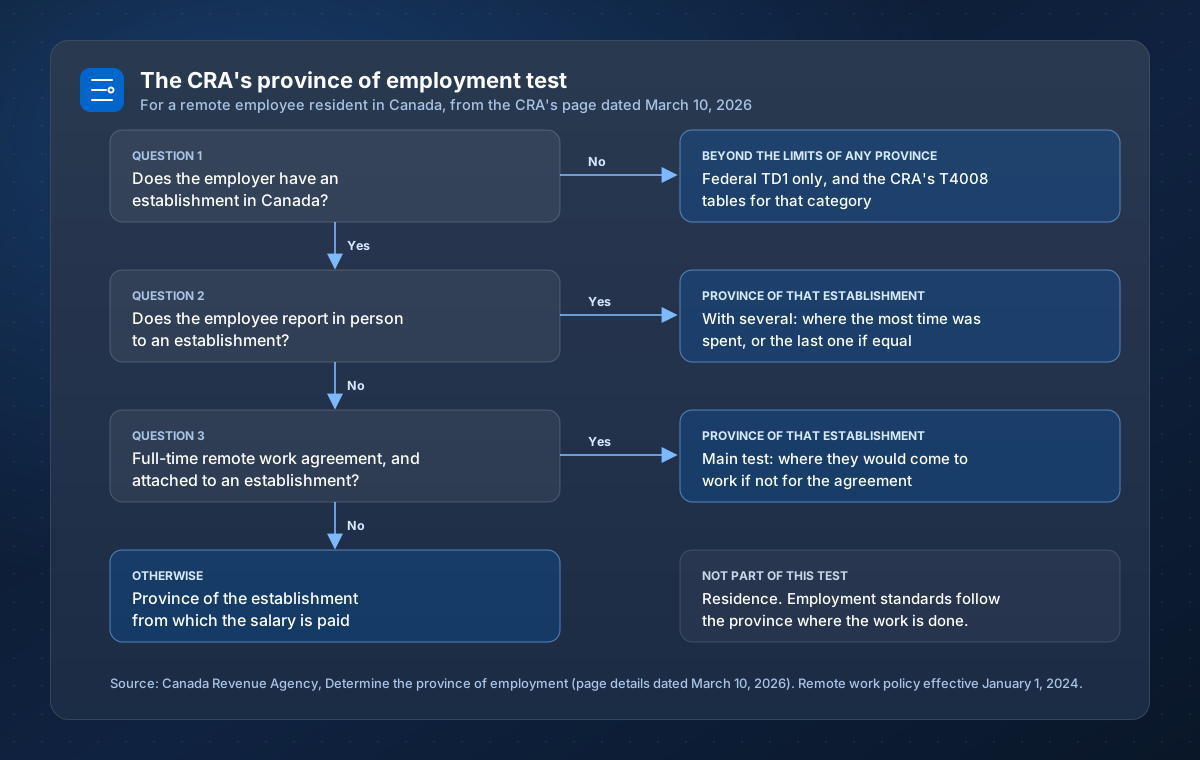
It is the province of the employer’s establishment that the remote employee is attached to, under a CRA administrative policy in effect since January 1, 2024. If the employee is not attached to any establishment, it is the province of the establishment from which their salary is paid.
The CRA’s page covers these cases for an employee who is resident in Canada:
- Reports in person to one establishment. The province of employment is where that establishment is, with no minimum amount of time the employee has to spend there. A hybrid employee who reports in person at all falls under this rule, not the remote work rule.
- Reports to more than one establishment in a pay period. It is the province of the establishment where the employee spent the most time, or worked last if the time was equal.
- Never reports in person, with a full-time remote work agreement. It is the province of the establishment the employee is reasonably considered attached to. The agreement can be temporary or permanent, but the employer must direct or allow 100% remote work at places that are not its establishments, and both sides must be able to justify it.
- Never reports in person and is not attached. It is the province of the establishment from which the salary is paid, generally where the payroll department or records are kept.
- The employer has no establishment in Canada. The work is employment in Canada beyond the limits of any province or territory (see below).
How does the CRA decide which establishment a remote employee is attached to?
The main test is whether the employee would physically come to work at that establishment if not for the remote work agreement. If the employee reported to an establishment just before going remote, that establishment still applies unless their circumstances or duties have changed.
When that is not decisive, the CRA looks at secondary indicators: where the employee would attend in-person meetings, where they receive equipment and materials, where they receive in-person instructions, which establishment the contract says supervises them, and which establishment matches the nature of their duties. If several establishments qualify, the closest attachment wins.
There is one firm limit. The CRA says an employee cannot be attached to an establishment in order to avoid source deductions or payroll contributions in any province or territory.
Which province’s employment standards apply to a remote employee?
A remote employee is generally covered by the employment standards of the province where the work is done. Overtime, vacation, public holidays, leaves and termination notice come from that province’s employment standards law, whatever province the payroll uses, unless the employer is federally regulated.
The two largest provinces say so in their statutes:
- Ontario. Section 3(1) of the Employment Standards Act, 2000 applies the Act when the employee’s work is to be performed in Ontario, or in and outside Ontario where the work outside is a continuation of work performed in Ontario.
- Québec. Section 2 of the Act respecting labour standards applies it to the employee regardless of where the employee works, and expressly to an employee working both in and outside Québec for an employer with a residence, head office or office in Québec.
- Federally regulated employers. Ontario’s guide to the Employment Standards Act says the Act does not cover sectors under federal jurisdiction, such as airlines, banks and interprovincial railways. Those employers follow the federal Canada Labour Code instead.
Workers’ compensation also follows the work. Ontario’s Workplace Safety and Insurance Board says, in its registration questions and answers, that a business not based in Ontario must find out whether to register when it hires Ontario residents, or people from elsewhere, to work in Ontario.
The thresholds differ more than U.S. employers expect. In 2026, weekly overtime starts after 44 hours in Ontario and after 40 in Québec. The post on overtime rules in Canada gives the threshold in each province, and the Canadian employment law basics page lists the other standards that follow the province.
What changes if the province of employment is Québec?
Québec runs its own pension plan, parental insurance plan and provincial income tax, so a Québec province of employment changes the deductions and who receives them. The CRA says the Québec Pension Plan and Québec Parental Insurance Plan apply regardless of the employee’s province of residence.
The CRA’s employer guide, T4001, sets out the split for an employee in Québec. The employer deducts QPP contributions instead of CPP, deducts both QPIP and Employment Insurance premiums, sends QPP, QPIP and Québec income tax to Revenu Québec, and sends EI and federal tax to the CRA. The employee fills out Québec’s Form TP-1015.3-V as well as the federal TD1. Revenu Québec administers Québec source deductions under its own guidance, so check it as well for a remote employee who may be attached to an establishment in Québec.
| 2026 payroll item | Province of employment outside Québec | Province of employment Québec | Source |
|---|---|---|---|
| Pension plan | CPP: 5.95% each for employee and employer, on earnings up to $74,600 after a $3,500 exemption | QPP instead of CPP | CRA CPP rates page; CRA T4001 |
| Second pension tier | CPP2: 4% each, on earnings from $74,600 to $85,000 | QPP instead of CPP | CRA CPP2 rates page |
| Employment Insurance | 1.63% for the employee, 1.4 times that for the employer, to $68,900 | Reduced rate, 1.30% for the employee, to $68,900 | CRA EI premium rates page |
| Parental insurance | Included in EI | QPIP premiums, sent to Revenu Québec | CRA T4001 |
| Provincial income tax | Remitted to the CRA with federal tax | Remitted to Revenu Québec | CRA T4001 |
The 2026 figures come from the CRA’s CPP, CPP2 and EI rate pages as published in November 2026. For the full cost of one role, the Canadian employer cost calculator works through a salary and province.
A Québec hire also changes the paperwork beyond payroll. The post on hiring an employee in Québec covers the French-language contract and the province’s other rules.
What if the U.S. company has no establishment in Canada?
When a U.S. employer has no establishment in Canada, the CRA treats a resident employee’s work as employment in Canada beyond the limits of any province or territory. The employee fills out only the federal TD1 form, not a provincial one, and the employer uses the CRA’s T4008 tables for that category.
This is the situation of a U.S. company that registers its own Canadian payroll account and pays a remote employee directly, with no office, lease or payroll establishment in Canada. The employment standards question does not go away: an employee working from home in Toronto is still covered by Ontario’s Employment Standards Act, which applies to work performed in Ontario.
The CRA’s page also flags the side effect. When the province of employment differs from the province the employee lives in, the employee may have too little or too much tax deducted during the year. The CRA requirements for U.S. companies page covers the payroll account and remittances that come first.
What changes when a remote employee moves to another province?
The employment standards change first. Once the employee works from the new province, that province’s rules on overtime, vacation, holidays and termination apply to the work done there. The payroll province changes only if the CRA’s tests now point to a different establishment.
Because residence does not set the province of employment, a move from Montréal to Ottawa does not by itself move payroll from Québec to Ontario. A change in duties or circumstances can, under the attachment test above. Before the move, settle these points in order:
- Confirm the new work location in writing, with the date the employee starts working there.
- Apply the new province’s employment standards to hours, overtime, vacation, public holidays and termination clauses in the contract.
- Re-run the CRA’s province of employment test and update the TD1 forms if the province changes; add Québec’s TP-1015.3-V for a move into Québec.
- Register for workers’ compensation in the new province if its rules require it.
- Check benefits with the plan provider, so cover continues after the change of province.
A worked example: one U.S. team, three remote employees
The scenario is illustrative. A U.S. software company hires three fully remote engineers in 2026 through its own Canadian payroll account. It has no office or other establishment in Canada. Two engineers work from home in Toronto and one in Montréal.
- Payroll. With no establishment in Canada, all three are employed in Canada beyond the limits of any province. Each fills out the federal TD1 only, and the company uses the CRA’s T4008 tables for that category. No province’s tables are used, even for the Montréal engineer, so the CRA’s warning applies: the tax deducted may not match what the employee owes where they live.
- Employment standards. Each engineer is covered by the province where they work: Ontario’s Employment Standards Act for the two in Toronto, and Québec’s Act respecting labour standards for the one in Montréal. Overtime, for example, starts after 44 hours a week in Ontario, according to the province’s overtime pay guide, while section 52 of Québec’s Act sets the regular workweek for overtime at 40 hours.
- Workers’ compensation. The company has to check each province’s registration rule, as Ontario’s WSIB asks of businesses not based in Ontario.
- The Montréal engineer moves to Ottawa. Ontario’s Employment Standards Act now applies to the work, because it is performed in Ontario. Payroll stays beyond the limits of any province, because the company still has no establishment in Canada.
If the same company instead opened a leased office in Toronto, the CRA’s tests would change the answer for payroll: an engineer who reports to it in person would take Ontario as the province of employment, and a fully remote engineer could be attached to it only if the facts support that.
How does an employer of record handle the province for a remote employee?
The employer of record is the legal employer, so it applies the CRA’s province of employment rules to its own establishments and runs the matching deductions. It also applies the employment standards of the province where your remote hire works, and updates both when the person moves.
InfraDev has been an employer of record in Canada since 2016, and most hires start within 24–48 hours once terms are agreed. Your company directs the work; we issue the employment contract for the employee’s province, register and run payroll, and remit to the CRA and, for Québec, to Revenu Québec. The Employer of Record page sets out what we handle as the employer, and how to pay someone in Canada from the U.S. compares the other routes.
If the person you want to hire is still deciding whether to work remotely for a U.S. company, the page on working remotely for a U.S. company from Canada explains the arrangement from their side.
Summary
- A remote employee in Canada has two provinces to check: the province of employment for payroll and the province whose employment standards apply.
- The CRA sets the province of employment by the employer’s establishment the employee reports to, is attached to under a full-time remote work agreement, or is paid from. Residence does not decide it.
- A U.S. employer with no establishment in Canada withholds as employment in Canada beyond the limits of any province.
- Employment standards follow the province where the work is done, unless the employer is federally regulated.
- A Québec province of employment brings QPP, QPIP and Revenu Québec into payroll. A move changes the labour law at once and the payroll province only if the CRA’s tests change.
Sources
- Canada Revenue Agency: Determine the province of employment (POE) (page details dated March 10, 2026)
- Canada Revenue Agency: T4001, Employers’ Guide, Payroll Deductions and Remittances
- Canada Revenue Agency: CPP contribution rates, maximums and exemptions, CPP2 rates and EI premium rates and maximums
- Ontario: Employment Standards Act, 2000, section 3, and Your guide to the Employment Standards Act, including its overtime pay chapter (updated February 5, 2026)
- Québec: Act respecting labour standards, sections 2 and 52 (up to date to October 15, 2026)
- Workplace Safety and Insurance Board (Ontario): Questions and answers, registration (updated July 20, 2026)
This article is general information, not legal or tax advice. It reflects each source as published in November 2026; confirm the province of employment for a specific employee with the CRA or a payroll professional before setting up payroll.
Frequently asked questions
What is the province of employment for a remote employee in Canada?
For a remote employee in Canada, the province of employment is where the employer's establishment the employee is attached to is located, under the CRA's policy in effect since January 1, 2024. If the employee is not attached to one, it is the province of the establishment that pays their salary. Where they live does not decide it.
Which province's employment standards apply to a remote employee?
The employment standards of the province where the remote employee does the work generally apply. Ontario's Employment Standards Act covers work performed in Ontario, and Québec's Act respecting labour standards covers employees working in Québec. Federally regulated employers, such as banks and airlines, follow the Canada Labour Code instead of provincial law.
Does a remote employee's province of residence matter for payroll in Canada?
No, the province of residence does not decide the province of employment for employment income. The CRA bases it on the employer's establishment the employee reports to, is attached to or is paid from. The CRA warns that when the two provinces differ, the employee may have too little or too much tax deducted.
What happens when a remote employee moves to another province?
When a remote employee moves to another province, the employment standards of the new province start to apply to the work done there. The payroll province changes only if the CRA's tests point to a different establishment, for example because the employee's duties or circumstances have changed. Review the contract, payroll setup and benefits before the move.
How does a U.S. company with no establishment in Canada withhold tax for a remote employee?
A U.S. employer with no establishment in Canada treats a resident employee's work as employment in Canada beyond the limits of any province, according to the CRA. The employee fills out the federal TD1 form only, and the employer uses the CRA's T4008 tables for that category instead of a province's tables.
Who sets the province of employment when a U.S. company hires through an employer of record?
The employer of record does, because it is the legal employer and runs payroll in Canada. It applies the CRA's province of employment rules to its own establishments, applies the employment standards of the province where the employee works, and updates both when the employee moves. The U.S. company directs the work.
Related reading
-
Overtime rules in Canada: thresholds by province, and who is exempt
Overtime rules in Canada follow the province where the employee works. Most employees earn overtime after 40 or 44 hours a week, and in several provinces after 8 hours a day, at 1.5 times their wage. A salary does not remove the right, and certain IT professionals are exempt in Ontario, British Columbia and Alberta.
Read the article -
Hiring an employee in Québec: what U.S. companies should know
What changes when your Canadian hire lives in Québec: French job offers and contracts, payroll through Revenu Québec, Québec labour standards, and Law 25.
Read the article -
Permanent establishment in Canada: when a U.S. company's hire creates a taxable presence
A permanent establishment in Canada is a taxable presence under the Canada-U.S. tax treaty. A U.S. company gets one through a fixed place of business, a person in Canada who habitually signs contracts in its name, or services delivered in Canada for 183 days or more. Hiring one remote employee does not create one automatically. What the person does, and where, decides it.
Read the article
Next steps for hiring in Canada
Hiring remote employees in more than one province?
Tell us the roles and where each person works. We'll explain how we would employ them, and how payroll and the province's rules are set for each.