
Blog
How to pay someone in Canada from the U.S.
How a U.S. company pays someone who works in Canada depends on whether they are an employee or a contractor. Employees are paid through Canadian payroll, with income tax, CPP and EI withheld and remitted to the CRA. Genuine contractors invoice and are paid by bank transfer, with no Canadian tax withheld.
Published November 3, 2026
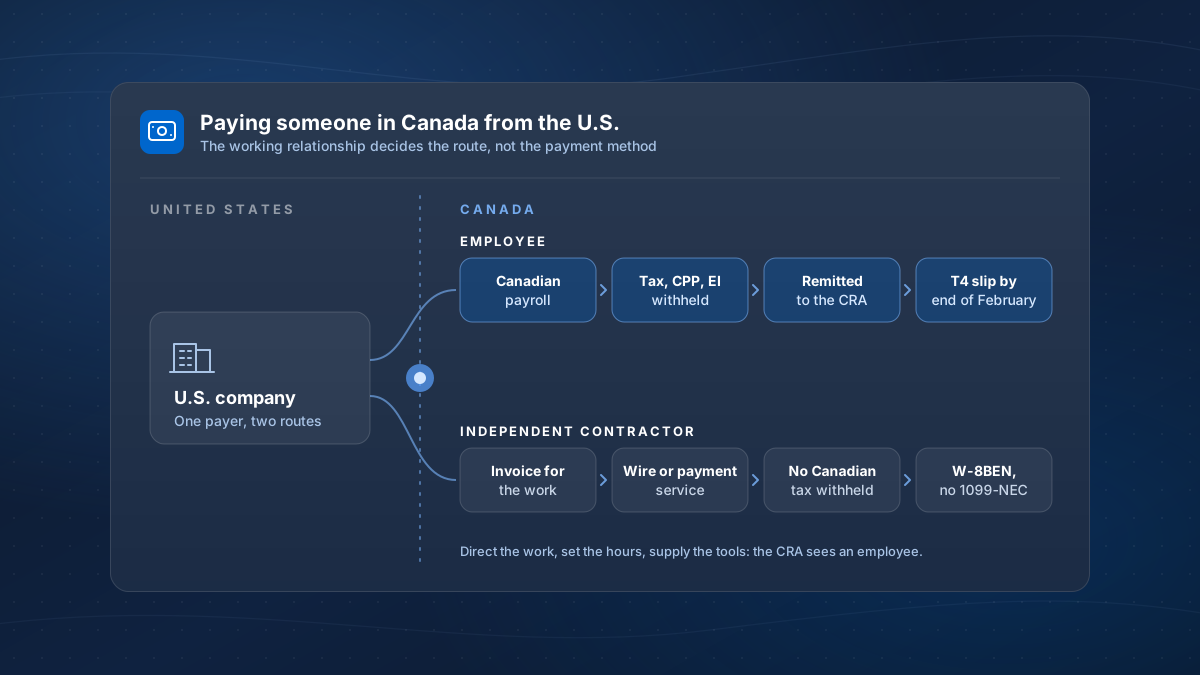
How you pay someone in Canada is decided by the relationship, not by the payment method. An employee must be paid through Canadian payroll. A genuine independent contractor sends invoices and is paid by transfer. Getting the relationship right comes first; the bank wire is the easy part.
Employee or contractor: how payment differs
| Employee | Independent contractor | |
|---|---|---|
| How they are paid | Canadian payroll, on a regular pay day | Against invoices, as the contract sets |
| Tax withheld by the payer | Income tax, CPP or QPP, EI (and QPIP in Québec) | None |
| Employer contributions | Employer’s share of CPP or QPP and EI, plus workers’ compensation | None |
| Remitted to | The CRA, and Revenu Québec for Québec employees | Nothing to remit |
| Year-end slip | T4 (and RL-1 in Québec), by the last day of February | No 1099-NEC; the contractor provides a Form W-8BEN |
Is the person an employee or a contractor?
The CRA decides whether someone is an employee or a contractor from how the work is done, not from the contract’s title. If your company directs the work, sets the hours and supplies the tools, the person is likely an employee and must be paid through payroll. A contractor runs their own business and controls how the work gets done.
Paying an employee as if they were a contractor leaves the payer owing the CPP and EI that should have been withheld, with penalties and interest. Our contractor vs employee comparison explains the CRA’s test.
How do you pay an employee in Canada from the U.S.?
A U.S. company pays an employee in Canada through Canadian payroll, not as a plain transfer. Each pay, income tax, CPP or QPP and EI are withheld, the employer adds its own contributions, and the amounts are remitted to the CRA, with Québec amounts going to Revenu Québec. The company runs this itself or through an employer of record.
Running Canadian payroll yourself
A U.S. company can employ and pay someone in Canada without a Canadian corporation, but it becomes a Canadian employer with the same duties as a local business:
- Register for a CRA business number and payroll program account, with workers’ compensation in the employee’s province, and with Revenu Québec if they work in Québec.
- Collect the employee’s social insurance number and their federal and provincial TD1 forms, which set their tax credits.
- Calculate each pay with the CRA’s payroll tables or payroll software, using the employee’s province.
- Pay the net amount on the regular pay day, usually by direct deposit to a Canadian bank account. Provincial employment standards set how often employees must be paid.
- Remit the withholdings and your contributions, usually by the 15th of the month after the pay date.
- Report each employee’s earnings and deductions on a T4 slip by the last day of February, and issue a Record of Employment when someone leaves.
The CRA requirements checklist covers each registration and deadline, and the Canadian payroll guide explains how each deduction is calculated.
Paying through an employer of record
With an employer of record, the EOR is the employee’s legal employer in Canada. It runs the payroll above under its own accounts: it withholds and remits, pays the employee, and issues the T4. Your company pays one monthly invoice covering salary, employer contributions and the EOR’s fee, and has no Canadian payroll account to open. See how InfraDev’s employer of record works.
How do you pay a contractor in Canada from the U.S.?
A U.S. company pays a genuine Canadian contractor against invoices, usually by international wire or an international payment service, in the currency the contract sets. The company withholds no Canadian tax and issues no 1099-NEC. The contractor provides a Form W-8BEN for U.S. records and pays their own Canadian income tax and both shares of CPP.
The contract should describe deliverables and fees rather than hours or supervision. If the role starts to look like employment, the payment method has to change with it.
Which currency should you pay in?
Employees in Canada are normally paid in Canadian dollars, and payroll deductions and their limits are calculated in Canadian dollars even when a salary is agreed in U.S. dollars. Contractors can invoice in either currency. Agree in writing which currency applies and who carries exchange-rate movements, because a moving rate changes either the person’s pay or your cost.
What does it cost on top of the person’s pay?
On top of an employee’s pay, a U.S. company pays the employer’s share of CPP or QPP and EI, workers’ compensation and, in some provinces, an employer health tax, plus the cost of running payroll or an employer of record’s fee. Paying a contractor adds only transfer and currency-conversion fees.
| Route | Paid on top of the pay | Who remits and files |
|---|---|---|
| Employing directly | Employer CPP or QPP and EI (EI at 1.4 times the employee premium), workers’ compensation, and in some provinces an employer health tax; plus payroll software or an accountant | Your company |
| Employer of record | The same statutory contributions, passed through at cost, plus the EOR’s fee | The employer of record |
| Contractor | Transfer and currency-conversion fees | The contractor, for their own taxes |
Rates and maximums change every January, so check the CRA’s current CPP and EI pages, or run the numbers for one role in our Canadian employer cost calculator.
Summary
- Decide the relationship first: the CRA’s test, not the contract, decides whether someone is an employee.
- Employees are paid through Canadian payroll, with income tax, CPP or QPP and EI withheld and remitted, and a T4 at year end.
- A U.S. company can run that payroll itself after registering with the CRA, or pay one invoice to an employer of record that runs it.
- Genuine contractors invoice and are paid by transfer, with no Canadian withholding and a W-8BEN instead of a 1099-NEC.
Sources
Related reading
-
Canada vs U.S. payroll: what changes for a U.S. employer
The differences a U.S. company meets when it pays employees in Canada: provincial instead of state tax, CPP and EI instead of Social Security and Medicare, TD1 and T4 instead of W-4 and W-2, and stricter remittance deadlines.
Read the article -
W-2 and 1099 vs the Canadian T4 and T4A: what U.S. companies should know
How the Canadian T4 and T4A compare with the U.S. W-2 and 1099-NEC: what each slip reports, when it is due, what it says about the employment relationship, and why a 1099-style contractor in Canada is often an employee.
Read the article -
Hiring an employee in Québec: what U.S. companies should know
What changes when your Canadian hire lives in Québec: French job offers and contracts, payroll through Revenu Québec, Québec labour standards, and Law 25.
Read the article
Next steps for hiring in Canada
-
How it works
The steps from your chosen candidate to their first payroll, and who does what.
-
Employer of Record
How InfraDev employs your hire in Canada so you don’t need a Canadian entity.
-
Estimate your costs
Deductions, filings and overhead for your role and province, not only the salary.
-
Compare your options
EOR, your own Canadian entity, or contractors: cost, timeline and risk.
-
Hiring in Canada guide
Payroll, CRA registration and employment law for U.S. companies.
Planning a hire in Canada?
Tell us the role and province. We'll explain how employment, payroll and compliance would work for your team.