
Blog
Permanent establishment in Canada: when a U.S. company's hire creates a taxable presence
A permanent establishment in Canada is a taxable presence under the Canada-U.S. tax treaty. A U.S. company gets one through a fixed place of business, a person in Canada who habitually signs contracts in its name, or services delivered in Canada for 183 days or more. Hiring one remote employee does not create one automatically. What the person does, and where, decides it.
Published November 13, 2026
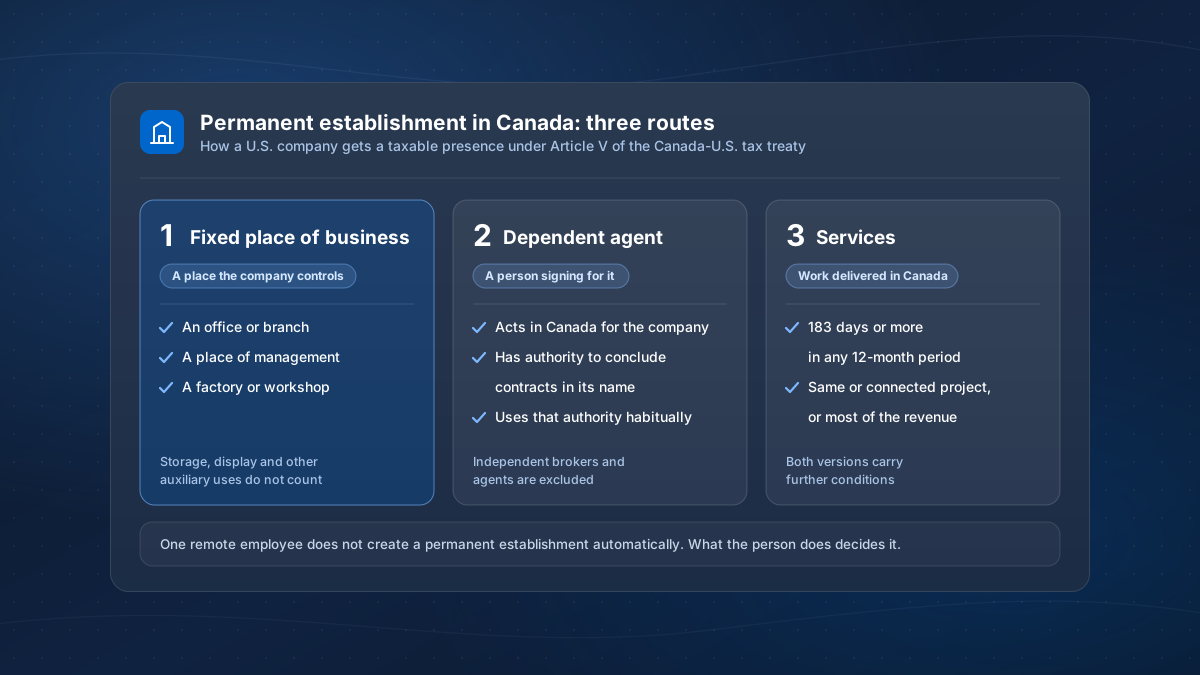
A U.S. company has a permanent establishment in Canada when its presence there is substantial enough for Canada to tax its business profits. Headcount alone does not get it there. An office the company controls, a person who habitually concludes contracts in its name, or a long services project does, each under its own test in the Canada-U.S. tax treaty.
What is a permanent establishment in Canada?
A permanent establishment is the threshold a tax treaty sets before one country may tax the business profits of a company from the other. Article V of the Canada-U.S. tax treaty defines it as “a fixed place of business through which the business of a resident of a Contracting State is wholly or partly carried on.”
The rule that makes this matter is Article VII. A U.S. company’s business profits are taxable only in the United States unless it carries on business in Canada through a permanent establishment, and then Canada may tax only the profits attributable to that permanent establishment.
Two different questions sit behind the term, and they are often mixed up:
- Is the company carrying on business in Canada? This is a question of Canadian domestic law. The Income Tax Act sets a low bar: under section 253, a non-resident that solicits orders or offers anything for sale in Canada through an agent or servant is deemed to be carrying on business in Canada.
- Does the company have a permanent establishment in Canada? This is the treaty question. It decides whether those profits are actually taxed.
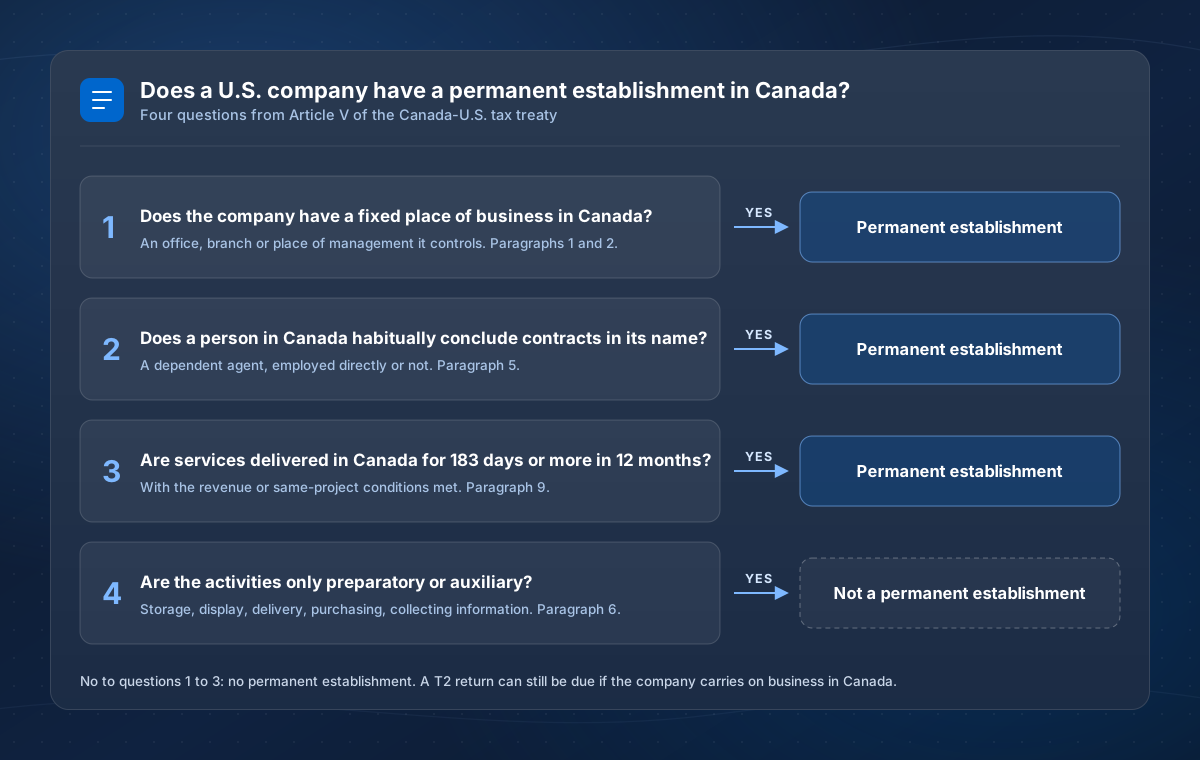
A company can answer yes to the first and no to the second. It then owes no Canadian income tax on its business profits, and still has a return to file.
What creates a permanent establishment under the Canada-U.S. tax treaty?
Article V of the treaty gives three main routes: a fixed place of business, a dependent agent, and services delivered in Canada past a 183-day threshold.
| Route | What the treaty says | Where it shows up |
|---|---|---|
| Fixed place of business (Article V, paragraphs 1 and 2) | A place of management, branch, office, factory or workshop through which the business is carried on | A leased office or a dedicated desk the company controls in Canada |
| Dependent agent (paragraph 5) | A person acting in Canada on the company’s behalf who has, and habitually exercises, authority to conclude contracts in its name | A sales lead in Canada who signs customer agreements |
| Services (paragraph 9) | Services delivered in Canada for 183 days or more in any 12-month period, with further conditions | Consultants or engineers on a long project at a Canadian client’s site |
The services rule has two versions. The first applies when one individual is present in Canada for 183 days or more in a 12-month period and more than 50% of the company’s gross active business revenues come from the services that person performs there. The second applies when services are provided in Canada for 183 days or more in a 12-month period on the same or connected project for customers who are resident in Canada or have a permanent establishment there.
The treaty also lists what does not count:
- Short building projects. A building site or construction project is a permanent establishment only if it lasts more than 12 months (paragraph 3).
- Preparatory or auxiliary activities. A place used only for storage, display, delivery, purchasing or collecting information is not a permanent establishment (paragraph 6).
- Independent agents. Doing business through a broker or other independent agent acting in the ordinary course of its own business does not create one (paragraph 7).
- A subsidiary. Owning a Canadian company does not, by itself, give the U.S. parent a permanent establishment (paragraph 8).
Does a remote employee in Canada create a permanent establishment?
Not by default. A remote employee creates a permanent establishment only when the facts meet one of the tests above, so the same headcount can produce different answers. The three situations below show how the tests sort common roles. They are illustrations, not rulings.
| Situation | Test that matters | How it reads |
|---|---|---|
| A software developer works from home in Ontario on the U.S. company’s product. No customer contact, no authority to sign anything. | Fixed place of business | Lower risk. The company has no office in Canada and nobody concluding contracts there. |
| An account executive in British Columbia negotiates and signs agreements with Canadian customers. | Dependent agent | Higher risk. Habitually concluding contracts in the company’s name is the paragraph 5 test. |
| Three U.S. consultants spend nine months on site at a client in Alberta. | Services | Higher risk. The project passes 183 days in a 12-month period for a Canadian customer. |
Does a home office count as a fixed place of business?
A home office has generally not been treated as the company’s place of business when the company has no right to use it. That view is being tested by newer guidance.
On November 19, 2025, the OECD released an update to the commentary on its model tax treaty. As summarized by the law firm Borden Ladner Gervais in March 2026, the update points to a home office as a possible fixed place of business when two things are true: the person works there for at least 50% of their working time over a 12-month period, and there is a commercial reason for the person to be in that country, such as serving customers there. An employee’s preference to live in Canada, or the employer’s wish to retain them, is not a commercial reason.
Two cautions apply. The commentary interprets the OECD model, not the Canada-U.S. treaty itself, and it does not bind Canadian courts. The same summary notes that Canada filed no objection to the update and that the CRA had not issued a formal statement on applying it as of March 2026. Treat it as the direction of travel, and take a sales or customer-facing role in Canada to a cross-border tax adviser before the hire starts.
What happens if a U.S. company has a permanent establishment in Canada?
The company files a Canadian corporate return and pays Canadian tax on the profits attributable to the permanent establishment. Four consequences follow.
Corporate income tax. The CRA’s corporation tax rates page, as updated in October 2026, gives a basic federal rate of 38%, which is 28% after the federal abatement and 15% after the general tax reduction. The province where the permanent establishment sits adds its own rate: the general rate is 11.5% in Ontario and 12% in British Columbia. Québec and Alberta collect their own corporate income tax; the CRA does not administer it.
Branch tax. The Income Tax Act adds a 25% tax on a non-resident corporation’s Canadian earnings that are not reinvested in Canada. The treaty caps it at 5% for U.S. companies and exempts the first C$500,000 of earnings, counted cumulatively.
Provincial allocation. The Income Tax Regulations use their own definition to assign income to a province. Under section 400, a corporation that carries on business through an employee or agent established in a particular place is deemed to have a permanent establishment there if that person has general authority to contract for it, or holds a stock of its merchandise from which orders are regularly filled.
A return either way. The CRA’s T2 guide says a non-resident corporation has to file a T2 return if it carried on business in Canada at any time in the year, and that this applies even if it claims a treaty exemption. The claim is made on Schedule 91, and the return is due within six months of the tax year-end. A non-resident corporation that files late pays the greater of the ordinary late-filing penalty, which is based on unpaid tax, and a flat amount of C$25 a day for up to 100 days, with a C$100 minimum. When no tax is owing because of the treaty, that is up to C$2,500 a return.
A worked example
Assume a U.S. company’s account executive in Ontario is found to create a permanent establishment, and C$400,000 of profit for the year is attributable to it. At the 2026 rates above:
- Federal tax at 15%: C$60,000.
- Ontario tax at 11.5%: C$46,000.
- Combined: C$106,000, or 26.5% of the attributable profit.
- Branch tax: none on these figures, because earnings are within the treaty’s C$500,000 exemption.
The hard part in practice is step zero: deciding how much profit is attributable to the permanent establishment. That is a transfer pricing exercise for a tax adviser, and this example skips it.
What Canadian obligations apply even without a permanent establishment?
Payroll and withholding duties do not wait for a permanent establishment. They apply to a U.S. company from its first Canadian employee or its first day of services in Canada.
- Payroll. The CRA’s employer guide says that an employer resident outside Canada with no place of business in Canada still has the same responsibilities as a Canadian employer. A U.S. company that employs a Canadian directly registers a payroll account, deducts income tax, Canada Pension Plan contributions and Employment Insurance premiums, and remits them. CRA requirements for U.S. employers lists the registrations and deadlines.
- Services in Canada. Anyone who pays a non-resident for services provided in Canada has to withhold 15% of the fee under Regulation 105 and remit it to the CRA. A Canadian customer paying a U.S. firm for on-site work will withhold it unless the CRA has granted a waiver.
- GST/HST. Registration is a separate test. The CRA’s guide for non-residents, RC4027, says a non-resident that carries on business in Canada has to register if it makes taxable supplies in Canada and is not a small supplier. A small supplier is one whose worldwide taxable supplies are C$30,000 or less in a single calendar quarter and over the last four consecutive calendar quarters. Where the company’s agents or employees are located is one of the factors the CRA lists, and the guide says a company can be carrying on business in Canada for GST/HST without having a permanent establishment there.
- U.S. staff travelling to Canada. Under Article XV of the treaty, a U.S. resident’s pay for work in Canada in a calendar year is exempt from Canadian tax if it is C$10,000 or less for that year, or if the person is in Canada 183 days or fewer in any 12-month period beginning or ending in that year and the pay is not paid by a Canadian resident or borne by a permanent establishment in Canada.
- Withholding on that travel. The U.S. employer still has to withhold unless the employee has a waiver from the CRA or the employer holds a non-resident employer certification from the CRA, which covers employees who work in Canada fewer than 45 days in the calendar year or are present fewer than 90 days in any 12-month period. The certification is valid for up to two calendar years.
Does an employer of record remove permanent establishment risk?
No. An employer of record changes who the employer is. It does not change what the person does for your business, and the treaty tests look at activity.
What an employer of record does change is real. The employer of record is the legal employer in Canada, so it holds the payroll account, makes the remittances, issues the T4 slip and applies the province’s employment standards. The U.S. company has no employees in Canada and no Canadian payroll registration. Employer of Record sets out what InfraDev handles as the employer.
What it leaves untouched is the dependent agent test. Paragraph 5 of Article V refers to “a person” acting on the company’s behalf, not to an employee. A person employed through an employer of record who habitually concludes contracts in the U.S. company’s name raises the same question as a direct employee would. InfraDev is the employer of your hire; it does not give tax advice, and a permanent establishment opinion comes from your tax adviser.
The same reasoning applies to contractors. A genuinely independent contractor serving several clients fits the independent agent exclusion more easily, while a “contractor” who works only for you and signs your deals is a dependent agent in substance, and probably an employee in the CRA’s eyes as well.
If the business needs people in Canada who close contracts, hold inventory or run a Canadian office, the cleaner answer is often a Canadian subsidiary that earns and reports its own profit. EOR vs Canadian entity compares the two routes on cost and timing.
How to lower permanent establishment risk when hiring in Canada
The steps below reduce the chance that a Canadian hire meets one of the treaty tests. None of them replaces advice on your facts.
- Write the role down before the offer. List what the person will do in Canada and for whom. Engineering, support and internal operations sit far from the tests; selling to Canadian customers sits close.
- Keep contract authority in the United States. Have agreements reviewed, approved and signed by someone in the U.S., and say so in the employment agreement and in your approval process. The practice has to match the paper: a person in Canada who negotiates the essential terms, while the U.S. office only countersigns, can still raise the dependent agent question.
- Don’t lease space in the company’s name without advice. An office or dedicated desk that the U.S. company controls is the plainest fixed place of business.
- Count days on Canadian projects. Track the days your people spend delivering services in Canada for each customer, against the 183-day thresholds.
- File what is due. If the company carries on business in Canada, file the T2 return with Schedule 91 each year. A treaty exemption claimed on time is easier to defend than one raised after a CRA letter.
- Review when the role changes. A developer promoted to a customer-facing lead is a new set of facts.
How U.S. companies hire in Canada compares the three hiring routes, and the employer cost calculator shows the payroll cost of a salary by province.
Summary
- A permanent establishment in Canada is the treaty threshold that lets Canada tax a U.S. company’s business profits.
- The Canada-U.S. tax treaty creates one through a fixed place of business, a person who habitually concludes contracts in the company’s name, or services in Canada that pass the 183-day tests.
- One remote employee does not create one automatically. The role, the contract authority and the workplace decide it.
- With a permanent establishment, attributable profit is taxed at 15% federally plus the province’s rate in 2026, and a branch tax of up to 5% can apply above C$500,000.
- Without one, a U.S. corporation carrying on business in Canada still files a T2 return and Schedule 91, and payroll, Regulation 105 withholding and the GST/HST registration test apply regardless.
- An employer of record takes on the employment obligations in Canada. The permanent establishment question stays with the U.S. company and its tax adviser.
Sources
- Department of Finance Canada: Canada-United States Tax Convention, consolidated text (Articles V, VII, X and XV)
- Income Tax Act: section 253, extended meaning of carrying on business, section 150, filing returns, section 162, failure to file and section 219, branch tax
- Income Tax Regulations: section 105, non-residents and section 400, permanent establishment
- CRA: T2 Corporation Income Tax Guide, Before you start (non-resident corporations)
- CRA: Corporation tax rates
- CRA: T4001 Employers’ Guide, Payroll Deductions and Remittances
- CRA: RC4445, Payments to Non-Residents for Services Provided in Canada
- CRA: RC4027, Doing Business in Canada, GST/HST Information for Non-Residents
- CRA: Non-resident employer certification
- Borden Ladner Gervais: Permanent establishment and remote work, the OECD’s 2025 update (March 2026)
This article is general information, not legal or tax advice. Figures are 2026 rates and rules as published by each source in November 2026.
Frequently asked questions
What is a permanent establishment in Canada?
A permanent establishment in Canada is a taxable presence defined by a tax treaty. Under Article V of the Canada-U.S. tax treaty, it is a fixed place of business through which a U.S. company carries on its business in Canada, such as an office or branch, or a person in Canada who habitually concludes contracts in the company's name.
Does one remote employee in Canada create a permanent establishment for a U.S. company?
No, a remote employee in Canada does not automatically create a permanent establishment for a U.S. company. Under the Canada-U.S. tax treaty, one arises only from a fixed place of business of the company, a habit of concluding contracts in its name, or services that pass the 183-day thresholds. The role matters more than the headcount.
Does an employee's home office in Canada count as a permanent establishment?
An employee's home office in Canada is usually not a permanent establishment on its own. OECD guidance updated on November 19, 2025 treats a home office as a possible place of business when the person works there at least half of their working time over 12 months and the company has a commercial reason for them to be there.
Does an employer of record remove permanent establishment risk in Canada?
No, an employer of record does not remove permanent establishment risk in Canada by itself. It takes over the employer's payroll, remittance and employment law duties, so the U.S. company runs no Canadian payroll. Permanent establishment is a separate corporate tax test based on what the person does, such as concluding customer contracts in the company's name.
What tax does a U.S. company pay if it has a permanent establishment in Canada?
A U.S. company with a permanent establishment in Canada pays Canadian corporate income tax on the profits attributable to it: a 15% net federal rate plus the province's rate, 11.5% in Ontario in 2026. A branch tax of up to 5% under the treaty can apply to earnings above a C$500,000 exemption.
Does a U.S. company with no permanent establishment still file a Canadian tax return?
Yes, if it carried on business in Canada. The CRA requires a non-resident corporation that carried on business in Canada to file a T2 return within six months of its year-end, even when a tax treaty exempts its profits. The exemption is claimed on Schedule 91. A late return costs up to C$2,500 when no tax is owing.
Related reading
-
How a U.S. company hires a Canadian independent contractor
A U.S. company can hire a Canadian independent contractor directly, with no Canadian entity and no payroll registration. It needs a role that is genuinely independent, a contract that describes deliverables rather than hours, a Form W-8BEN, and payment against invoices.
Read the article -
Compliance checklist for U.S. companies employing Canadians
A one-page checklist of what a U.S. company must get right when it employs people in Canada: registrations, payroll, provincial employment standards, workers' compensation, contracts, privacy and classification.
Read the article -
Why U.S. companies use an Employer of Record for Canadian employees
The reasons U.S. companies hire Canadian employees through an Employer of Record instead of opening a Canadian entity: speed, no entity to run, compliance carried by a specialist, one invoice, and the flexibility to change course.
Read the article
Next steps for hiring in Canada
Planning a role in Canada?
Tell us the role and the province. We'll explain how we would employ the person in Canada, and which questions to take to your tax adviser first.