
Blog
H-1B alternatives for U.S. employers: when hiring in Canada makes sense
The main alternatives to an H-1B are TN status, an L-1 transfer, an O-1, or employing the person in Canada. How each route works, who qualifies, and what to do when a U.S. visa is not an option.
Published October 31, 2026 · Updated November 6, 2026
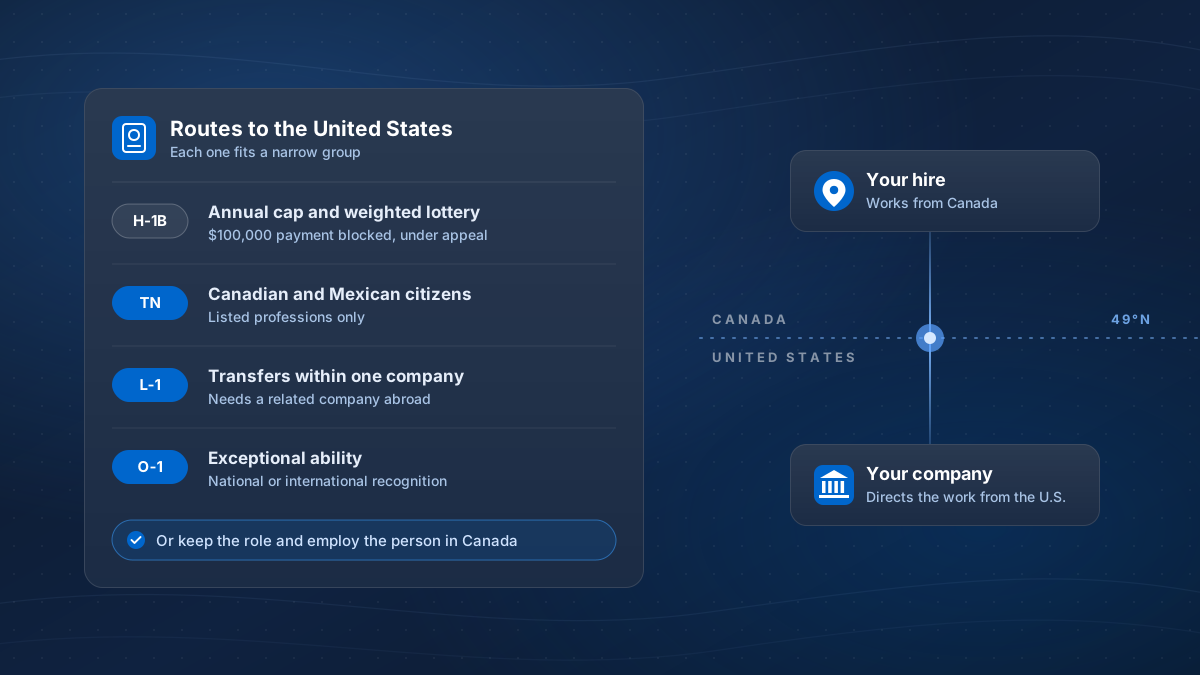
The main alternatives to an H-1B are TN status for Canadian and Mexican citizens, an L-1 transfer within a multinational company, an O-1 for people with exceptional ability, and employing the person outside the United States. The first three bring someone to the U.S., and each fits a narrow group. The fourth keeps the role on your team while the person works from another country. For many U.S. companies that country is Canada: the same time zones, an established technology workforce, and no U.S. work visa, because the work is performed in Canada.
This article explains where the H-1B stands as of October 31, 2026, how the alternatives compare, and which one fits the situations U.S. employers most often face.
Where the H-1B stands in late 2026
Three things make the H-1B hard to plan around right now.
- The cap. The regular cap is 65,000 new visas a year, plus 20,000 for holders of U.S. master’s degrees or higher. USCIS reports that both were reached for fiscal 2027.
- Wage-weighted selection. Since February 27, 2026, selection favors higher pay. A registration at the top wage level enters the pool four times; one at the entry level enters once. Junior hires now have the lowest odds.
- The $100,000 payment. A September 2025 proclamation added a $100,000 payment for certain new petitions, mainly for workers outside the United States, and it was later extended through September 21, 2027. Federal courts in Massachusetts and California have blocked it, so it is not being collected. The government has appealed, and USCIS has said it intends to collect the payment if the orders are lifted.
Separately, the Department of Homeland Security has proposed a $103,265 fee for certain cap-subject petitions. It is not in effect, and no final rule has been issued.
The payment could return, stay blocked or change form. A sound hiring plan works in each of those cases, which is why many employers now look at the alternatives before the next registration season.
How the alternatives compare
| Route | Who it fits | Where the person works | Main limits |
|---|---|---|---|
| TN status | Canadian and Mexican citizens in a USMCA-listed profession, with a job offer from a U.S. employer | United States | Listed professions only; stays of up to three years at a time, which can be extended |
| L-1 transfer | Executives, managers and specialized-knowledge staff moving within one company | United States | Needs a related company abroad and generally one continuous year there in the last three |
| O-1 | People with exceptional ability and national or international recognition | United States | A high evidence bar; few candidates qualify |
| Employer of Record in Canada | People already authorized to work in Canada | Canada | Gives no right to work in the U.S.; the person stays in Canada |
| Your own Canadian entity | Companies committing to Canada, including those able to sponsor a work permit | Canada | Takes time and cost to set up and run; see EOR vs Canadian entity |
Which route fits your situation
The candidate is a Canadian citizen
You have two good options. If the job has to be done in the U.S. and the profession is on the USMCA list, TN status avoids the H-1B lottery. A Canadian can apply at a port of entry with proof of citizenship and a job letter, or the employer can file Form I-129 first. If the job does not have to be done in the U.S., employing the person in Canada avoids the immigration question altogether.
The candidate lives in Canada and can work there
This is the simplest case. A Canadian citizen or permanent resident can start through an Employer of Record, typically within 24–48 hours of agreeing the terms. Someone on a work permit needs a closer look first, because some permits are tied to one named employer.
The candidate is not authorized to work in Canada
Canada is not an automatic fallback for someone on an H-1B, on OPT or living elsewhere. They need Canadian work authorization of their own, and the options are limited for a U.S. company with no presence in Canada:
- Global Talent Stream. This fast-track work permit program is designed for firms in Canada and requires a Labour Market Benefits Plan, so it suits companies with their own Canadian entity.
- A pathway for H-1B holders. Canada’s 2025 federal budget committed to an accelerated pathway, and an IRCC briefing for a House of Commons committee said it would follow. At the time of writing we have not seen eligibility rules or an opening date, and the similar 2023 program closed once it reached its cap. Check IRCC directly before making plans around it.
InfraDev does not provide immigration sponsorship. We employ people who are already authorized to work in Canada, so anyone else should speak with an immigration lawyer first.
The role matters more than the person
Often the real question is not one candidate but where a position should sit. If a lottery result or a possible fee puts a U.S. hire in doubt, ask whether the work has to happen in the U.S. at all. Software, data, infrastructure and many finance and operations roles usually do not. Recruiting in Canada’s technology market can also change the budget: for comparable roles, fully loaded costs are typically 10–40% lower than in the U.S., though that is not guaranteed. Our cost comparison shows what to include.
What changes when the role sits in Canada
Moving a role to Canada replaces a visa problem with a different set of employment rules. Plan for these points:
- The employer. Your company has no U.S. petition to file. Through an Employer of Record, the EOR is the Canadian employer and you direct the day-to-day work. How it works covers who does what.
- Employment law. Canadian employees are not at-will. Written notice or pay in lieu applies, and the rules depend on the province. See our employment law basics.
- Payroll and tax forms. Pay runs in Canadian dollars with CPP and EI in place of Social Security and Medicare, and the year ends with a T4 rather than a W-2. See Canada vs U.S. payroll.
- Worker classification. Engaging the person as a contractor to avoid all of this carries its own risk. See EOR vs contractor.
- Travel to the U.S. Someone working from Canada needs no U.S. work visa for that work. Trips to the U.S. are a separate matter with limits of their own, so confirm what is allowed before anyone travels on business.
Summary
| Situation | Usual next step |
|---|---|
| Canadian citizen, job must be in the U.S. | Check the USMCA profession list for TN status |
| Canadian citizen or permanent resident, job can be remote | Employ them in Canada through an EOR |
| Existing employee at a related company abroad | Assess an L-1 transfer |
| Candidate with no right to work in Canada | Speak with an immigration lawyer before making an offer |
| The role can sit anywhere | Recruit in Canada, where no U.S. visa is needed |
This article is general information as of its publication date, not legal or immigration advice. The H-1B rules above are under active litigation, so confirm the current position with immigration counsel.
If a role could sit in Canada, book a call and we will explain how employment and payroll would work, or read how our Employer of Record service works.
Related reading
-
What hiring a Canadian developer really costs compared with a U.S. hire
How to compare the cost of a Canadian developer with a U.S. hire on a fully loaded basis: salary, employer contributions, benefits, exchange rate and the Employer of Record fee, and why savings of 10–40% are typical rather than guaranteed.
Read the article -
Why U.S. companies use an Employer of Record for Canadian employees
The reasons U.S. companies hire Canadian employees through an Employer of Record instead of opening a Canadian entity: speed, no entity to run, compliance carried by a specialist, one invoice, and the flexibility to change course.
Read the article -
How a U.S. company hires a Canadian independent contractor
A U.S. company can hire a Canadian independent contractor directly, with no Canadian entity and no payroll registration. It needs a role that is genuinely independent, a contract that describes deliverables rather than hours, a Form W-8BEN, and payment against invoices.
Read the article
Next steps for hiring in Canada
Planning a hire in Canada?
Tell us the role and province. We'll explain how employment, payroll and compliance would work for your team.