Contractor vs employee in Canada: how the CRA decides

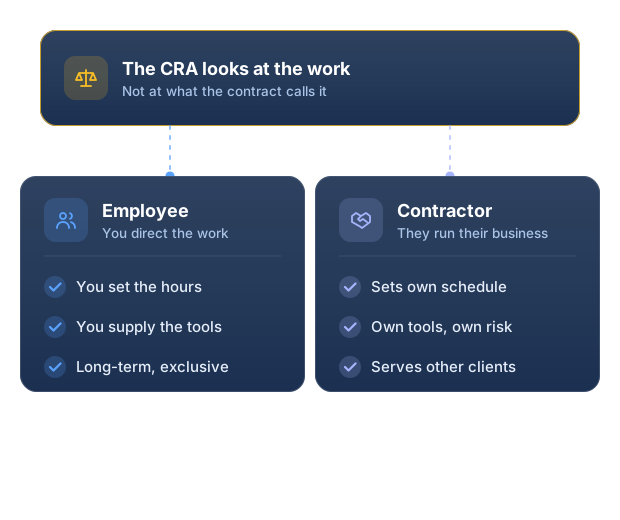
If you direct someone's work, set their hours and supply their tools, the CRA will likely treat them as an employee, whatever the contract says. Employing them through an Employer of Record settles the question; a genuine contractor arrangement suits defined, independent projects.

Published November 22, 2025 · Updated November 6, 2026

How the CRA tells an employee from a contractor

Can a U.S. company hire a Canadian independent contractor?

Yes. A U.S. company can engage a Canadian independent contractor directly, with no Canadian registration, as long as the relationship is genuinely independent. The contractor invoices for the work and pays their own income tax and both shares of CPP. If the company controls hours, methods and tools, the CRA may treat the person as an employee instead.

  • Contract: describe deliverables and fees, not hours, supervision or exclusivity.
  • U.S. paperwork: the contractor is a foreign person for U.S. tax purposes and typically provides a Form W-8BEN; no 1099-NEC is issued.
  • Ongoing check: the CRA judges how the work is actually done, so review the role against the test below as it changes.
  • Step by step: how a U.S. company hires a Canadian independent contractor, from the contract to the first invoice.
  • If the role looks like employment: employ the person through an employer of record, or engage them through InfraDev as a genuine contractor.

Quick Comparison

Key differences at a glance

Contractor vs employee in Canada: how the CRA decides: Quick Comparison
FactorEOR (Employee)Independent Contractor
Legal Relationship Employee-employerClient-contractor
Tax Withholding Automatic (T4)Contractor responsible (T4A)
CPP/EI Contributions Required (employer matches)Contractor pays own CPP
Benefits Can provide benefitsContractor provides own
Control & Direction You control workContractor controls work
Compliance Risk Settled: they are an employeeDepends on how the work is done
Termination Notice/severance requiredContract terms apply
Best For Ongoing work, team integrationProject-based, specialized skills

Detailed Comparison

In-depth analysis of each approach

Legal Classification

EOR (Employee)

  • Clear employee-employer relationship
  • Legally compliant classification
  • No classification question to defend
  • Protected by employment standards
  • Entitled to statutory benefits

Independent Contractor

  • Business-to-business relationship
  • Must meet strict criteria
  • Status depends on how the work is actually done
  • Not protected by employment standards
  • No statutory benefits entitlement

Warning: Misclassifying an employee as a contractor can result in significant penalties, back taxes, and legal issues. Source: Canada Revenue Agency

Tax Implications

EOR (Employee)

  • Automatic tax withholding
  • T4 slip issued annually
  • CPP contributions (employer matches)
  • EI contributions (employer pays 1.4x)
  • No tax surprises for worker

Independent Contractor

  • No tax withholding (T4A if over $500)
  • Contractor files own taxes
  • Contractor pays own CPP
  • No EI contributions
  • Contractor responsible for GST/HST

Source: CRA Payroll Information

Control & Work Relationship

EOR (Employee)

  • You control when, where, how work is done
  • Can set work hours and schedule
  • Can provide equipment and tools
  • Can require specific work methods
  • Full integration into your team

Independent Contractor

  • Contractor controls work methods
  • Contractor sets own schedule
  • Contractor provides own equipment
  • Limited control over how work is done
  • Less team integration

Key Factor: The level of control you exercise is a primary factor in determining employee vs. contractor status. Too much control can trigger reclassification.

Compliance & Risk

EOR (Employee)

  • Payroll, remittances and filings run by the EOR
  • No classification question to defend
  • Employer obligations sit with the EOR
  • Rate and rule changes applied every payroll
  • No failure-to-deduct exposure for you

Independent Contractor

  • You must ensure proper classification
  • Status depends on how the work is actually done
  • Reassessments are addressed to you
  • Must verify contractor status
  • Penalties for misclassification

Penalties: Misclassification can result in back taxes, penalties, interest charges, and legal fees. CRA can audit and reclassify workers retroactively.

Cost Comparison

EOR (Employee)

  • Salary + employer contributions
  • CPP/QPP and EI employer contributions (current rates)
  • Statutory vacation and holiday pay
  • EOR service fee: $499-$1,500/month
  • Benefits (optional)

Independent Contractor

  • Contractor rate (typically higher)
  • No employer contributions
  • No CPP/EI contributions
  • No service fees
  • May charge GST/HST

Note: Contractors can look cheaper on paper. Price in the reclassification exposure below before deciding.

Termination & Severance

EOR (Employee)

  • Notice period required (varies by province)
  • Severance pay may be required
  • Record of Employment (ROE) issued
  • Protected by employment standards
  • EOR handles termination compliance

Independent Contractor

  • Contract terms govern termination
  • No severance required
  • No ROE required
  • Not protected by employment standards
  • You handle contract termination

Source: Federal Employment Standards

How the CRA Decides: The Classification Test

The CRA looks at how the relationship works in practice, not the title on the contract.

Signs of an Employee

  • You decide how, when and where the work is done
  • You supply the laptop, software and other tools
  • They are paid for their time, with no chance of profit or loss
  • They cannot hire helpers or subcontract the work
  • They work mostly or only for you, as part of your team
  • The engagement is ongoing, with no defined end

Signs of a Genuine Contractor

  • They decide how the work is done and deliver a defined result
  • They use their own equipment and pay their own expenses
  • They price the work and carry the risk of a loss
  • They can hire or subcontract to get it done
  • They serve several clients and run their own business
  • They invoice, charge GST/HST where required, and receive a T4A

Quebec applies its own Civil Code test with similar factors. Unsure about a role? The CRA can issue a formal ruling (form CPT1), or you can engage genuine contractors through us with the contract, GST/HST and T4A handled. Source: CRA, Employment status: employee or self-employed.

What Misclassification Costs

If the CRA reclassifies a contractor as an employee

  • Unpaid CPP and EI

    Both shares

    employer and employee

    Assessed against the payer, not the worker

  • Failure to deduct

    10%

    penalty on amounts not withheld

    20% for a repeat failure made knowingly

  • Interest

    Daily

    compounded on unpaid amounts

    Running from the original due date

  • Employment claims

    Notice + severance

    reclassified workers can claim

    Under provincial employment standards

Sources: CRA payroll obligations and employment status guidance. General information, not legal advice.

Sources

InfraDev's team reviews this page twice a year and when a rule it describes changes. General information, not legal or tax advice. How we review our guides · Report an error

Not Sure How a Role Will Be Classified?

Describe the role on a 15-minute call. We'll tell you how it is likely to be classified and whether an EOR or a compliant contractor setup fits.