EOR vs setting up a Canadian entity: cost, timeline and break-even

Use an Employer of Record while you are hiring your first people or your plans are still taking shape; open your own Canadian corporation when your headcount and time horizon justify carrying fixed overhead. Below: setup time, running costs, risk, and how to find your break-even point.

Published November 22, 2025 · Updated November 22, 2026

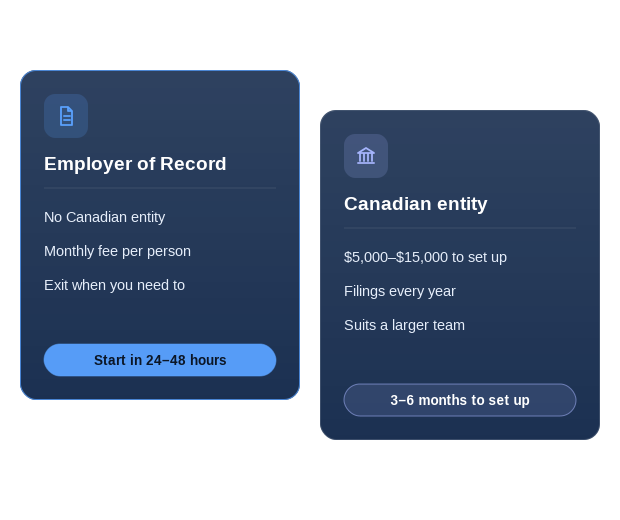
An Employer of Record starting in 24–48 hours beside a Canadian entity taking months to set up

Can we hire in Canada before we set up a Canadian entity?

An employer of record lets you hire in Canada with no Canadian entity. The EOR is the legal employer: it runs payroll and remittances under its own CRA accounts and applies the provincial employment standards, while you choose the person and direct the work. Hires through InfraDev typically start within 24–48 hours of terms being agreed.

How long does it take to set up a Canadian subsidiary?

Incorporating can take a few days. Being ready to run payroll usually takes weeks to a few months, because the corporation then needs a business number and payroll account with the CRA, registration in each province where it will employ people, workers' compensation coverage, a Canadian bank account and a payroll provider. An employer of record can employ your first hires while that work happens.

At what headcount does our own Canadian entity start to cost less?

Your own entity costs less once your yearly entity overhead is lower than the employer of record fees for the same people. Divide the overhead by the yearly fee per employee to get your break-even headcount. Many companies keep an employer of record past that point while their Canadian plans are still taking shape, because the entity's costs are fixed and the EOR's are per person.

Can we start with an employer of record and move to our own entity later?

Starting with an employer of record and moving later is a common path. Once your Canadian entity is registered and running payroll, the employment relationships transfer to it and InfraDev helps with the handover. Timing the move to a pay period, and ideally to the start of a year, keeps the tax slips simple.

Quick comparison

An employer of record and your own Canadian corporation, side by side.

EOR vs setting up a Canadian entity: cost, timeline and break-even: Quick comparison
Employer of recordYour own Canadian entity
Time to first hire 24–48 hours once terms are agreed (InfraDev)Weeks to a few months, until registrations, bank account and payroll are in place
Setup cost No setup feeGovernment filing fees plus legal and accounting help: often several thousand dollars (estimate; quotes vary)
Running cost A fee per employee: InfraDev starts at an estimated 10% of salary (15% above US$200,000), with a minimum of US$499 a monthFixed overhead: annual filings, bookkeeping, payroll provider, HR and legal advice, admin time
CRA payroll account The EOR's, not yoursYours, with remittance deadlines and year-end T4 slips
Provincial registrations Held by the EORYours, in each province where you employ people
Employer obligations Sit with the EOR as legal employerSit with your corporation
Headcount changes Add people one at a time; costs follow headcountOverhead stays the same whether you employ two people or twenty
Fits best First hires, a small team, or plans still taking shapeA large, long-term Canadian team, or business in Canada beyond employing people

Setup and overhead figures for an entity are estimates; ask a Canadian accountant and lawyer for quotes for your structure. InfraDev's fee is a starting estimate, agreed with each client.

What each route involves

Setup, cost, compliance and flexibility, point by point.

Getting set up

Employer of record

  • A service agreement with the EOR
  • The EOR prepares the employment agreement under the province's rules
  • Onboarding and payroll setup under the EOR's accounts
  • No Canadian corporation, bank account or registrations for you

Your own Canadian entity

  • Incorporate federally with Corporations Canada or in a province
  • Register as an extra-provincial corporation in other provinces where you employ people
  • A business number and payroll program account with the CRA
  • In Québec, registration with Revenu Québec for provincial payroll
  • Workers' compensation coverage in each province
  • A Canadian bank account and a payroll provider

Full registration checklist: CRA requirements for U.S. employers.

Running costs

Employer of record

  • One monthly invoice per person: salary, employer contributions and the fee
  • InfraDev's fee starts at an estimated 10% of salary (15% above US$200,000), with a minimum of US$499 a month
  • No setup, deposit or exit fee with InfraDev
  • No entity to keep up or wind down if plans change

Your own Canadian entity

  • The same salary and employer contributions
  • Annual corporate filings and a corporate tax return
  • Bookkeeping, payroll software or a provider, and year-end slips
  • HR and employment-law advice in each province
  • Internal time to manage it all

See every line of an InfraDev invoice on the pricing page, or run one salary through the employer cost calculator.

Compliance and risk

Employer of record

  • Payroll deductions and remittances run under the EOR's accounts
  • Rate changes applied each payroll, including each January
  • CRA and provincial correspondence goes to the EOR
  • You still direct the work and own what the person creates

Your own Canadian entity

  • Your corporation deducts, remits and files on time
  • You track rule changes in each province
  • CRA payroll reviews are addressed to you (CRA payroll obligations)
  • Late remittances bring penalties and interest

Wondering whether a remote employee creates tax exposure for your U.S. company? See permanent establishment in Canada.

Flexibility

Employer of record

  • Costs follow headcount
  • Hire in any province without new registrations
  • Move people to your own entity when you are ready

Your own Canadian entity

  • Overhead stays fixed as headcount changes
  • Each new province can mean new registrations
  • A base for business in Canada beyond employment

Which fits your plans

Most U.S. companies start on the left and some move right as their Canadian team grows.

An employer of record fits if

  • You are hiring your first people in Canada, or a small team
  • You need someone to start in days, not months
  • Your people are in more than one province
  • You would rather not run Canadian payroll and filings yourself
  • Your Canadian plans are still taking shape

Your own Canadian subsidiary fits if

  • Your Canadian team is large and long-term
  • Your yearly entity overhead is below the EOR fees for the same people
  • You will do business in Canada beyond employing people: sales, contracts, property
  • You have, or will hire, people to run Canadian payroll and HR

Find your break-even headcount

Compare the two routes with your own numbers.

  • Your entity overhead

    A

    per year

    Filings, bookkeeping, payroll provider, HR and legal advice, admin time

  • EOR fee per employee

    B

    per year

    For a US$120,000 salary at 10%, about US$12,000

  • Break-even headcount

    A ÷ B

    employees

    Below this number, the employer of record costs less

  • Then weigh

    Time

    to first hire

    Plus setup costs and the cost of waiting to hire

Example: US$60,000 a year of entity overhead ÷ US$12,000 per employee = 5 employees. Your numbers will differ; an estimate, not a quote.

Sources

InfraDev's team reviews this page twice a year and when a rule it describes changes. General information, not legal or tax advice. How we review our guides · Report an error

Want your break-even number?

Share your headcount, provinces and timeline on a 15-minute call. We'll run both routes with your numbers.