
Blog
How a U.S. company hires a Canadian independent contractor
A U.S. company can hire a Canadian independent contractor directly, with no Canadian entity and no payroll registration. It needs a role that is genuinely independent, a contract that describes deliverables rather than hours, a Form W-8BEN, and payment against invoices.
Published November 4, 2026
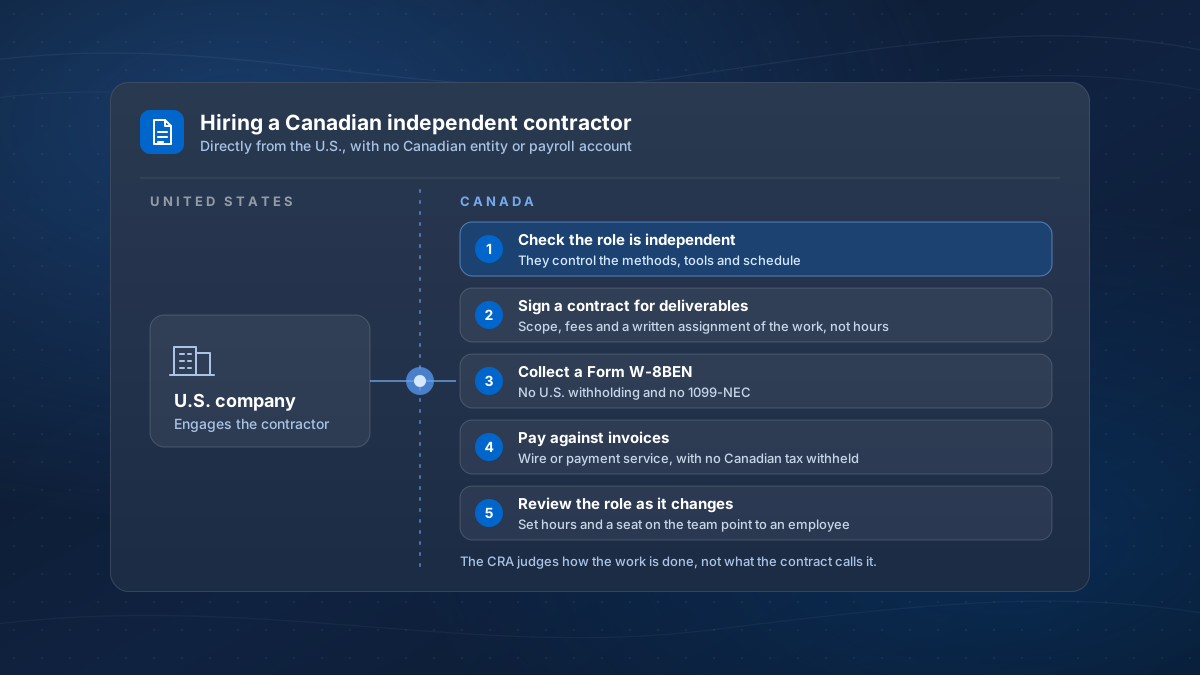
A U.S. company can hire a Canadian independent contractor directly. It needs no Canadian corporation, no CRA payroll account and no Canadian withholding. What it does need is a role that is genuinely independent, because the CRA judges the relationship by how the work is done, not by what the contract calls it.
What you need and what you don’t
| You need | You don’t need |
|---|---|
| A role the contractor controls: defined results, their own methods and tools | A Canadian corporation or branch |
| A written contract describing deliverables, fees and ownership of the work | A CRA business number or payroll account |
| A Form W-8BEN (or W-8BEN-E if they work through a company) | To withhold Canadian income tax, CPP or EI |
| Invoices from the contractor, paid by transfer | To issue a 1099-NEC |
1. Check that the role is genuinely independent
Before anything else, decide whether the work can be done independently. A contractor decides how the work gets done, uses their own equipment, prices the work and can take on other clients. If your company will set their hours, supervise them day to day and fold them into a team, the CRA is likely to see an employee, whatever the contract says.
The contractor vs employee comparison sets out the CRA’s test and what reclassification costs. Québec applies its own test under the Civil Code, with similar factors.
2. Write a contract that matches how the work is done
The contract should describe a business relationship, and the day-to-day work should match it. Include:
- Scope and deliverables: what will be delivered, and by when.
- Fees: a fixed price or rate, how often the contractor invoices, the currency, and who pays expenses.
- Independence: the contractor’s right to choose their methods, use helpers or subcontract, and serve other clients.
- Ownership of the work: under Canada’s Copyright Act, a contractor owns the copyright in what they create unless they assign it in writing. Include a signed assignment, and a waiver of moral rights, which can be waived but not assigned.
- Confidentiality, termination and governing law.
Leave out terms that describe employment: set working hours, exclusivity, paid vacation, benefits, or a manager who directs the work.
3. Collect a Form W-8BEN
A Canadian contractor is a foreign person for U.S. tax purposes. Payments for work they perform in Canada are generally not U.S.-source income, so your company withholds no U.S. tax and issues no 1099-NEC. Collect a Form W-8BEN from an individual contractor, or a W-8BEN-E if they invoice through their own corporation, and keep it on file to document why no 1099 was issued.
4. Pay against invoices
The contractor invoices as the contract sets and your company pays by international wire or an international payment service, with nothing withheld. Agree in the contract which currency applies and who carries exchange-rate movements. How to pay someone in Canada from the U.S. compares the payment routes for contractors and employees.
Whether the invoice includes GST/HST is the contractor’s question, not yours. Many services supplied to a client outside Canada are zero-rated, so a registered contractor may charge no GST/HST on your invoices. Their accountant decides, using the CRA’s GST/HST rules.
5. Review the role as it changes
Classification can change over time. A six-month project that becomes an open-ended role, with set hours and a seat on the team, can turn a contractor into an employee without anyone signing anything new. Review the arrangement whenever the work changes, and before renewing the contract.
If a role is genuinely unclear, either party can ask the CRA for a formal ruling on form CPT1.
What if the role is really a job?
If the person will work like an employee, hire them as one. A U.S. company can employ someone in Canada through an employer of record, which becomes the legal employer and runs Canadian payroll, or by registering as an employer with the CRA itself. If the work is genuinely independent but you would rather not hold the contract directly, InfraDev can engage the consultant as the Canadian party and handle the agreement, invoicing and GST/HST.
Summary
- A U.S. company can hire a Canadian independent contractor directly, with no Canadian entity, payroll account or withholding.
- The role must be genuinely independent: the CRA looks at how the work is done, not the contract’s title.
- The contract should describe deliverables and fees, assign ownership of the work in writing, and leave out employment terms.
- Collect a W-8BEN (or W-8BEN-E), pay against invoices, and issue no 1099-NEC.
- Review the arrangement whenever the work changes; if it has become a job, employ the person through an employer of record.
Sources
Related reading
-
How to pay someone in Canada from the U.S.
How a U.S. company pays someone who works in Canada depends on whether they are an employee or a contractor. Employees are paid through Canadian payroll, with income tax, CPP and EI withheld and remitted to the CRA. Genuine contractors invoice and are paid by bank transfer, with no Canadian tax withheld.
Read the article -
W-2 and 1099 vs the Canadian T4 and T4A: what U.S. companies should know
How the Canadian T4 and T4A compare with the U.S. W-2 and 1099-NEC: what each slip reports, when it is due, what it says about the employment relationship, and why a 1099-style contractor in Canada is often an employee.
Read the article -
Compliance checklist for U.S. companies employing Canadians
A one-page checklist of what a U.S. company must get right when it employs people in Canada: registrations, payroll, provincial employment standards, workers' compensation, contracts, privacy and classification.
Read the article
Next steps for hiring in Canada
-
How it works
The steps from your chosen candidate to their first payroll, and who does what.
-
Employer of Record
How InfraDev employs your hire in Canada so you don’t need a Canadian entity.
-
Estimate your costs
Deductions, filings and overhead for your role and province, not only the salary.
-
Compare your options
EOR, your own Canadian entity, or contractors: cost, timeline and risk.
-
Hiring in Canada guide
Payroll, CRA registration and employment law for U.S. companies.
Planning a hire in Canada?
Tell us the role and province. We'll explain how employment, payroll and compliance would work for your team.