
Blog
Non-compete agreements in Canada: what a U.S. employer can still enforce
Non-compete agreements in Canada are mostly unenforceable for employees. Ontario has banned them since October 25, 2021, except for executives and the sale of a business. Québec allows one only in writing and within strict limits. Elsewhere, courts presume them unenforceable unless the employer proves they are reasonable.
Published November 18, 2026
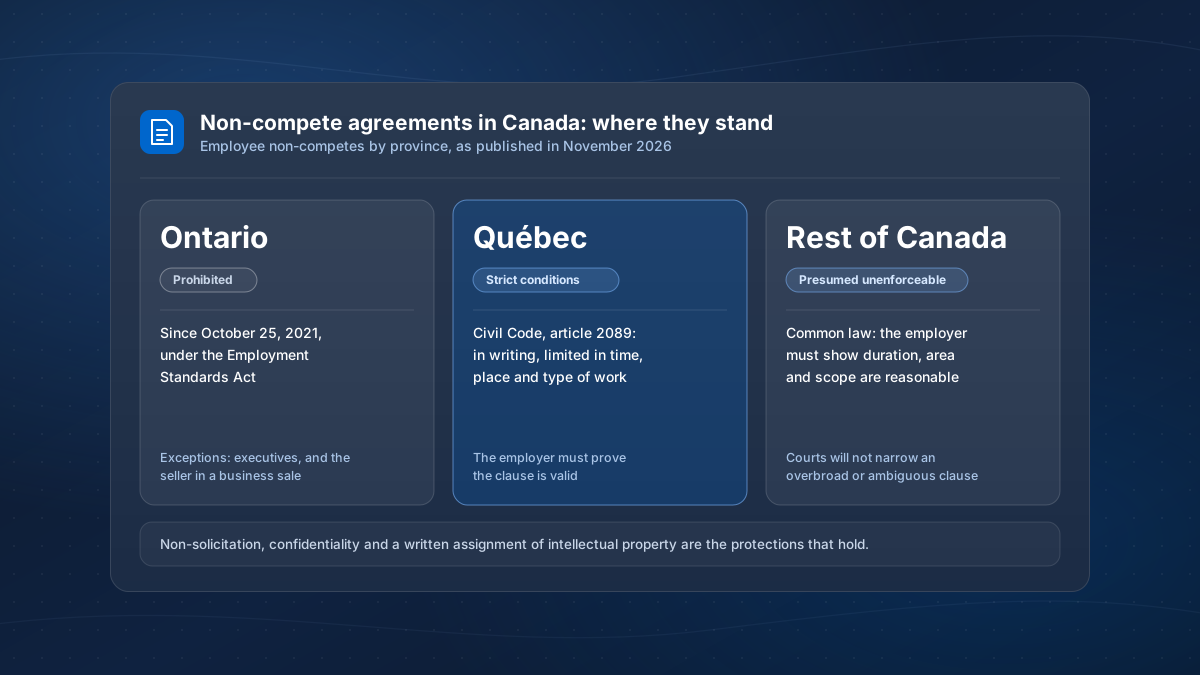
Non-compete agreements in Canada are mostly unenforceable against employees. Ontario has prohibited them since October 25, 2021, except for executives and the sale of a business. Québec allows one only in writing and within strict limits. In the other provinces, courts presume a non-compete unenforceable unless the employer proves it is reasonable.
What are non-compete agreements in Canada?
A non-compete agreement is a contract term that stops an employee, after the job ends, from working for a competitor or starting a competing business. Ontario’s guide to the Employment Standards Act defines it that way, and adds that a clause can be a non-compete whether or not it is limited in time or area.
It belongs to a family of clauses that Canadian lawyers call restrictive covenants. Four of them matter to a U.S. employer:
- Non-compete: the former employee may not compete with the employer, usually for a period and within an area.
- Non-solicitation: the former employee may not actively pursue the employer’s clients, customers or employees.
- Confidentiality (non-disclosure): the employee may not share or use the employer’s confidential information, during or after the job.
- Intellectual property assignment: the employee’s work product belongs to the employer, or is assigned to it in writing.
The distinction matters because Canadian law treats them very differently. A U.S. template that bundles all four under one heading can lose the one clause that would have held. Ontario’s guide makes the same point from the other side: what decides whether a clause is a non-compete is its substance, not its heading.
For a U.S. company, the starting point is also different. The Federal Trade Commission’s rule banning most non-competes never took effect: its rule page says a district court stopped enforcement on August 20, 2024, and the FTC took steps to dismiss its appeal on September 5, 2025. Canada’s limits come from provincial law and the courts instead, and they follow the province where the employee works. The Canadian employment law basics page explains why the province governs.
Are non-compete agreements enforceable in Canada?
Rarely, for employees. The answer depends on the province: a statutory ban in Ontario, a code with strict conditions in Québec, and a court-made presumption against them everywhere else.
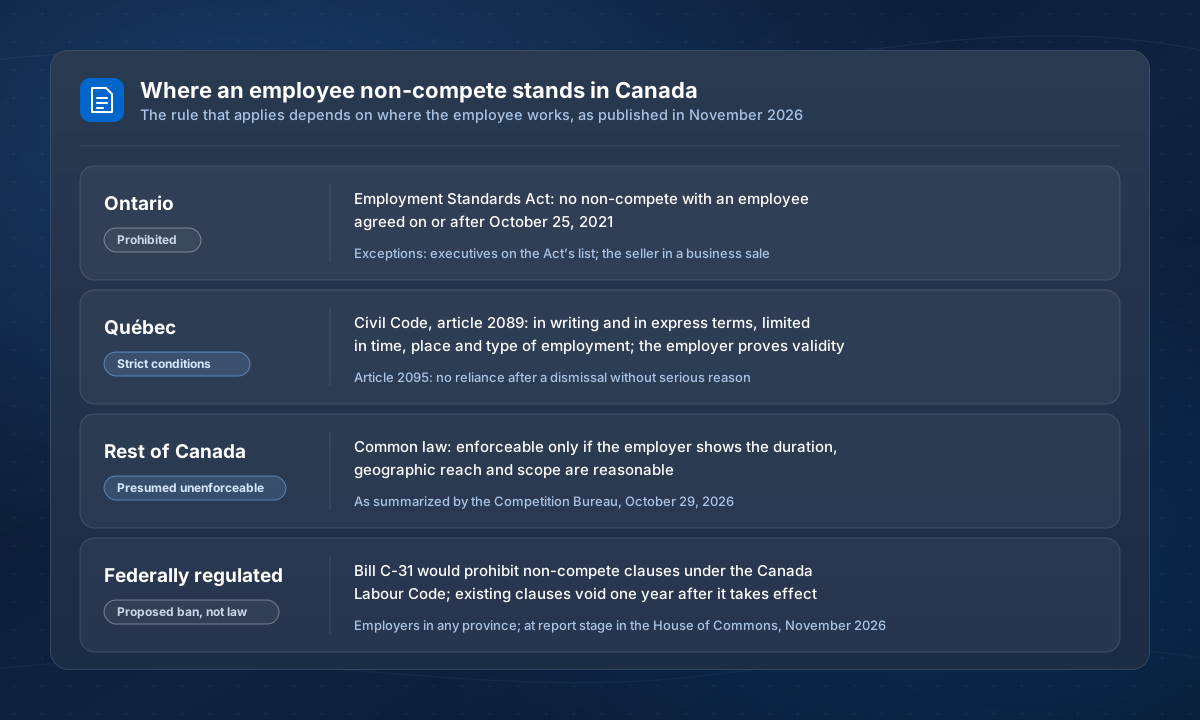
| Where the employee works | Rule on employee non-competes | Source |
|---|---|---|
| Ontario | Prohibited for agreements made on or after October 25, 2021, except executives and the seller in a business sale | Employment Standards Act, as explained in the province’s guide |
| Québec | Valid only if written, express and limited in time, place and type of employment; the employer must prove validity | Civil Code of Québec, articles 2089 and 2095 |
| Other provinces and territories | Presumed unenforceable unless the employer shows the duration, area and scope are reasonable | Common law, as summarized by the Competition Bureau in October 2026 |
| Federally regulated employers | No ban in force; Bill C-31 would prohibit them, with exceptions | Bill C-31, at report stage in November 2026 |
The common-law test is strict. The Competition Bureau’s open letter of October 29, 2026 summarizes it: employment non-competes are presumed unenforceable unless the employer can justify the restriction and show that its duration, geographic reach and scope are reasonable. It cites the Supreme Court of Canada’s decision in Shafron v. KRG Insurance Brokers (Western) Inc. for that rule.
The same letter reports how common these clauses still are. Citing OECD surveys commissioned in 2025, it says Canadian employers report that 29% to 39% of private-sector employees are covered by a non-compete, and that 30% of firms using them apply them to every employee. The Bureau encouraged the other provinces and territories to consider rules like Ontario’s.
Will a court narrow an overbroad non-compete?
No. A court will not rewrite an overbroad or ambiguous non-compete into a reasonable one; it refuses to enforce it. That is the practical lesson of Shafron, a 2009 Supreme Court of Canada decision summarized in Osgoode Hall Law School’s commentary.
- No reading down. The Court held that “notional” severance, reading an unreasonable clause down to what would have been reasonable, does not apply to restrictive covenants in employment contracts. Otherwise an employer could draft broadly and let the court trim the excess.
- Striking words only rarely. “Blue-pencil” severance, deleting words, is available sparingly, and only for a part that is clearly severable, trivial and not central to the covenant.
- Ambiguity is fatal. The clause in Shafron covered the “Metropolitan City of Vancouver”, an area with no clear meaning, so the employer could not show it was reasonable and the covenant failed.
- A business sale is different. Courts scrutinize a non-compete in an employment contract more closely than one given by the seller of a business, who is paid for goodwill and bargains on more equal terms.
Can an employer in Ontario use a non-compete agreement?
No, not with an ordinary employee. Since October 25, 2021, Ontario’s Employment Standards Act has prohibited employers from entering into employment contracts or other agreements with an employee that include a non-compete agreement.
The province’s guide to non-compete agreements sets out how far the ban reaches:
- Before, during and after the job. The prohibition covers an agreement with a job applicant, with a current employee, and with a former employee.
- Limits do not save it. A six-month restriction, or one limited to 100 km of the workplace, is still a non-compete.
- Two exceptions only. The ban does not apply to an executive, meaning a person who holds the office of chief executive officer, president, chief administrative officer, chief operating officer, chief financial officer, chief information officer, chief legal officer, chief human resources officer, chief corporate development officer or any other chief executive position. It also does not apply to the seller of a sole proprietorship or partnership who becomes the buyer’s employee immediately after the sale and signs the non-compete as part of it.
- Older agreements. The Act does not prohibit non-compete agreements made before October 25, 2021, although the guide says employees may have greater rights under the common law.
- Enforcement. Employees, applicants and former employees can file a claim with the province’s labour ministry. Penalizing someone for refusing to sign a prohibited non-compete counts as a reprisal.
The exception for executives applies to the office, not the salary. A principal engineer or a vice-president of sales in Toronto is not an executive under that list, however senior the role.
Contractors sit outside Ontario’s statute. The Employment Standards Act defines a non-compete as an agreement between an employer and an employee, so the ban does not govern a genuine independent contractor, whose covenants the courts still test for reasonableness. Whether the person really is a contractor is a separate question, covered in EOR vs contractor.
Is a non-compete clause valid in Québec?
It can be, within the conditions of article 2089 of the Civil Code. The clause must be in writing and in express terms, and limited in time, place and type of employment to what is necessary to protect the employer’s legitimate interests. The employer carries the burden of proving it is valid.
Two more articles of the Civil Code of Québec, and the way article 2089 itself is read, shape how the clause works in practice:
- Article 2095: a dismissal can cancel it. An employer cannot rely on a non-competition clause if it ended the contract without a serious reason, or if it gave the employee a serious reason to leave.
- Article 2088: confidentiality survives by law. An employee must act faithfully and honestly and must not use confidential information obtained through the work. These duties continue for a reasonable time after the contract ends, and permanently where the information concerns the reputation and privacy of others.
- Article 2089 applies to each limit separately. A clause with no geographic limit, or one covering every kind of work, does not meet the article’s terms.
Article 2095 is the one U.S. employers tend to miss. A restructuring that ends a Montréal employee’s job without a serious reason can leave the employer unable to rely on the clause it drafted. The post on hiring an employee in Québec covers the French-language contract and the province’s other rules.
Which clauses still protect a U.S. employer in Canada?
Non-solicitation, confidentiality and a written assignment of intellectual property. They protect what a non-compete is usually meant to protect (client relationships, information and work product), and Ontario’s ban does not reach them.
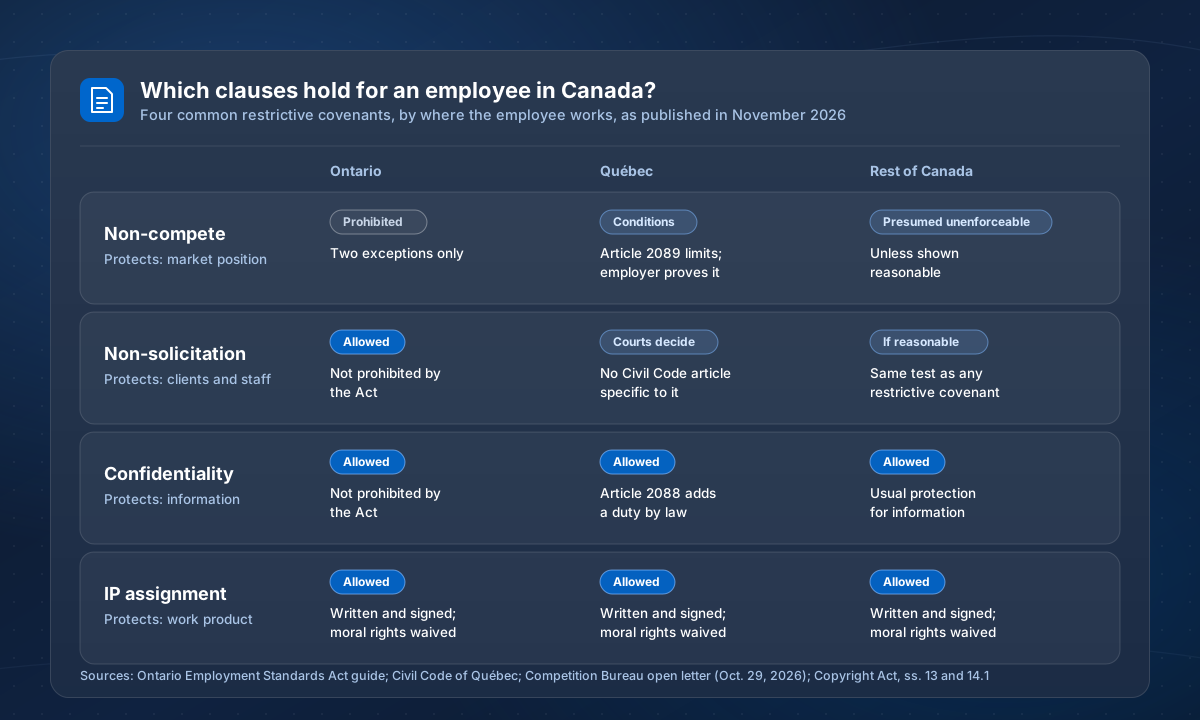
| Clause | What it protects | Ontario | Québec | Other provinces and territories |
|---|---|---|---|---|
| Non-compete | Market position | Prohibited, with two exceptions | Allowed within article 2089’s limits | Presumed unenforceable unless reasonable |
| Non-solicitation | Clients, customers and staff | Not prohibited by the Act | No Civil Code article specific to it | Must be shown reasonable, like any restrictive covenant |
| Confidentiality | Information and processes | Not prohibited by the Act | Also a duty under article 2088 | Allowed |
| Intellectual property assignment | Code, designs and documents | Allowed | Allowed | Allowed |
Non-solicitation. Ontario’s guide says the Employment Standards Act does not prohibit non-solicit agreements, and gives an example: a clause headed “Non-Competition” that only bars the former employee from contacting the employer’s customers is, in substance, a non-solicit. The guide also says employees may have greater rights under the common law, and the rule the Competition Bureau quotes from Shafron applies to any restrictive covenant, so the clause still needs a reasonable scope and period.
Confidentiality. A non-disclosure clause is allowed in every province. In Québec, article 2088 adds a duty that applies whether or not the contract has one.
Intellectual property. Section 13(3) of the Copyright Act makes the employer the first owner of copyright in a work made in the course of employment, unless an agreement says otherwise. Section 13(4) requires an assignment of copyright to be in writing and signed by the owner. Under section 14.1, the author’s moral rights cannot be assigned, only waived, so a careful contract includes a waiver.
A worked example: one U.S. template, three provinces
The scenario is illustrative. A U.S. software company hires three senior engineers in 2026, one each in Toronto, Montréal and Calgary. Its U.S. offer letter includes a 12-month non-compete covering North America, a 12-month non-solicitation clause, a confidentiality clause and an invention assignment.
- Toronto. The non-compete is prohibited, because none of the engineers holds an office on Ontario’s executive list. The non-solicitation, confidentiality and assignment clauses are not touched by the Employment Standards Act.
- Montréal. The non-compete has a period and an area, so article 2089 is in play, but the employer would have to prove that 12 months, North America and every kind of competing work are no broader than its legitimate interests require. If the company later ends the job without a serious reason, article 2095 stops it from relying on the clause.
- Calgary. The common-law presumption applies. A court would ask whether 12 months across North America is reasonable for this engineer’s role, and the employer would have to show it is. If it is too broad, the court will not cut it down to a shorter period or a smaller area.
- The fix that works in all three. Drop the non-compete from the template for anyone below an executive office, keep a non-solicitation clause scoped to clients and colleagues the engineer actually worked with, keep confidentiality, and make the intellectual property assignment and moral rights waiver explicit and in writing.
One contract drafted for one province can also fail in another for reasons unrelated to non-competes. The probation period and termination clauses follow the same rule: the province where the employee works decides.
What does Bill C-31 change for non-competes?
Nothing yet. Bill C-31, the Budget 2025 Implementation Act, No. 2, would add a ban on non-compete clauses to the Canada Labour Code for federally regulated employers. As of its last recorded activity on November 4, 2026, it was at report stage in the House of Commons.
The bill’s page on LEGISinfo shows first reading on May 6, 2026, second reading on June 3, 2026 and committee consideration completed on October 30, 2026. As amended in committee, Division 9 of Part 4 would:
- Prohibit the clause. An employer could not agree to, impose or induce a non-compete clause, and the clause would be void, or null in Québec.
- Keep a short list of exceptions. A person who sells or transfers a federal business and immediately becomes the buyer’s employee; a chief executive officer; the only holder of certain offices reporting directly to the chief executive, such as president, chief financial officer or chief technology officer, provided the person is a manager; and other positions reporting to the chief executive that the government names by regulation.
- Reach other clauses by regulation. The ban would also cover any “other employment-related restriction” in a class the government specifies by regulation, so clauses beyond non-competes could later be caught for federally regulated employers.
- Give existing clauses a year. Clauses already in effect would become void one year after the prohibition takes effect.
- Start on a date the government sets. The division would come into force by order of the Governor in Council, not on Royal Assent.
The bill would apply only to federally regulated employers, so a U.S. company hiring in a provincially regulated industry stays under its province’s rule. It is a signal, though. The Competition Bureau’s October 2026 letter encourages every province and territory to consider similar reforms.
How do restrictive covenants work through an employer of record?
The employer of record is the legal employer, so the restrictive covenants sit in the employment contract between it and the employee, and the province’s limits apply to that contract. What the U.S. company needs is a written chain showing how confidential information and work product reach it.
Two points follow from the Copyright Act. The first owner of copyright in work made in the course of employment is the employer, which here is the employer of record. The assignment to the U.S. company therefore has to be written into the contracts, and section 13(4) requires it to be signed. Check that the employment contract and the service agreement between your company and the employer of record cover confidentiality, assignment of work product and a waiver of moral rights.
With InfraDev as the employer, the employment contract is drafted for the employee’s province, and the Employer of Record page sets out what we handle as the employer. The compliance checklist for employing Canadians lists the other contract terms to settle before the first day, and the post on converting a Canadian contractor to an employee covers carrying confidentiality over from a contractor agreement.
Summary
- Non-compete agreements in Canada are mostly unenforceable for employees, and the rule depends on the province where the employee works.
- Ontario has prohibited them since October 25, 2021, except for executives on the Act’s list and the seller in a business sale.
- Québec’s Civil Code allows one only in writing, limited in time, place and type of employment, with the burden of proof on the employer and no reliance after a dismissal without serious reason.
- Elsewhere, courts presume them unenforceable unless the employer shows they are reasonable. Bill C-31 would ban them for federally regulated employers, but was not law in November 2026.
- Non-solicitation, confidentiality and a written intellectual property assignment with a moral rights waiver are the protections that hold.
Sources
- Ontario: Your guide to the Employment Standards Act, Non-compete agreements (updated July 8, 2024)
- Civil Code of Québec, articles 2088, 2089 and 2095
- Competition Bureau: Open letter to provinces and territories on non-compete agreements and news release (October 29, 2026)
- Parliament of Canada, LEGISinfo: Bill C-31 (45-1) and the bill text as amended in committee (Part 4, Division 9)
- TheCourt.ca, Osgoode Hall Law School: Beware Ambiguity, on Shafron v. KRG Insurance Brokers (Western) Inc., 2009 SCC 6 (January 27, 2009)
- Copyright Act, section 13 and section 14.1
- U.S. Federal Trade Commission: Noncompete Rule
This article is general information, not legal advice. It reflects each source as published in November 2026; have an employment lawyer in the employee’s province review any restrictive covenant before it is signed.
Frequently asked questions
Are non-compete agreements enforceable in Canada?
Non-compete agreements are rarely enforceable against employees in Canada. Ontario prohibits most of them by statute. Québec's Civil Code allows one only in writing and within strict limits. In the other provinces, courts presume an employee non-compete unenforceable unless the employer proves its duration, area and scope are reasonable.
Can an employer in Ontario use a non-compete agreement with an employee?
No, an employer in Ontario cannot enter into a non-compete agreement with an employee on or after October 25, 2021. The Employment Standards Act allows two exceptions: executives such as the chief executive officer or chief financial officer, and a seller who becomes the buyer's employee immediately after selling a business.
Is a non-compete clause valid in Québec?
A non-compete clause can be valid in Québec if it meets article 2089 of the Civil Code. It must be in writing and in express terms, and limited in time, place and type of employment to what protects the employer's legitimate interests. The employer must prove it is valid, and loses it on a dismissal without serious reason.
Are non-solicitation and confidentiality clauses allowed in Canada?
Yes, non-solicitation and confidentiality clauses are allowed in Canada, including in Ontario, where the Employment Standards Act prohibits only non-compete agreements. A court can still refuse to enforce an unreasonable non-solicitation clause. In Québec, article 2088 of the Civil Code keeps an employee bound by confidentiality for a reasonable time after the job ends.
What does Bill C-31 change for non-compete agreements in Canada?
Bill C-31 would prohibit non-compete clauses for federally regulated employers under the Canada Labour Code, with exceptions for a chief executive, certain executives reporting to the chief executive, and the sale of a business. As of November 2026 it is at report stage in the House of Commons and is not law.
Who owns the work a Canadian employee creates for a U.S. company through an employer of record?
Under section 13(3) of Canada's Copyright Act, the employer is the first owner of copyright in work an employee makes in the course of employment, unless an agreement says otherwise. Through an employer of record, the legal employer is the employer of record, so the contracts should pass the rights to the U.S. company in writing.
Related reading
-
Converting a Canadian contractor to an employee: a guide for U.S. companies
A U.S. company can convert a Canadian contractor to an employee without opening a Canadian entity: an employer of record employs them, or the company registers as an employer with the CRA. The work is in six steps: review the history, set the salary, settle the service date, sign a provincial agreement, close the contract and start payroll on day one.
Read the article -
Hiring an employee in Québec: what U.S. companies should know
What changes when your Canadian hire lives in Québec: French job offers and contracts, payroll through Revenu Québec, Québec labour standards, and Law 25.
Read the article -
Compliance checklist for U.S. companies employing Canadians
A one-page checklist of what a U.S. company must get right when it employs people in Canada: registrations, payroll, provincial employment standards, workers' compensation, contracts, privacy and classification.
Read the article
Next steps for hiring in Canada
Hiring in Canada and worried about what leaves with the hire?
Tell us the role and the province. We'll explain which clauses the employment contract can carry there, and how your company's confidential information and work product are protected.