A U.S. company wants to hire you but isn't set up in Canada: what to say
When a U.S. company says it would like to hire you but is not set up in Canada, the hire is not over. The company cannot run Canadian payroll from the United States, and it does not have to. A Canadian employer of record can employ you on its behalf. Say so, send the short email below, and keep applying for U.S. roles.
Published November 14, 2026
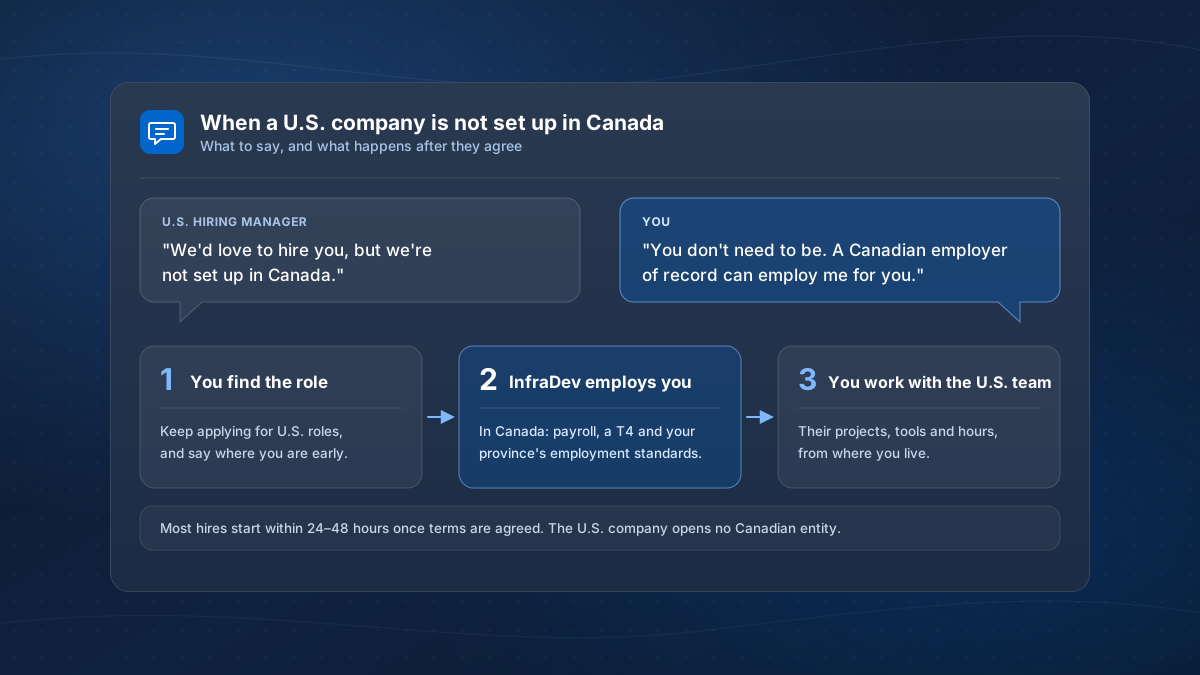
“We’d love to hire you, but we’re not set up in Canada” sounds like a no. It is a payroll problem, and a solvable one. A U.S. company that is not set up in Canada can still hire you: a Canadian employer of record employs you on its behalf, and you work with the U.S. team as planned. Your part is to say so.
Why U.S. companies say they are not set up in Canada
They say it because their payroll stops at the border. A U.S. payroll withholds U.S. taxes. It does not deduct Canadian income tax, Canada Pension Plan (CPP) contributions or Employment Insurance (EI) premiums, and those are owed when the work is done in Canada.
The CRA’s employers’ guide is direct about it: non-resident employers with employees working in Canada “are subject to the same withholding, remitting, and reporting obligations as Canadian resident employers.” To employ you directly, the company would register a payroll account with the CRA, remit deductions on the CRA’s schedule, issue your T4 and follow the employment standards of your province.
Most hiring managers have never done that, so they assume the only alternative is to open a Canadian company. That takes months and a budget nobody approved for one hire: EOR vs Canadian entity compares the two. The recruiter is not rejecting you. They are telling you they don’t know the third option.
Do U.S. companies hire Canadians?
Yes. U.S. companies hire Canadians who live in Canada, and they do it in three ways: through an employer of record, through a Canadian subsidiary if they have one, or by engaging an independent contractor. Working for a U.S. company from Canada compares the three and explains which country taxes the income.
So keep applying for U.S. roles. A posting that says “U.S. only” often reflects where the company’s payroll runs, not a view on Canadian candidates. Two habits help:
Say where you are early. One line in your application saves a surprise at the offer stage: “I’m based in Ontario and can be employed through a Canadian employer of record, so you don’t need a Canadian entity to hire me.”
Bring the answer with the problem. A hiring manager who hears “not set up in Canada” from legal or finance needs something to send back. The email below is that something.
What to say when a U.S. company is not set up in Canada
Say that the company does not need to be set up in Canada, because a Canadian employer of record can employ you for it. In a conversation, one sentence is enough:
“You don’t need a Canadian entity to hire me. A Canadian employer of record can employ me on your behalf and handle the payroll and compliance, and I’d work with your team exactly as we discussed. Can I introduce you?”
The objection comes in a few versions. Each has the same answer.
What you hear
What it usually means
What to say
”We’re not set up in Canada.”
No Canadian payroll account and no Canadian entity
”You don’t need either. An employer of record in Canada employs me for you."
"We can only hire in the U.S.”
The payroll provider or policy covers U.S. employees only
”I wouldn’t be on your payroll. The employer of record pays me in Canada and bills you."
"Legal says we’d have to open a Canadian company.”
Nobody has looked at alternatives
”An employer of record exists for this case. They can explain it to legal in 15 minutes."
"Could you just invoice us as a contractor?”
The company wants the simplest route for itself
”For an ongoing role on your team, I’d rather be an employee. An employer of record makes that as simple for you as an invoice.”
An email you can copy
Send this to the hiring manager or recruiter. Replace the parts in brackets.
If the reply is “send me more”, Employer of Record covers pricing and what the U.S. company signs, and how it works shows the steps.
What being employed through an employer of record means for you
It means you are an employee in Canada, with a Canadian employer on paper and a U.S. team in practice. The employer of record signs your employment agreement and carries the legal duties of an employer. The U.S. company decides your work.
Employer of record (InfraDev)
U.S. company
On your employment agreement
Yes, as your employer in Canada
No
Pays you, deducts and remits
Yes
No, it pays the employer of record
Issues your T4
Yes
No
Applies vacation, holidays and notice
Yes, under your province’s rules
Agrees the terms of your offer
Sets your priorities, hours and tools
No
Yes
Decides your salary and any group benefits
Administers them
Yes
In practical terms:
Pay in Canadian dollars. Your salary is stated and paid in Canadian dollars, on Canadian payroll.
Deductions at source. Income tax, CPP contributions (Québec Pension Plan contributions in Québec) and EI premiums come off each pay. Your employer adds its own share: it matches your CPP contribution and pays 1.4 times your EI premium.
A T4. Employers have to give employees their T4 slips by the last day of February of the following year, so filing your return works as it would with any Canadian employer.
Vacation and holidays under your province’s rules. In Ontario, Québec and Alberta the minimum is two weeks of vacation a year with vacation pay of at least 4% of wages, rising to three weeks and 6% with longer service. Public holidays are separate: Ontario has nine.
Notice if the job ends. Provincial standards set minimum notice or pay in its place. In Ontario, an employee who has been employed for at least three months is entitled to notice of termination or termination pay.
Employment Insurance. EI regular benefits require insurable employment. As an employee you are in it, and your employer issues a record of employment if your earnings are interrupted.
Group benefits, where offered. Health and dental cover depends on what the U.S. company chooses to include in your offer. Ask about it when you discuss salary.
Employee or contractor: why “just invoice us” is not always the better deal
A contractor’s rate can look higher than a salary and still leave you with less. As a contractor you run a business: nobody deducts tax for you, you pay both halves of your pension contributions, and the employment standards that protect employees do not apply.
Employee through an employer of record
Independent contractor
Income tax
Deducted from each pay
You set it aside and pay it yourself
CPP
You pay half and your employer pays half
You pay both halves
EI
Insurable employment, with premiums shared with your employer
Special benefits if you register, after a 12-month wait
Vacation, holidays, notice
Provincial minimums apply
Only what your contract says
Year-end
T4 slip
Your own records as a self-employed person
GST/HST
Does not apply to a salary
You may have to register once revenue passes $30,000 over four calendar quarters
Three points deserve a closer look.
Pension contributions. The CRA’s rates page shows the difference in one line. In 2026 the maximum base CPP contribution is $4,230.45 for an employee and $8,460.90 for a self-employed person, because a self-employed person pays “both the employer and employee contribution.”
Protection if the work stops. Ontario’s guide to the Employment Standards Act says the Act “does not apply to independent contractors”. That means no statutory vacation pay, no public holiday pay and no notice. EI regular benefits, the ones paid when a job ends, require insurable employment. The EI program for self-employed people provides special benefits such as maternity, parental and sickness benefits, and the agreement has to be active for at least 12 months before a claim.
The label does not decide your status. The CRA says “all of the facts, including the actual terms and conditions of employment, determine a worker’s employment status.” If you work under the company’s direction, on its schedule and with its tools, you may be an employee whatever the contract says. Either party can ask the CRA for a ruling, by June 29 of the year after the year in question.
Contracting is the right choice for genuinely independent work: your own business, several clients, your own methods and the chance of profit or loss. For an ongoing role inside one U.S. team, employment usually describes the job more accurately. Contractor vs employee in Canada explains how the CRA tells the two apart, and the worked example after this article puts an employee’s pay stub beside a contractor’s invoice for the same annual amount.
What happens after the U.S. company says yes
Once the company agrees to use an employer of record, the remaining steps are short. Through InfraDev they run like this.
The introduction. You connect the hiring manager with InfraDev. A 15-minute call covers cost, timing and what the company signs.
Terms are agreed. The U.S. company confirms your role, salary in Canadian dollars, province and start date, and signs a service agreement with InfraDev.
You receive a Canadian employment agreement. It names InfraDev as your employer, records the terms the U.S. company offered, and follows the employment standards of your province.
You send your onboarding details. Your employer needs your social insurance number within three days of your start, a federal Form TD1 and, where it applies, the provincial form, plus your banking details for direct deposit.
You start. Most hires start within 24–48 hours once terms are agreed and documents are in. You work with the U.S. team from day one.
Your first pay. InfraDev runs payroll and pays you in Canadian dollars. Your pay statement shows gross pay and each deduction.
After that, the arrangement is quiet. Your manager is at the U.S. company. Questions about pay, time off or your agreement go to InfraDev.
If you hold a work permit or a study permit
Canadian citizens and permanent residents can work for any employer. Permit holders need to check before accepting, because an employer of record is a new employer in Canada.
Open work permit. IRCC describes it as a permit that “lets you work for any employer in Canada”, with a short list of exceptions.
Employer-specific work permit. It lets you work under the conditions on the permit, which include the employer. IRCC says a holder who wants to change jobs or employers must apply for a new work permit.
Study permit. Eligible students can work off campus up to 24 hours a week during regular terms, and IRCC treats remote work for an employer outside Canada differently from off-campus work in Canada. How your arrangement is classified matters.
These rules change, and this is not immigration advice. Confirm your own situation with Immigration, Refugees and Citizenship Canada before you sign.
Still looking? Join the talent network
If you have not found the role yet, InfraDev can help with that too. Our talent network has more than 1,000 Canadian professionals, and U.S. companies we work with send us job descriptions to share with it.
Roles are announced to people in the relevant field.
You are presented to a client only for roles you have said you want. Nobody browses the network.
If you are hired, InfraDev employs you in Canada and you work with the U.S. team.
“We’re not set up in Canada” describes a payroll gap. A U.S. company does not need a Canadian entity to hire you.
Say that a Canadian employer of record can employ you on the company’s behalf, and send the email above.
Through an employer of record you are an employee in Canada: paid in Canadian dollars, with deductions at source, a T4 and provincial employment standards.
A contractor pays both halves of CPP, up to $8,460.90 in 2026, and has no statutory vacation, holidays or notice.
Through InfraDev, most hires start within 24–48 hours once terms are agreed.
Work permit and study permit holders should confirm their conditions with IRCC first.
This article is general information, not legal, tax or immigration advice. Amounts are in Canadian dollars and are 2026 figures as published by each government in November 2026.
A worked example: the same $100,000, paid two ways
An employee’s pay stub beside a contractor’s invoice for the same annual amount in Ontario.
Pay statement · Example
Employee, Ontario
Pay frequency
Every two weeks
Pays a year
26
Rates
2026
Earnings and deductions for one pay, with the full-year total
Earnings
This pay
Full year
Regular salary
$3,846.15
$100,000.00
Deductions
1Income tax, federal and Ontario
−$770.17
−$20,024.35
2CPP and CPP2 contributions
−$178.71
−$4,646.45
3EI premiums
−$43.20
−$1,123.07
Net pay
$2,854.08
$74,206.13
4Employer's share, paid on top of salary
Employer contributions for one pay, with the full-year total
CPP and CPP2, employer share
$178.71
$4,646.45
EI, employer share (1.4×)
$60.47
$1,572.30
5Remitted to the CRA
$1,231.25
$32,012.61
Illustrative, in Canadian dollars, using 2026 rates with income tax simplified. CPP and EI stop once the yearly maximums are reached, so per-pay amounts here are averages over the year.
Contractor invoice · Example
Self-employed contractor, Ontario
Billing
Monthly
Invoices a year
12
Rates
2026
Contractor fees for one invoice, with the full-year total
Fees
This invoice
Full year
Fees for services
$8,333.33
$100,000.00
Withheld by the client
AIncome tax, CPP and EI
$0.00
$0.00
Paid to the contractor
$8,333.33
$100,000.00
The contractor pays on their own
What the contractor pays themselves over the year
BCPP and CPP2, both shares
$774.41
$9,292.90
Income taxPaid by instalments and at tax time
Own return
CEmployment Insurance
Not covered
Illustrative, in Canadian dollars, using 2026 rates. CPP shown on the full fee amount; a contractor's actual base is net business income after expenses. GST/HST is added to the invoice if the contractor is registered.
A
Who withholds An employer withholds income tax, CPP and EI from every pay. A client withholds nothing from a contractor’s invoice.
B
Pension contributions A contractor pays both the employee and employer shares of CPP and CPP2 on their own net earnings, when they file their tax return.
C
Employment Insurance Contractors are not covered by EI by default; they can opt in to EI special benefits only.
D
Year-end slips The employee gets a T4. The contractor may get a T4A for fees over $500, and reports the income as self-employed.
Frequently asked questions
Do U.S. companies hire Canadians who live in Canada?
Yes. U.S. companies hire Canadians who live and work in Canada, and it is legal when the person is entitled to work in Canada. The company needs a way to employ or pay the person in Canada: an employer of record, its own Canadian entity, or an independent contractor agreement for genuinely independent work.
What should I say when a U.S. company says it is not set up to hire in Canada?
Tell the hiring manager that the company does not need a Canadian entity to hire you. A Canadian employer of record can employ you in Canada on the company's behalf, run Canadian payroll and apply your province's employment rules, while you work with the U.S. team. Then offer to make the introduction.
What does being employed through an employer of record in Canada mean for the worker?
Being employed through an employer of record in Canada means the employer of record is your legal employer and the U.S. company directs your daily work. You are paid in Canadian dollars with income tax, pension contributions and Employment Insurance premiums deducted, you receive a T4 slip, and your province's employment standards apply.
Is it better to be an employee or a contractor when working for a U.S. company from Canada?
Neither is better in every case. An employee in Canada has tax deducted from each pay, an employer that shares pension and Employment Insurance costs, and provincial vacation, holiday and notice rules. A contractor invoices, pays both halves of Canada Pension Plan contributions and has none of those protections. The CRA decides status from the facts.
Will I get a T4 if I work for a U.S. company from Canada?
Yes, if you are an employee in Canada. A person employed through an employer of record or by a Canadian subsidiary receives a T4 slip by the last day of February for the previous calendar year. An independent contractor does not receive a T4 and reports the income as self-employed.
How long does it take to start working for a U.S. company through InfraDev?
Most hires through InfraDev start within 24–48 hours once the U.S. company and InfraDev have agreed terms and the new employee has sent the required documents. InfraDev issues the Canadian employment agreement and runs payroll, so the U.S. company has nothing to register in Canada.
Can I work for a U.S. company through an employer of record on a Canadian work permit?
A Canadian work permit holder can, if the permit allows it. An open work permit lets you work for any employer in Canada, with limited exceptions, while an employer-specific permit sets conditions that include the employer. An employer of record is a new Canadian employer, so check your permit's conditions with Immigration, Refugees and Citizenship Canada first.
Payroll, CRA registration and employment law for U.S. companies.
Have an offer from a U.S. company?
Send your hiring manager our Employer of Record page, or book a 15-minute call together. We'll explain how we would employ you in Canada and what the company needs to do.