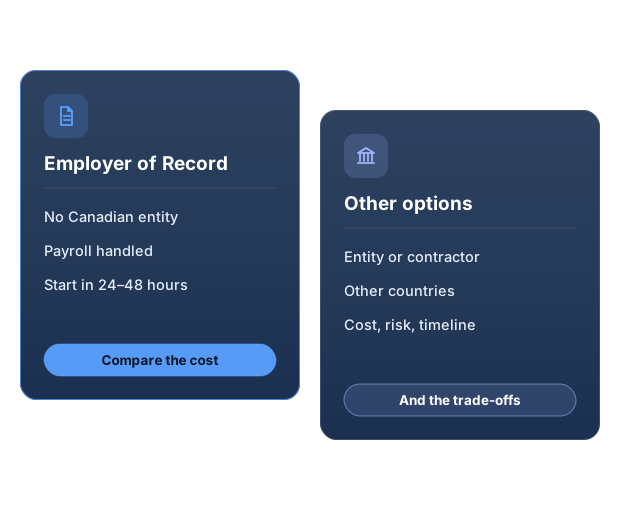
A global employer of record fits if…
- You hire in many countries and want one contract and one dashboard for all of them
- Canada is one market among several, not the main one
- Your HR team already runs a global platform and wants Canada inside it

Choose an employer of record in Canada on who the legal employer is, how the fee and the payroll money work, whether it knows each province, how fast a hire can start, and how employment ends. Ask every provider the same seven questions below, then compare the answers on the scorecard.
Published November 22, 2026
The best employer of record in Canada for a U.S. company is the one that employs your hire through its own Canadian company, shows every line of its invoice, applies each province’s rules, including Québec’s, and can start your hire within days. Ask every provider the same questions, score the answers side by side, and the choice usually makes itself.
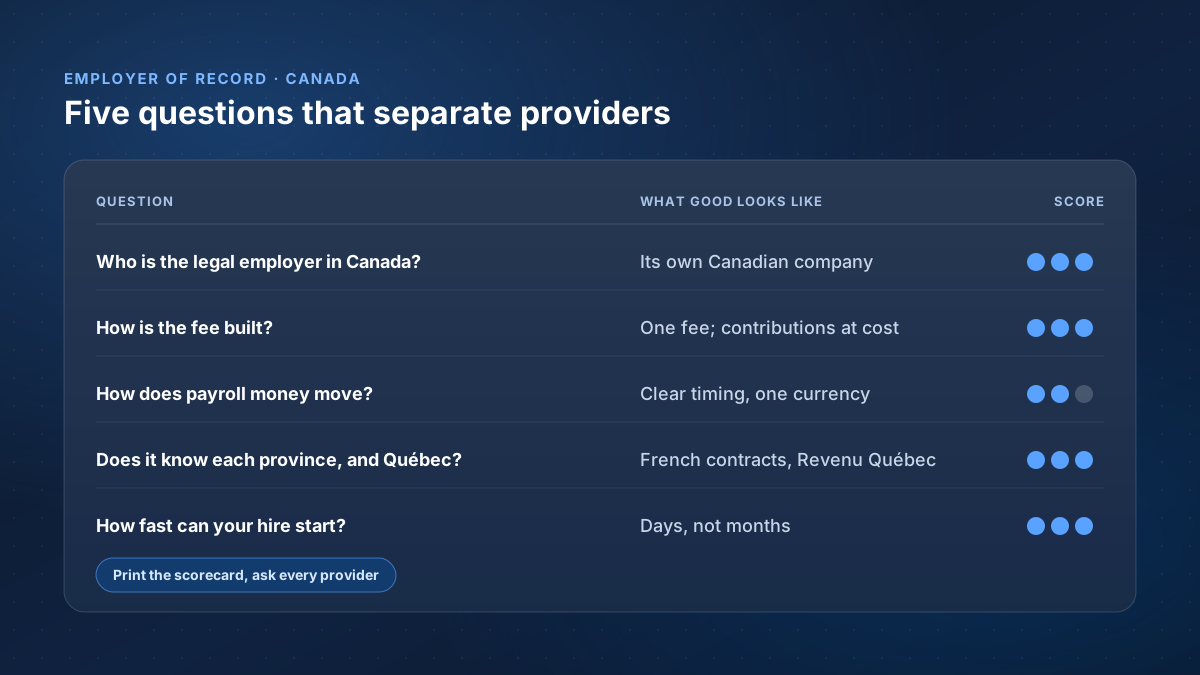
For each one: why it matters, and what a good answer sounds like.
The legal employer signs the contract, answers to the CRA and the provincial regulators, and carries the employer’s obligations. Some providers employ through a partner company in certain countries, which adds a party you never chose.
A good answer: Its own Canadian company, named in the agreement, in every province.
A flat fee favours high salaries; a percentage favours lower ones. Margins hidden in contributions, setup fees and exit fees change the real cost.
A good answer: One clear fee; salary and statutory contributions passed through at cost; no surprises at the start or the end.
Your hire is paid on schedule only if the money is in place first. Timing, currency and exchange rates decide what you actually pay and when.
A good answer: A stated funding date before each pay run, one invoice, and the currency set in the agreement.
Employment standards, payroll and workers’ compensation are provincial. Québec adds French contracts, Revenu Québec, QPP, QPIP and CNESST.
A good answer: Registered for payroll and workers’ compensation where your hire works, with Québec handled in-house.
A strong candidate with competing offers won’t wait for registrations. If you have no candidate yet, finding one is half the job.
A good answer: A start within days of agreeing terms, and a way to source people if you need them.
Engagements change. You want a clear, lawful way to close an employment when the work ends, and to move people across if you open your own Canadian company.
A good answer: Terms that match your engagement, and help transferring staff to your entity later.
Code, designs and inventions should belong to you, and employee data crosses a border.
A good answer: Work product assigned to you in every agreement; documented security and privacy practices.
Print it, ask employer of record companies in Canada the same questions, and score the answers from 1 to 3. InfraDev's answers are filled in, so you can hold us to them.
| Question | InfraDev | Provider A | Provider B |
|---|---|---|---|
| Who is the legal employer in Canada? | Infradev Consulting Inc., our own Canadian company, employs every hire in every province. No partner employer in between. | ||
| How is the fee built? | Starting at an estimated 10% of salary, from US$499 a month, agreed with each client. Contributions at cost. No setup fee, deposit or exit fee. | ||
| How does payroll money move? | You pay one monthly invoice before payday, normally in U.S. dollars, so your hire is always paid on time in Canadian dollars. | ||
| Does it know each province, and Québec? | Every province and territory. Based in Beaconsfield, Québec, so Québec’s rules are the ones we work under ourselves. | ||
| How fast can your hire start, and can it find them? | Usually within 24–48 hours of agreeing terms. No candidate? We present people from our network of more than 1,000 Canadian professionals, usually within a week. | ||
| How does employment end, and can it move to your own entity? | Employment usually runs on a fixed-term agreement that matches your engagement and is renewed as the work continues. When you open your own entity, we help transfer the employment. | ||
| Who owns the work, and how is data protected? | Every agreement assigns work product and inventions to your company. Our certifications and insurance are listed below. |
Book 15 minutes and put the scorecard to us directly. We'll answer each question for your role and province, with the estimated monthly invoice.
Both are legitimate choices. Which one fits depends on where your people are.
Independently certified management systems, backed by corporate liability and cyber security insurance.
ISO 9001
Quality management
CertifiedISO/IEC 27001
Information security management
CertifiedISO/IEC 42001
AI management
CertifiedInsured
Corporate liability and cyber security insurance
CoveredCommon questions from U.S. companies comparing employers of record.
A global employer of record suits a company hiring in many countries that wants one contract for all of them. A Canadian employer of record suits a company whose hires are mainly in Canada: the provider is usually the legal employer itself, knows each province, including Québec, and can often help find the person as well as employ them.
Ask who the legal employer is, how the fee is built, how and when payroll is funded, how it handles each province and Québec, how fast a hire can start, how employment ends or moves to your own entity, and who owns the work your hire produces. Score each answer side by side for every provider.
An employer of record (EOR) is the legal employer of your hire in a country where you have no entity. A professional employer organization (PEO) co-employs staff alongside a company that already has its own entity there, sharing HR and payroll duties. For a U.S. company with no Canadian entity, EOR vs PEO usually means an EOR.
InfraDev is Canadian-owned and based in Beaconsfield, Québec, since 2016. Its own Canadian company, Infradev Consulting Inc., is the legal employer of every hire, in every province and territory, with no partner employer in between.
InfraDev’s employer of record fee starts at an estimated 10% of salary, from US$499 a month per employee, with salary and statutory contributions billed at cost and no setup, deposit or exit fee. Other providers price differently, so compare the full monthly invoice, not the headline fee. See pricing.
The InfraDev fee and an estimated monthly invoice for a US$120,000 hire.
What InfraDev does as your hire’s legal employer in Canada.
When your own company starts to pay off, and the break-even headcount.
No candidate yet? We present people from our network, usually within a week.
Tell us the role and the province. We'll answer the scorecard for your hire and confirm the cost and timing on a 15-minute call.