
Outsourcing to Canada: key benefits for U.S. companies
U.S. companies outsource to Canada because it combines lower employment costs, typically 10–40% below comparable U.S. roles, with shared time zones, a familiar business culture and legal system, and, through an employer of record, no Canadian entity to set up.
Published November 27, 2025 · Updated November 22, 2026
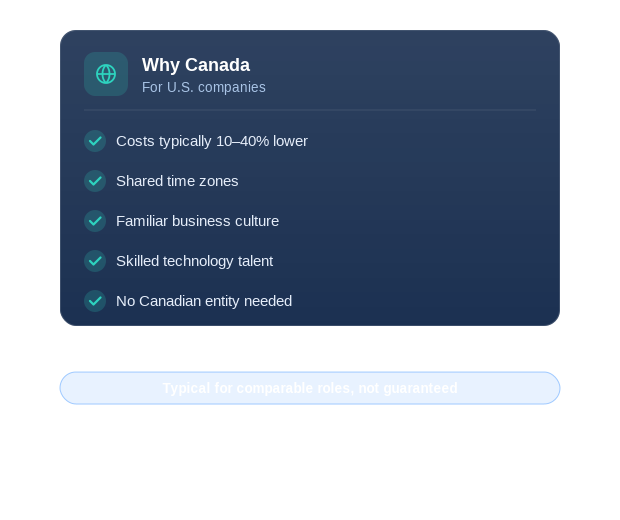
Top benefits of outsourcing to Canada
What a Canadian developer costs
Indicative salary ranges in U.S. dollars. Actual pay depends on the city, the specialty and experience.
| Level | Canada | United States |
|---|---|---|
| Junior developer | $50,000–$70,000 | $70,000–$85,000 |
| Mid-level developer | $70,000–$100,000 | $100,000–$130,000 |
| Senior developer | $100,000–$120,000 | $140,000–$180,000 |
Add employer contributions and benefits on both sides and total savings typically run 10–40% for comparable roles; they are typical, not guaranteed. See the full cost comparison, or price one salary in the employer cost calculator.
Have a role you want filled in Canada?
Send us the role. We present people from our network of more than 1,000 Canadian professionals, or recruit, and then employ your hire in Canada, usually within 24–48 hours of agreeing terms.
Nearshore vs offshore: Canada and other outsourcing destinations
For a U.S. company, Canada is nearshore outsourcing: the same time zones and a short flight. Here is how it compares when you outsource software development further away.
-
Canada vs India
India offers lower costs; Canada offers time zone alignment, cultural compatibility, more consistent quality, and more experience with North American business practices.
-
Canada vs Eastern Europe
Eastern Europe has strong engineering talent, but works six to ten hours ahead of U.S. time zones. Canada works your hours, with no language barrier and a more familiar legal framework.
-
Canada vs U.S. domestic hiring
Typical savings of 10–40% for comparable roles, with similar quality and cultural fit. Shared time zones and a familiar legal framework make it feel close to domestic hiring.
-
Canada vs an H-1B hire
When the H-1B cap or the uncertainty around it blocks a hire, the person can work for your team from Canada with no U.S. visa, employed through an employer of record.
Frequently asked questions
Common questions about outsourcing to Canada.
How much can I save by outsourcing to Canada?
U.S. companies typically save 10–40% on employment costs when hiring Canadian talent compared to equivalent U.S. positions. The exact savings depend on the role, location, and specific requirements; savings are typical, not guaranteed.
How do U.S. companies outsource to Canada without a Canadian company?
Through an employer of record such as InfraDev, which employs the people you choose in Canada and handles payroll, taxes, employment compliance and HR administration, while you manage the work. Your company forms no Canadian entity, and a hire can start within 24–48 hours of agreeing terms.
What types of roles can I outsource to Canada?
U.S. companies outsource a wide range of technical and professional roles to Canada, including software developers, cloud engineers, DevOps specialists, data analysts, project managers, QA engineers, UI/UX designers and support staff. Canada has strong talent pools in software development, AI and machine learning, cloud computing and modern web technologies.
How does the quality of Canadian talent compare to U.S. talent?
Canadian talent is highly skilled and often comparable to U.S. talent in technical expertise, education, and experience. Canada has strong computer science programs, growing tech hubs, and professionals who work with modern technologies and frameworks.
What are the time zone advantages of outsourcing to Canada?
Most of Canada shares a time zone with most of the United States, enabling real-time collaboration during normal business hours. Teams communicate instantly and hold meetings during overlapping hours, without the delays common with offshore outsourcing. See which provinces share your time zone.
Is outsourcing to Canada legal for U.S. companies?
Canadian employment law permits third-party employers (EORs) to hire workers on behalf of foreign companies. As long as you're not recruiting or employing U.S. workers inside the United States, hiring Canadian talent through an EOR is a compliant and widely used approach.
Can our Canadian staff work from an office?
Staff employed or contracted through InfraDev can work from its office in Beaconsfield, Québec, up to five days a week, and access to your systems or data can be limited to that office where your security requirements call for it. See Host your hire.
How this page is reviewed
InfraDev's team reviews this page twice a year and when a rule it describes changes. General information, not legal or tax advice. How we review our guides · Report an error
Ready to build your team in Canada?
Tell us the roles and the provinces. We'll confirm salaries, total cost and timing on a short call.