Canada vs U.S. hiring costs compared

Hiring a software developer in Canada typically costs 10–40% less than a comparable U.S. hire once salary, employer payroll contributions and benefits are counted. Below: how to compare for your own role, a worked example for a senior developer, and the costs on each side of the border.

Published November 22, 2025 · Updated November 22, 2026

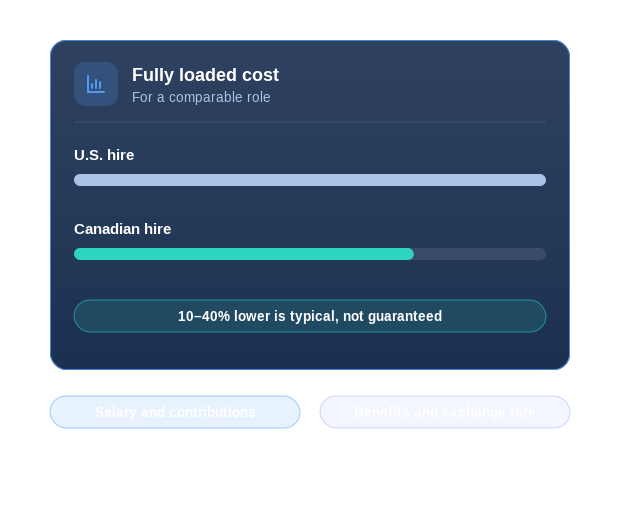
Fully loaded cost of a U.S. hire beside a lower Canadian hire, typically 10–40% lower

How much cheaper is it to hire a developer in Canada than in the U.S.?

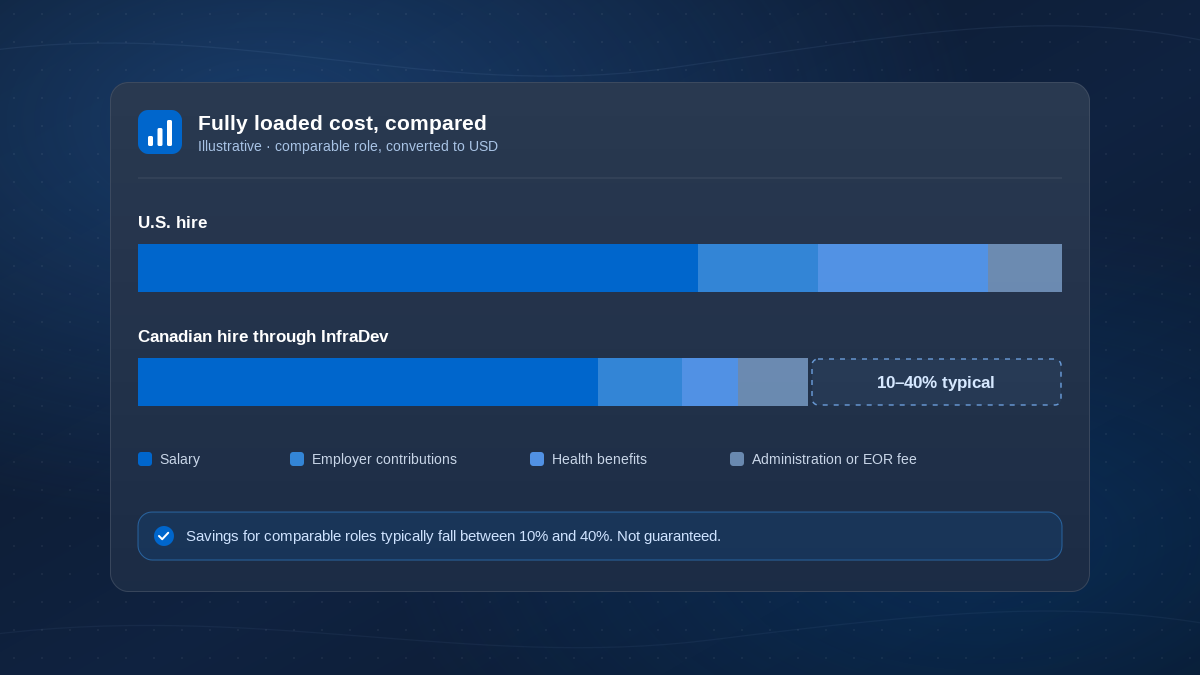
A software developer employed in Canada typically costs 10–40% less than a comparable U.S. hire, counting salary, employer payroll contributions and benefits. The gap is widest against high-cost U.S. tech hubs and narrower against lower-cost states. The 10–40% range is typical, not guaranteed: province, seniority, exchange rate and benefits all move it.

What should a U.S. company count when comparing Canadian and U.S. hiring costs?

The fully loaded cost on both sides: salary, employer social contributions, workers' compensation, health and retirement benefits, paid time off and employment administration. Convert the Canadian total at a conservative exchange rate and add the employer of record fee. Comparing salary alone overstates the gap.

An illustrative fully loaded cost comparison of a U.S. hire and a Canadian hire through InfraDev

How to compare for your own role

  1. Pick the role and level, and the U.S. city you would otherwise hire in.
  2. Get salary data for both markets from a current salary survey or recruiter, for the same experience.
  3. Add employer contributions and benefits on each side, line by line, using the table below.
  4. Convert the Canadian total to U.S. dollars at your budget rate.
  5. Add the employer of record fee to the Canadian side, or entity costs if you would hire directly.
  6. Compare, then test the result at a less favourable exchange rate.

A worked example: one senior developer, two countries

The full annual cost to the employer, line by line, for a senior developer in the United States and in Ontario.

Employer cost · Example

Senior developer, United States

Currency
USD
Period
One year
Annual employer cost of a U.S. senior developer
Base salary$160,000
Social Security (6.2%)$9,920
Medicare (1.45%)$2,320
Unemployment insurance, estimated at 1%$1,600
Health insurance$10,000
401(k) match (4%)$6,400
Total annual cost$190,240

Employer cost · Example

Senior developer, Ontario

Currency
USD
Period
One year
Annual employer cost of a Canadian senior developer
Base salary$120,000
CPP and CPP2, employer share$3,319
EI, employer share (1.4×)$1,123
Workers’ compensation (0.3%)$360
Extended health benefits$2,500
RRSP match (4%)$4,800
Total annual cost$132,102

$58,138 less a year in Canada in this example, about 31%

Illustrative. Canadian CPP, CPP2, EI and workers’ compensation use 2026 rates for Ontario, converted at about 1.40 Canadian dollars to the U.S. dollar. U.S. lines use statutory Social Security and Medicare rates, with unemployment insurance, health insurance and retirement matches as stated assumptions. Actual costs depend on the state or province, salary, exchange rate and benefits; savings for comparable roles are typically 10–40%, not guaranteed.

Quick cost comparison

Total annual cost of employment, in U.S. dollars.

Canada vs U.S. hiring costs compared: Quick cost comparison
PositionU.S. total cost (USD a year)Canada total cost (USD a year)Savings (USD a year)
Junior developer $85,000–$100,000$60,000–$75,000$25,000–$30,000 (30–35%)
Mid-level developer $120,000–$150,000$85,000–$110,000$35,000–$40,000 (25–30%)
Senior developer $160,000–$200,000$110,000–$140,000$50,000–$60,000 (30–35%)
Lead or principal developer $200,000–$250,000$140,000–$180,000$60,000–$70,000 (30–35%)

Note: Illustrative ranges based on 2024 salary surveys. Costs include base salary, employer contributions (CPP and EI in Canada, Social Security and Medicare in the U.S.) and typical benefits. Actual savings vary with location, experience and the benefits package.

What to count: the fully loaded cost, line by line

Build both sides the same way. Base salary is the biggest line, but not the whole cost.

Canada vs U.S. hiring costs compared: What to count: the fully loaded cost, line by line
Cost lineU.S. hireCanadian hire through an employer of record
Base salary In U.S. dollarsIn Canadian dollars, converted at the rate you budget
Employer social contributions Social Security, Medicare, FUTA, state unemploymentCPP or QPP, EI, and any provincial employer health tax
Workplace injury insurance State workers' compensationProvincial workers' compensation premiums
Health benefits Employer share of health insurance, often the largest benefit costSupplementary health and dental plan; core health care is public
Retirement 401(k) match, if offeredRRSP or group plan match, if offered
Paid time off Company policyStatutory vacation and holidays, plus any policy above them
Employment administration Payroll, HR and compliance staff or vendorsIncluded in the employer of record fee

Canadian contribution rates and maximums change every January: take them from the CRA's CPP and EI pages when you budget, or run one salary through the employer cost calculator.

Detailed cost breakdown

Salary, employer contributions and benefits, side by side.

Base salary

United States

  • Junior developer: $70,000–$85,000
  • Mid-level developer: $100,000–$130,000
  • Senior developer: $140,000–$180,000
  • Lead or principal: $180,000–$220,000
  • Higher in tech hubs such as San Francisco, New York and Seattle

Canada

  • Junior developer: $50,000–$70,000 USD
  • Mid-level developer: $70,000–$100,000 USD
  • Senior developer: $100,000–$120,000 USD
  • Lead or principal: $120,000–$160,000 USD
  • More consistent across the major cities

Illustrative ranges from 2024 salary surveys and market data.

Employer contributions

United States

  • Social Security: 6.2% up to the annual wage base, set each year
  • Medicare: 1.45% (no cap)
  • Unemployment insurance: 0.6–6% (varies by state)
  • Workers' compensation: 0.5–2% (varies by state)
  • Total: about 8–10% of salary

Canada

  • CPP: employer contribution up to the first earnings ceiling, plus CPP2 between the first and second ceilings
  • EI: employer pays 1.4 times the employee premium, up to the yearly maximum
  • Workers' compensation: 0.5–3% (varies by province)
  • Québec: QPP and QPIP instead of CPP and part of EI
  • Total: about 8–12% of salary

Rates and maximums change every January: see the CRA's current CPP and EI pages.

Benefits

United States

  • Health insurance: $6,000–$12,000 per employee
  • Dental and vision: $1,000–$2,000 per employee
  • 401(k) match: 3–6% of salary (typical)
  • Paid time off: 10–15 days typical
  • Total benefits: $10,000–$20,000+ per employee

Canada

  • Core health care: public, so no employer health insurance for it
  • Extended health and dental: $1,500–$3,000 per employee
  • RRSP match: 3–5% of salary (typical)
  • Vacation: 2–3 weeks minimum (statutory)
  • Total benefits: $5,000–$10,000 per employee

Because core health care is public in Canada, the employer plan covers supplementary care only, which is the main reason benefits cost less.

Where the difference comes from, and what works the other way

An honest comparison counts both columns. The gap is real, but some lines narrow it.

What makes the Canadian hire cost less

  • Salary levels: generally lower in Canadian tech hubs, with the largest gap against high-cost U.S. cities
  • Health benefits: the employer plan covers supplementary care only, because core health care is public
  • The exchange rate: salaries are paid in Canadian dollars, so a stronger U.S. dollar widens the gap

What narrows the gap

  • Statutory minimums: vacation and public holidays are set by the province, not by policy
  • Québec: QPP and QPIP apply instead of CPP and part of EI
  • The employer of record fee: a cost a U.S. hire doesn't have, though it replaces setting up and running a Canadian entity
  • A weaker U.S. dollar: budget at a conservative rate

The numbers that matter

From the tables above and InfraDev's published pricing.

  • Typical saving

    10–40%

    Per comparable role

    Typical, not guaranteed

  • Mid-level developer

    $35K–$40K

    Saved a year

    From the quick comparison

  • Time to start

    24–48 hrs

    Once terms are agreed

    Through an employer of record

  • InfraDev fee

    US$499

    Monthly minimum

    From 10% of salary

When does hiring in Canada make financial sense?

Hiring in Canada makes financial sense when the role can be done remotely or from a Canadian office, the team needs overlapping U.S. working hours, and the saving outweighs the employer of record fee or entity overhead. It makes less sense when the role needs a U.S. location, a U.S. security clearance or U.S.-only contracts.

Choose Canada if…

  • The role can be done remotely, or from an office in Canada
  • Your team needs overlapping U.S. working hours
  • You are building or growing a development team
  • The saving outweighs the employer of record fee or entity overhead

Hire in the U.S. if…

  • The role needs an on-site presence at a U.S. location
  • It requires a U.S. security clearance or U.S.-specific certification
  • Your contracts require U.S.-based staff
  • You need someone in a specific U.S. market

Cost is rarely the only reason. Most Canadian developers work U.S. hours, on the same stacks and tools, in English: see why U.S. companies outsource to Canada.

Sources

InfraDev's team reviews this page twice a year and when a rule it describes changes. General information, not legal or tax advice. How we review our guides · Report an error

Get a fully loaded cost for your role

Tell us the role, the level and the province. We will show the full cost of employing that person through InfraDev, next to your U.S. figure.