Ontario employment standards for U.S. employers

Ontario's Employment Standards Act sets the minimum terms for anyone working in Ontario, including a remote employee of a U.S. company. It covers hours and overtime, vacation, public holidays, leaves and notice, and adds written policies and job information for employers with 25 or more employees. There is no at-will employment.

Published November 22, 2026

Ontario employment standards: notice, vacation and statutory holidays

What are the employment standards in Ontario?

Ontario's Employment Standards Act sets the minimum terms for anyone working in Ontario, including a remote employee of a U.S. company: hours limits, overtime after 44 hours a week, two weeks of vacation, nine public holidays, job-protected leaves and notice before termination. Employers with 25 or more employees also need written policies and must give new hires written job information.

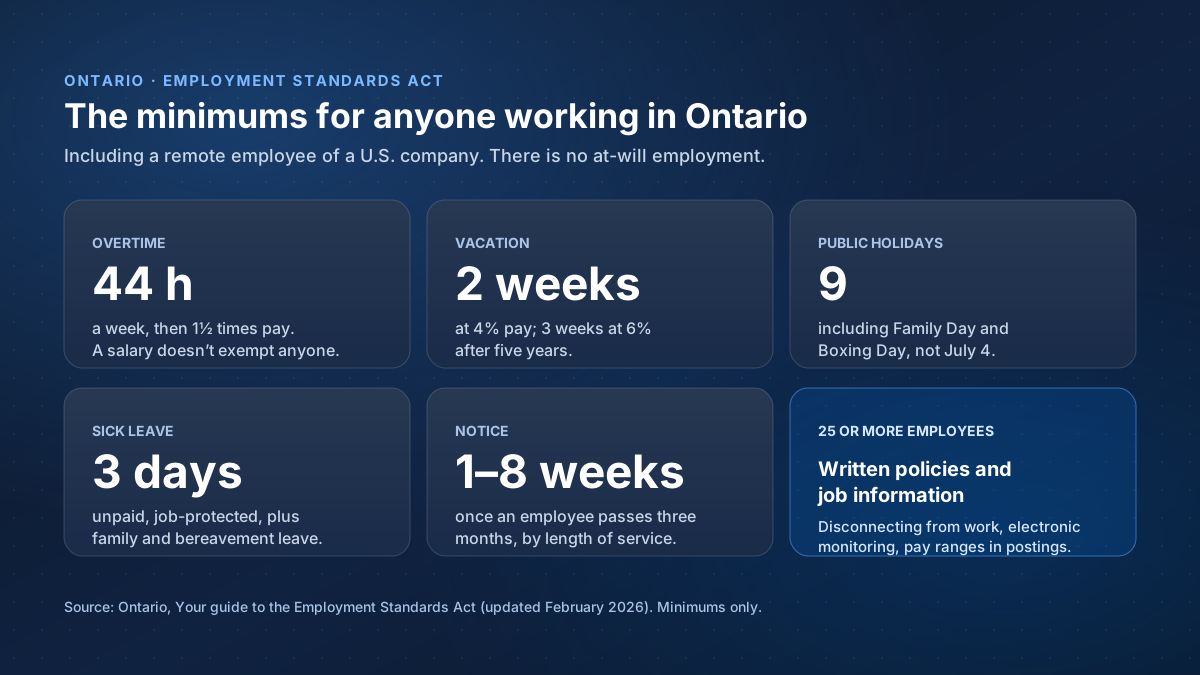
Ontario employment standards at a glance: overtime after 44 hours at 1½ times pay, two weeks of vacation rising to three after five years, nine public holidays, three unpaid sick days, one to eight weeks of notice after three months, and written policies and job information for employers with 25 or more employees

The Act at a glance, next to what a U.S. employer expects

Each rule is a minimum: a contract can give more, never less. Where we have a deeper guide, it's on the right.

RuleOntario minimumU.S. baselineFull guide
Who it covers Work performed in Ontario, including from a home in Ontario. Federally regulated employers follow the Canada Labour Code instead. The state where the employee works Province of employment
Hours of work 8 hours a day (or the regular workday, if longer) and 48 hours a week. More only by written or electronic agreement, after giving the employee the government information sheet. No federal limit for adults –
Overtime After 44 hours a week, at 1½ times the regular rate. A salary does not remove the right; managers and some IT professionals are exempt. After 40 hours a week (FLSA), with salaried exemptions Overtime rules
Minimum wage Set by the province and adjusted every October 1 with inflation. Current rates. Federal and state rates –
Vacation Two weeks a year, at least 4% vacation pay; three weeks and 6% after five years. No federal requirement –
Public holidays Nine: New Year's Day, Family Day, Good Friday, Victoria Day, Canada Day, Labour Day, Thanksgiving, Christmas and Boxing Day. No federal requirement –
Leaves Unpaid, job-protected: 3 sick days, 3 family responsibility days and 2 bereavement days a year, up to 27 weeks of long-term illness leave, and pregnancy and parental leave. Domestic or sexual violence leave: up to 10 days and 15 weeks, the first 5 days paid. FMLA: 12 weeks, for employers with 50 or more employees Maternity and parental leave
Probation No statutory probation; the notice rules below start once an employee has three months of service. At-will from day one Probation period
Ending employment Written notice or termination pay after three months: 1 week in the first year, then 1 week per year of service up to 8 weeks. Severance pay applies separately after five years with an employer whose global payroll is at least $2.5 million, up to 26 weeks. At-will employment Employment law basics
Non-competes Prohibited in employment agreements since October 25, 2021, with narrow exceptions for executives and the sale of a business. Varies by state Non-compete agreements
Job postings Employers with 25 or more employees: a pay range, an AI disclosure and no Canadian-experience requirement in public postings, from January 1, 2026. Pay transparency laws in some states Job posting rules
Records Most employment records kept for three years after the employee stops working for the employer. FLSA: generally three years for payroll records –

What U.S. employers most often miss in Ontario

None of these exist under U.S. federal law, and each one applies to a remote hire as fully as to an office one.

  • Written policies at 25 employees

    An employer with 25 or more employees on January 1 needs written policies on disconnecting from work and on electronic monitoring, with a copy for every employee. Monitoring a remote employee is covered too.

  • Job information before day one

    Since July 1, 2025, an employer with 25 or more employees must give a new hire specified information about the job, in writing, before the first day, or as soon after as reasonably possible.

  • The information sheet

    Every new employee gets a copy of the government’s "Employment Standards in Ontario" poster within 30 days of starting. It is easy to forget for a remote hire.

  • A salary is not an exemption

    A salaried developer who works 50 hours a week is still owed overtime after 44, unless a specific exemption applies to the job itself.

  • Workers’ compensation

    Most employers register with Ontario’s Workplace Safety and Insurance Board (WSIB) and pay premiums on payroll, for remote employees too.

  • Incorporated consultants

    A business or IT consultant who works through their own corporation or sole proprietorship, at $60 an hour or more, can fall outside the Act when four conditions are met. Otherwise the Act applies.

Hiring someone in Ontario?

InfraDev employs your hire in Ontario and applies the Act under its own name, so your team only directs the work. A hire can usually start within 24–48 hours of agreeing terms.

How InfraDev applies Ontario's standards

As the employer of record, InfraDev carries the employer's side of the Act for each hire in Ontario.

InfraDev handles

  • An employment agreement written to Ontario’s standards
  • Ontario payroll, with income tax, CPP and EI withheld and remitted
  • WSIB registration and premiums
  • Vacation, public holidays and job-protected leaves under the Act
  • The information sheet and written job information for each new hire
  • Written policies and records the Act requires of the employer

Frequently asked questions

Common questions from U.S. companies with people in Ontario.

When is overtime paid in Ontario?

Overtime in Ontario is paid after 44 hours in a work week, at 1½ times the employee’s regular rate. A salary does not remove the right. Managers and supervisors doing managerial work are exempt, and some information technology professionals have special rules. Employees can bank overtime as paid time off at 1½ hours for each overtime hour, by written agreement.

How much vacation does an employee in Ontario get?

An employee in Ontario gets two weeks of vacation after each 12-month vacation year, with vacation pay of at least 4% of gross wages. After five years with the employer, the minimum rises to three weeks and 6%. Ontario also has nine public holidays, including Family Day, Good Friday, Thanksgiving and Boxing Day.

Which written policies does an Ontario employer need?

An Ontario employer with 25 or more employees on January 1 needs a written policy on disconnecting from work and a written policy on electronic monitoring, with a copy given to every employee. Since July 1, 2025, the same employers must also give each new hire written information about the job before the first day.

How much notice of termination does Ontario require?

Ontario requires written notice or termination pay once an employee has been employed for three months: one week in the first year, then one week per year of service, up to eight weeks. Severance pay is a separate entitlement after five years of service, where the employer’s global payroll is at least $2.5 million.

How can a U.S. company employ someone in Ontario without an Ontario entity?

Through an employer of record. InfraDev employs your hire in Ontario under its own registrations, runs Ontario payroll and WSIB, and applies the Employment Standards Act as the employer, while your team directs the work. A hire can usually start within 24–48 hours of agreeing terms.

Ready to hire in Ontario?

Tell us the role and the salary. We'll confirm the cost and how soon your hire can start, on a 15-minute call.