
Form W-8BEN for Canadians: how to fill it in
A U.S. company asks a Canadian contractor for Form W-8BEN to confirm you are not a U.S. person. You complete Part I with your name, citizenship and Canadian address, usually leave the treaty claim blank, sign Part III and give it to the company, not the IRS. It stays valid until December 31 of the third year after you sign.
Published November 22, 2026
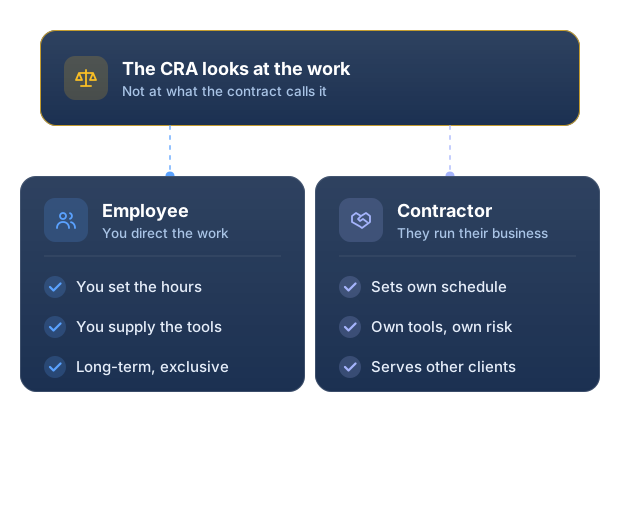
Why does a U.S. company ask a Canadian for Form W-8BEN?
A U.S. company asks a Canadian contractor for Form W-8BEN to document that you are not a U.S. person. With the form on file, the company withholds no U.S. tax from your invoices and issues no 1099-NEC. You fill in Part I, usually skip the treaty claim in Part II, sign Part III, and give it to the company, not the IRS.
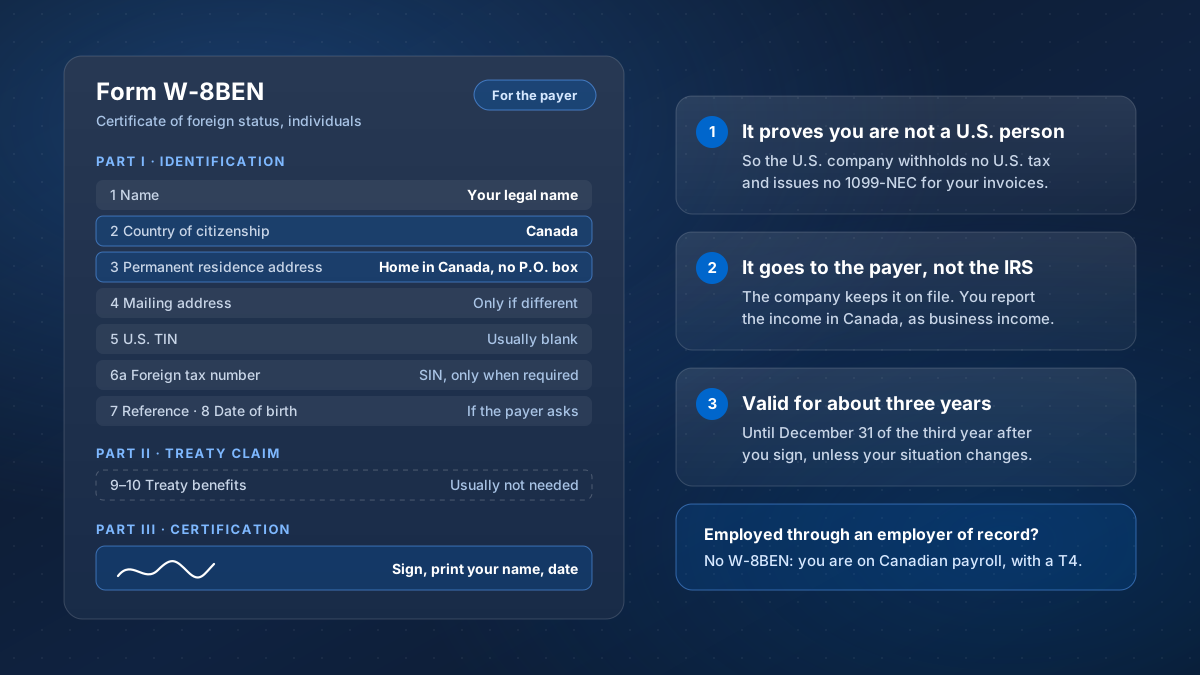
General information for Canadians paid by U.S. companies, not tax advice. Your situation may differ; the IRS instructions are the authority.
Part I, line by line
Part I identifies you. Most Canadians need lines 1 to 3 and a signature, and nothing else.
| Line | What it asks | What a Canadian enters |
|---|---|---|
| 1 | Name of individual | Your legal name, as on your tax records. |
| 2 | Country of citizenship | Canada. A dual citizen enters the country where they are both a citizen and a resident. A U.S. citizen should not use this form at all: give the company Form W-9. |
| 3 | Permanent residence address | Your home address in Canada, where you are resident for tax. Not a post office box, a bank’s address or a mailing-only address. |
| 4 | Mailing address | Only if it differs from line 3. |
| 5 | U.S. taxpayer identification number | Usually blank. You only need an SSN or ITIN in specific cases, such as a treaty claim made without a foreign tax number. |
| 6a | Foreign tax identifying number | For a Canadian, this is your Social Insurance Number (SIN). The IRS requires it when you hold a financial account at a U.S. office of a financial institution, and a treaty claim needs either it or a U.S. number. For ordinary contractor payments it is often not required, so give your SIN only where the form genuinely calls for it. |
| 6b | FTIN not legally required | Only for account holders who are not legally required to obtain a foreign tax number. A Canadian with a SIN rarely needs it. |
| 7 | Reference number | Optional. The company may ask you to enter a vendor or account number here. |
| 8 | Date of birth | Required only for a financial account at a U.S. office of a financial institution, in MM-DD-YYYY format. Fill it in if the company asks. |
Part II: the treaty claim, usually blank
Part II claims a reduced rate of U.S. withholding under the Canada–U.S. tax treaty. Withholding applies to income from U.S. sources, and IRS Publication 515 treats pay for services as U.S.-source when the services are performed in the United States. For work you do in Canada there is generally nothing to reduce, so most Canadian contractors leave lines 9 and 10 blank.
If the company or its payment platform asks you to complete Part II anyway, line 9 is Canada. A treaty claim needs a tax number on line 5 or 6a, which for most Canadians means the SIN. Line 10 is only for treaty benefits with extra conditions, which ordinary contractor work doesn't involve.
Part III: sign it
Sign and date the form, and print your name. The capacity box is only for someone signing on your behalf under a power of attorney. An electronic signature is fine if the company accepts one, but typing your name into the signature line on its own does not count.
After you sign
Four rules from the IRS instructions that are easy to miss.
Is the W-8BEN the right form for you?
| Your situation | The form | Why |
|---|---|---|
| You invoice a U.S. company as yourself (sole proprietor) | Form W-8BEN | This page |
| You invoice through your own corporation | Form W-8BEN-E | The corporation is the one being paid; see below |
| You are a U.S. citizen or green card holder living in Canada | Form W-9 | U.S. persons never use a W-8BEN |
| You do the work while physically in the United States | Form 8233 or W-4 | Different rules; speak to a cross-border tax professional |
| You are employed through an employer of record in Canada | None | You are on Canadian payroll and receive a T4 |
| You are engaged through InfraDev as contractor of record | None | You invoice a Canadian company and receive a T4A |
If you invoice through your own corporation
The corporation is the one being paid, so it completes Form W-8BEN-E. The parts that differ from the individual form:
- Part I: the corporation's legal name, Canada as the country of incorporation, "Corporation" on line 4, and its address in Canada on line 6. Line 5 asks for the company's FATCA status; an operating consulting company isn't a financial institution, so confirm the right non-financial status with your accountant.
- Part III, the treaty claim: this is where a corporation states that its business profits are taxed in Canada. Line 14a is Canada, line 14b is the treaty's limitation-on-benefits test your company meets, and line 15 names the treaty article for business profits not attributable to a U.S. permanent establishment. A treaty claim needs a U.S. EIN on line 8 or a Canadian tax number on line 9b.
- Part XXX: signed by an officer or authorized representative of the corporation. The same three-year validity and 30-day update rules apply.
Your Canadian side as a contractor
The W-8BEN settles the U.S. side. In Canada, you report the income as self-employed business income on Form T2125 with your return, pay both the employee and employer shares of CPP, and set tax aside yourself, because nothing is withheld from your invoices. Whether you charge GST/HST to a U.S. client is a question for your accountant: many services supplied to clients outside Canada are zero-rated.
If you would rather be an employee, with tax withheld, CPP and EI shared with an employer, and your province's employment standards, the U.S. company can employ you through an employer of record instead. Compare employee, contractor and employer of record.
Would you rather be an employee than a contractor?
Send the U.S. company to us. InfraDev employs you in Canada, on Canadian payroll with a T4, while you keep working for their team. No W-8BEN, and nothing for them to set up in Canada.
Frequently asked questions
Common questions from Canadians paid by U.S. companies.
Do Canadians need to fill out a W-8BEN for a U.S. company?
A Canadian who invoices a U.S. company as an independent contractor fills out Form W-8BEN whenever the company asks for it. It shows you are not a U.S. person, so the company withholds no U.S. tax and issues no 1099-NEC. A Canadian employed through an employer of record in Canada needs no W-8BEN at all.
What does a Canadian put on line 6a of Form W-8BEN?
For a Canadian, the foreign tax identifying number on line 6a is the Social Insurance Number. The IRS requires it for a financial account at a U.S. office of a financial institution, and a treaty claim needs it or a U.S. number. For ordinary contractor payments it is often not required, so give your SIN only where the form genuinely calls for it.
Does a Canadian contractor need to claim tax treaty benefits on a W-8BEN?
Usually not, for work done in Canada. IRS Publication 515 treats pay for services as U.S.-source when the services are performed in the United States, and withholding applies to U.S.-source income, so work done in Canada generally leaves nothing for a treaty claim to reduce. If the company asks you to complete Part II, line 9 is Canada.
How long is a W-8BEN valid for a Canadian?
A W-8BEN stays valid from the day you sign it until December 31 of the third calendar year after, so a form signed in November 2026 lasts until December 31, 2029. If anything on it becomes untrue, such as a move to the United States, give the company a new form within 30 days.
Does a Canadian send Form W-8BEN to the IRS?
The form goes to the U.S. company or payment platform that asked for it, never to the IRS. The company keeps it on file to show why it withheld no U.S. tax and issued no 1099-NEC, and asks for a new one when it expires.
Which form does a Canadian corporation give a U.S. client?
A Canadian who invoices a U.S. client through their own corporation gives Form W-8BEN-E, the entity version, because the corporation is the one being paid. Its treaty claim in Part III states that the business profits are taxed in Canada. A U.S. citizen or green card holder living in Canada gives Form W-9 instead.
How can a Canadian work for a U.S. company without a W-8BEN?
Through an employer of record in Canada. Employed by a company such as InfraDev, you are on Canadian payroll with a T4, CPP, EI and your province’s employment standards, and the U.S. company pays InfraDev. No W-8BEN is involved, and you are an employee rather than a contractor.
Guides for Canadian professionals
-
Working for a U.S. company from Canada
Employee, contractor or employer of record: what each means for your pay, tax and benefits.
-
When the company isn’t set up in Canada
What to say, with an email you can copy, when a U.S. company wants to hire you.
-
W-2 and 1099 vs the T4 and T4A
How the U.S. and Canadian tax slips compare.
-
The U.S. company’s side
How a U.S. company hires a Canadian contractor: the role, the contract, invoices.
Sources
- IRS: Instructions for Form W-8BEN (Rev. October 2021)
- IRS: About Form W-8BEN
- IRS: Instructions for Form W-8BEN-E (Rev. October 2021)
- IRS Publication 515: Withholding of Tax on Nonresident Aliens and Foreign Entities
- IRS Topic 307: Backup withholding
- CRA: Self-employed business, professional, commission, farming, and fishing income (Form T2125)
InfraDev's team reviews this page twice a year and when a rule it describes changes. General information, not legal or tax advice. How we review our guides · Report an error
Looking for your next U.S. remote role?
Join our talent network of more than 1,000 Canadian professionals. U.S. roles are shared with the network first, and InfraDev employs the people who are hired.