Canada vs India for software development

Canada suits U.S. companies that need developers working U.S. hours with close, day-to-day collaboration. India suits well-specified work where cost matters most and a time difference of 9.5 to 13.5 hours is manageable. In both countries, quality depends more on the team you hire and how the work is specified than on the country.

Published November 22, 2025 · Updated November 6, 2026

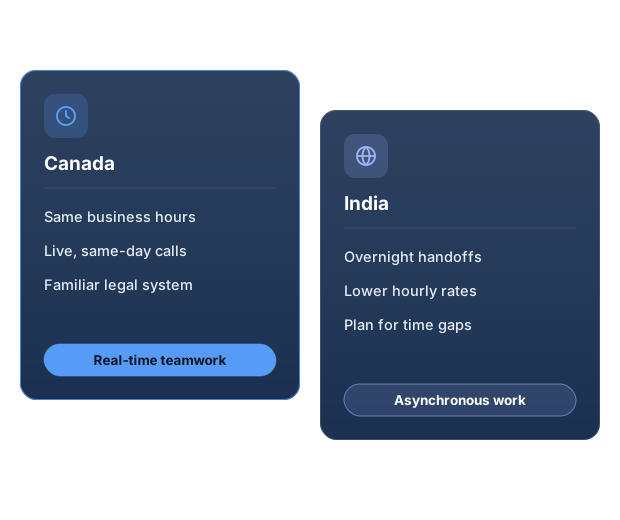
Same-day collaboration in Canada beside overnight handoffs with India

How big is the time difference between the U.S. and India?

India Standard Time is UTC+5:30 all year, with no daylight saving time. India is 9.5 hours ahead of U.S. Eastern time in summer and 10.5 in winter, and 12.5 to 13.5 hours ahead of Pacific time. A U.S. morning is an Indian evening, so most collaboration runs asynchronously or relies on shifted hours.

What does an employer in India owe on top of salary?

Since India's four labour codes took effect on 21 November 2025, an employer contributes 12% of basic wages to the Employees' Provident Fund, pays gratuity of 15 days' wages per year of service (after five years, or one for fixed-term staff), caps normal hours at 48 a week and pays overtime at twice the normal rate.

  • Labour codes: the Code on Wages, the Industrial Relations Code, the Code on Social Security and the Occupational Safety, Health and Working Conditions Code replaced 29 central labour laws. States notify their own rules under them.
  • What counts as wages: basic pay, dearness allowance and retaining allowance. If other allowances exceed 50% of total pay, the excess is added back, which raises gratuity and social security costs on allowance-heavy pay structures.
  • Provident fund: 12% of basic wages from the employer, matched by the employee.
  • Hours: 8 a day and 48 a week; overtime at least twice the normal rate.

Canada and India at a glance

What changes for a U.S. company building a software team in each country.

Canada vs India for software development: Canada and India at a glance
CanadaIndia
Time difference from the U.S. None: Canada spans the same Pacific-to-Atlantic time zones as the U.S. (Newfoundland is half an hour ahead of Atlantic)9.5 to 10.5 hours ahead of U.S. Eastern time, and 12.5 to 13.5 ahead of Pacific; no daylight saving time
Employer contributions on top of salary CPP (5.95%), CPP2 (4%) and EI (1.4 times the employee premium), each up to a yearly maximum: at most about C$6,200 per employee in 2026, outside Québec. Workers' compensation, and employer health tax in some provinces, are extra12% of basic wages to the Employees' Provident Fund, plus gratuity of 15 days' wages per year of service
Working hours and overtime Overtime after 40 or 44 hours a week, depending on the province, usually at 1.5 times pay8 hours a day and 48 a week; overtime at least twice the normal rate
How teams are usually engaged Employed through an employer of record or your own entity, or engaged as independent contractorsUsually through an outsourcing vendor; employing people directly needs an Indian entity or an employer of record
Legal system Common law (civil law in Québec), with employment rules set mainly by each provinceCommon law, with four national labour codes in force since 21 November 2025 and rules set by each state
Working language English, and French in QuébecEnglish is widely used in business and technology

Canadian figures use the CRA's 2026 rates. Indian figures follow the labour codes in force since 21 November 2025. Sources are listed at the end of this page.

When each country fits

Both countries have strong engineers and weak suppliers, so quality depends more on the team than the country. What changes the outcome is how clearly the work is specified, how much real-time review it needs, and whether the people building it are your employees or a vendor’s.

Canada fits when

  • The work changes often and needs daily review with U.S. product owners
  • Developers join your own stand-ups and work your hours
  • You want the people building your product to be employees, not a vendor’s staff
  • You want employment practices close to those of the U.S.

India fits when

  • The work is well specified and can run asynchronously
  • You want overnight progress or follow-the-sun handoffs
  • Cost per developer is the deciding factor for a large team
  • You have a proven vendor, or the means to manage one closely

Building a team in Canada?

InfraDev employs developers in Canada for U.S. companies. Tell us about the role and we will confirm the cost and timing on a short call.