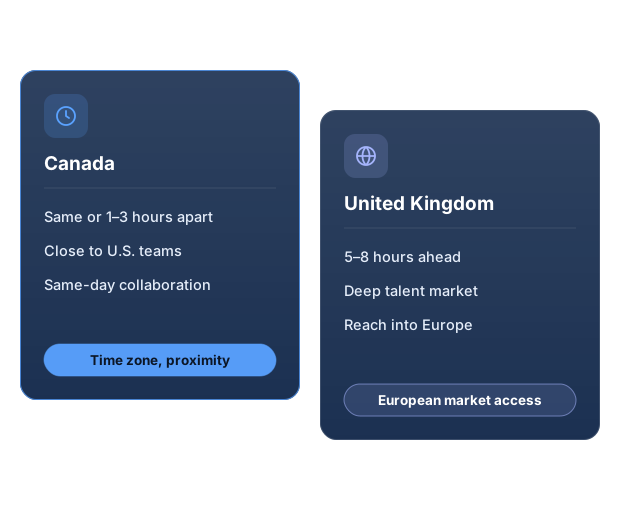
Employer of record in Canada vs the UK

Canada suits U.S. companies that need people working U.S. hours: most of Canada shares a U.S. time zone, while the United Kingdom is five hours ahead of Eastern time and eight ahead of Pacific. The UK suits companies that want a base for European customers or coverage before the U.S. day starts. Employer costs on top of salary are generally higher in the UK.

Published November 22, 2025 · Updated November 6, 2026

An Employer of Record in Canada compared with the United Kingdom

What does an employer pay on top of salary in the UK compared with Canada?

In the UK, an employer pays 15% National Insurance on each employee's earnings above £5,000 a year, plus at least 3% pension contributions on earnings between £6,240 and £50,270. In Canada, outside Québec, employer CPP, CPP2 and EI contributions stop at yearly maximums, about C$6,200 per employee in 2026.

  • UK example: on a £60,000 salary, employer National Insurance is £8,250 a year and the minimum pension contribution £1,321 (2026–27 rates).
  • Canada: once a salary passes the yearly maximums, each extra dollar adds no CPP, CPP2 or EI. Workers' compensation, and employer health tax in some provinces, are extra.
  • Salaries vary more by city and seniority than by country, so compare offers for the specific role. For Canada, the employer cost calculator shows the full cost of a salary.

Canada and the UK at a glance

What changes for a U.S. company employing someone in each country.

Employer of record in Canada vs the UK: Canada and the UK at a glance
CanadaUnited Kingdom
Time difference from the U.S. None: Canada spans the same Pacific-to-Atlantic time zones as the U.S. (Newfoundland is half an hour ahead of Atlantic)Five hours ahead of U.S. Eastern time and eight ahead of Pacific; one hour less for a few weeks each spring and fall, when the two countries change their clocks on different dates
Employer contributions on top of salary CPP (5.95%), CPP2 (4%) and EI (1.4 times the employee premium), each up to a yearly maximum: at most about C$6,200 per employee in 2026, outside Québec. Workers' compensation, and employer health tax in some provinces, are extra15% National Insurance above £5,000 a year, plus at least 3% pension on earnings from £6,240 to £50,270 (2026–27)
Minimum paid leave At least two weeks a year in most provinces, rising with service, plus provincial statutory holidays28 days (5.6 weeks) for a five-day week, which can include public holidays
Notice to end employment Notice or pay in lieu set by the province (in Ontario, one week per year of service, up to eight), and courts often award moreAt least one week after one month of service, then one week per full year from 2 to 12 years, up to 12 weeks
Legal system Common law (civil law in Québec), with employment rules set mainly by each provinceCommon law in England, Wales and Northern Ireland; Scotland has a mixed system
Working language English, and French in QuébecEnglish

Canadian figures use the CRA's 2026 rates; UK figures use GOV.UK's 2026–27 rates. Sources are listed at the end of this page.

When each country fits

For most U.S. companies the deciding factor is working hours, then the cost on top of salary.

Canada fits when

  • The role needs real-time overlap with U.S. colleagues for the whole working day
  • You want employer costs on top of salary that stop at yearly maximums
  • Your customers and teams are in North America
  • You want employment practices close to those of the U.S.

The UK fits when

  • You need a base for customers or partners in Europe
  • You want coverage that starts before the U.S. working day
  • The role is UK-specific, such as UK sales or UK-regulated work
  • The work runs well asynchronously, with a few overlapping hours

Hiring in Canada or the UK?

InfraDev employs people in Canada, not the UK. If Canada fits the role, we will confirm the cost and timing on a short call.