Employer of record in Canada vs Mexico

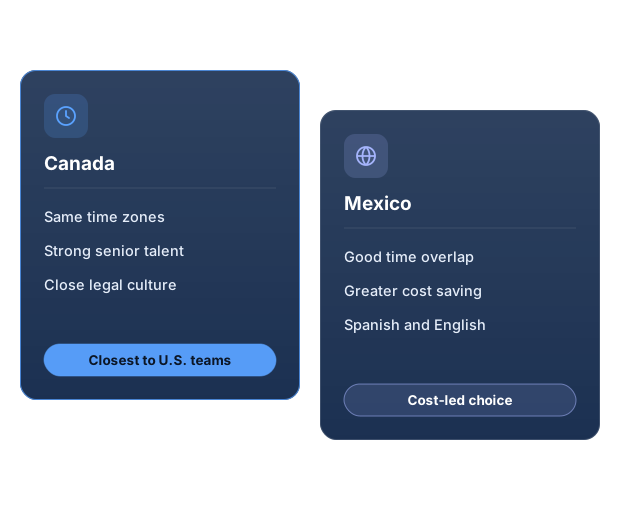
Canada suits U.S. companies that want employees working in English under rules much like their own. Mexico suits companies that put salary cost first and can work in Spanish under the Federal Labor Law, which adds a year-end bonus, profit sharing and housing contributions. Most of Mexico is one or two hours from U.S. Eastern time.

Published November 22, 2025 · Updated November 6, 2026

An Employer of Record in Canada compared with Mexico

What does an employer owe on top of salary in Mexico?

On top of salary, a Mexican employer owes an aguinaldo of at least 15 days' pay by December 20, at least 12 vacation days after the first year with a 25% vacation premium, 5% of salary to INFONAVIT, IMSS social security contributions, a state payroll tax, and a share of profits (PTU) set by a national commission.

  • Year-end bonus (aguinaldo): at least 15 days' salary, paid before December 20, and pro rata for part of a year (LFT article 87).
  • Vacation: at least 12 working days after the first year, rising by two days a year to 20, then by two days every five years, with a premium of at least 25% of the vacation pay (articles 76 and 80).
  • Housing fund (INFONAVIT): 5% of salary (article 136).
  • Profit sharing (PTU): employees share in profits at the percentage set by the national profit-sharing commission (article 117).
  • Social security (IMSS) and state payroll tax: rates depend on the salary and the state.

What did Mexico's 2021 outsourcing reform change for employers of record?

Mexico's 2021 reform of the Federal Labor Law prohibits subcontracting personnel, meaning one company putting its own workers at another's disposal (article 12). Only specialized services outside the client's core business remain allowed, and the provider must be registered with the Labor Ministry (articles 13 and 15). Ask any Mexican employer of record how its model complies.

Canada and Mexico at a glance

What changes for a U.S. company employing someone in each country.

Employer of record in Canada vs Mexico: Canada and Mexico at a glance
CanadaMexico
Time difference from the U.S. None: Canada spans the same Pacific-to-Atlantic time zones as the U.S. (Newfoundland is half an hour ahead of Atlantic)Most of Mexico, including Mexico City, stays on UTC−6 all year: one hour behind U.S. Eastern time in winter and two in summer. Baja California follows U.S. Pacific time
Employer contributions on top of salary CPP (5.95%), CPP2 (4%) and EI (1.4 times the employee premium), each up to a yearly maximum: at most about C$6,200 per employee in 2026, outside Québec. Workers' compensation, and employer health tax in some provinces, are extraIMSS social security, 5% of salary to INFONAVIT, a state payroll tax, and profit sharing (PTU)
Year-end bonus None requiredAguinaldo of at least 15 days' salary, paid before December 20
Minimum paid leave At least two weeks a year in most provinces, rising with service, plus provincial statutory holidays12 working days after the first year, rising with service, plus a vacation premium of at least 25%
Working week Overtime after 40 or 44 hours a week, depending on the province, usually at 1.5 times payMaximum 48 hours in 2026, falling by two hours a year to 40 in 2030 (reform of May 1, 2026)
Ending employment Notice or pay in lieu set by the province (in Ontario, one week per year of service, up to eight), and courts often award moreUnjustified dismissal: reinstatement or three months' salary, plus a seniority premium of 12 days' salary per year of service (articles 48 and 162)
Third-party employer An employer of record can be the legal employer for a clientSubcontracting personnel is prohibited; registered specialized services outside the client’s core business are allowed (articles 12 to 15)
Legal system Common law (civil law in Québec), with employment rules set mainly by each provinceCivil law, with a single federal labour code
Working language English, and French in QuébecSpanish

Canadian figures use the CRA's 2026 rates. Mexican figures come from the Federal Labor Law as reformed to May 14, 2026. Sources are listed at the end of this page.

When each country fits

Working hours are similar, so the decision usually turns on language, statutory extras and how the employment is structured.

Canada fits when

  • The team works in English with U.S. colleagues
  • You want employment rules and practices close to those of the U.S.
  • You prefer no mandatory year-end bonus or profit sharing
  • You want an employer of record to employ the person directly for you

Mexico fits when

  • Salary cost is your first priority
  • The role serves Spanish-speaking customers in Mexico or Latin America
  • You can budget for the aguinaldo, vacation premium and profit sharing
  • Your provider can show how its model complies with the 2021 outsourcing rules

Hiring in Canada or Mexico?

InfraDev employs people in Canada, not Mexico. If Canada fits the role, we will confirm the cost and timing on a short call.