
Blog
Job posting rules in Canada: pay ranges, AI disclosure and what U.S. employers must include
A U.S. company advertising a job in Canada follows the rules of the province where the person will work. Ontario, British Columbia and Prince Edward Island require the expected pay or a pay range in public job postings; since January 1, 2026, Ontario also requires AI disclosure, a vacancy statement and a reply to interviewed applicants within 45 days. Québec requires the posting in French.
Published November 9, 2026
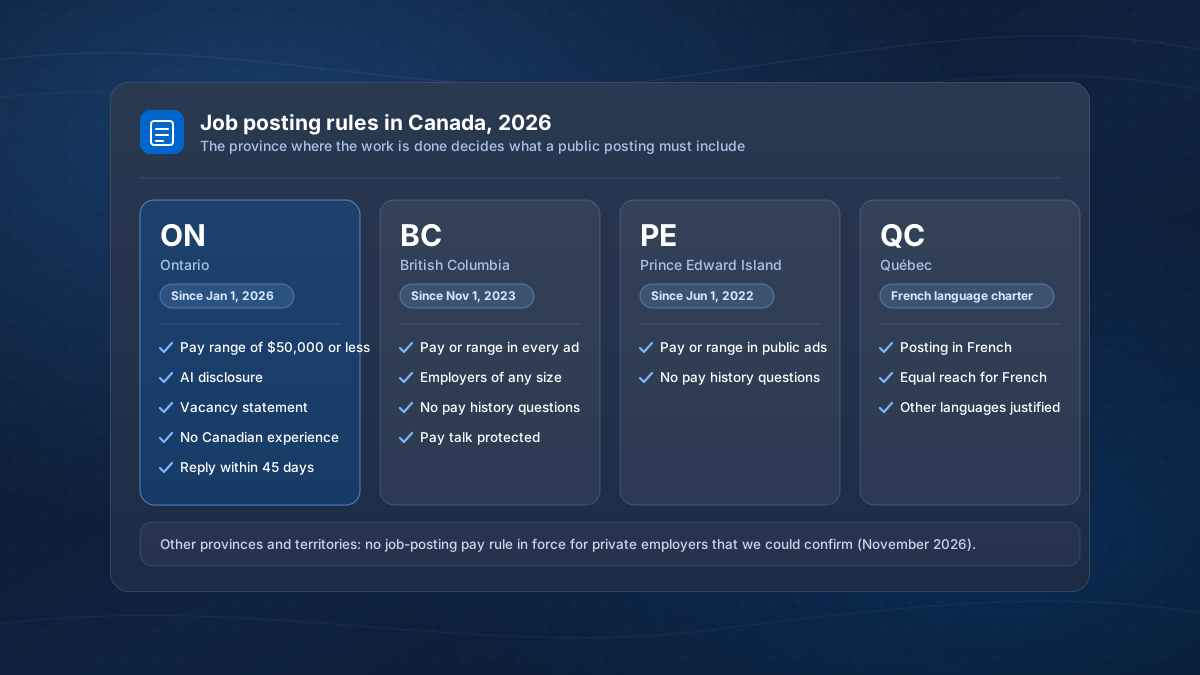
A U.S. company advertising a job in Canada follows the rules of the province where the person will work, not the state where the company is based. Three provinces require pay in the posting, Ontario added the most detailed rules on January 1, 2026, and Québec requires French. One posting can meet all of them, and the checklist near the end of this article shows how.
Which rules apply: where the work is done
Provincial employment law follows the place of work. A U.S. company hiring a developer who will work from Toronto follows Ontario’s rules, even if the posting is written in Austin and published on a U.S. job board.
Remote roles need one extra thought. A posting that says “remote, anywhere in Canada” will reach applicants in Ontario, British Columbia and Québec at once, so the simplest approach is to write it to the strictest combination. Ontario’s guidance excludes only postings for work performed outside Ontario, so a role open to Ontario residents is covered.
The rules by province
| Province | Pay in the posting | Pay history questions | Other posting rules | In force |
|---|---|---|---|---|
| Ontario | Expected pay or a range; range of $50,000 or less, unless pay is over $200,000 | Not banned | AI disclosure, vacancy statement, no Canadian-experience requirement, reply within 45 days of an interview, records kept 3 years | January 1, 2026, for employers with 25 or more employees |
| British Columbia | Expected pay or a range, in every publicly advertised job | Banned | No reprisal for discussing pay | November 1, 2023, for all employers |
| Prince Edward Island | Expected pay or a range | Banned | No reprisal for discussing pay | June 1, 2022 |
| Québec | Not required | Not banned | Posting in French; any other language requirement must be justified | In force |
| Other provinces and territories | No rule in force for private employers that we could confirm in November 2026 | Not banned | General human rights rules apply |
Newfoundland and Labrador has passed pay equity and pay transparency legislation. Check whether its job posting provisions apply to you before advertising a role there.
Ontario: the most detailed rules
Ontario’s rules took effect on January 1, 2026, under the Employment Standards Act, 2000. They apply to an employer with 25 or more employees on the day a job is posted, counting each part-time and casual employee as one. They cover an external job posting advertised to the general public “in any manner”, including one placed by a recruiter on the employer’s behalf. General “we’re hiring” campaigns and internal-only postings are excluded.
A covered posting must include:
- Expected pay or a range. The range can be no wider than $50,000 a year: $85,000 to $135,000 is allowed, $85,000 to $140,000 is not. If the expected pay or the top of the range is over $200,000 a year, no pay disclosure is required.
- AI disclosure. If artificial intelligence is used to screen, assess or select applicants, the posting must say so. A general statement is enough.
- A vacancy statement. Whether the posting is for an existing vacancy, or that there is none. Posting to build a pipeline is allowed, as long as the posting says so.
- No Canadian experience requirement. Neither the posting nor its application form may require Canadian work experience. Professional licensing requirements are excluded from this rule.
After the interviews:
- A reply within 45 days. Each applicant interviewed must be told whether a hiring decision has been made within 45 days of their last interview. It can be in person, in writing, by phone, email or text, or as a status update on an applicant portal they have a link to.
- Records for three years. Keep every version of the posting, its application form and linked pages for three years after the posting comes down, and records of the interview replies for three years after they are sent.
The Ministry of Labour can issue compliance orders and monetary penalties, and prosecutions can lead to fines of up to $100,000 for an individual and up to $500,000 for a corporation with prior convictions.
British Columbia and Prince Edward Island
British Columbia’s Pay Transparency Act requires the expected pay or a pay range in every publicly advertised job, for employers of any size, since November 1, 2023. Employers may not ask applicants what they were paid elsewhere, and may not penalize employees for discussing or disclosing their pay. Separately, B.C. employers with 50 or more employees publish an annual pay transparency report, starting November 1, 2026.
Prince Edward Island’s Employment Standards Act has required the expected pay or a range in public job postings since June 1, 2022, and bars employers from seeking an applicant’s pay history. If an applicant volunteers it, the employer may use it.
Québec: French first
Québec has no pay disclosure rule, but its Charter of the French language applies to every posting. A job offer published in English must also be published in French, through means of equal reach. Requiring knowledge of English or any other language must be justified by the duties of the role, after reasonable steps to avoid it. A bilingual posting, with the French version first or alongside, meets both rules. Hiring an employee in Québec covers the French employment contract that follows.
If the posting also reaches U.S. applicants
A posting open to both countries carries both sets of rules. Several U.S. states, among them California, Colorado, Illinois, New York and Washington, require pay ranges in postings that can be filled in the state. A U.S. range in U.S. dollars and a Canadian range in Canadian dollars, each labelled, is the clearest way to meet both.
A posting that works across Canada
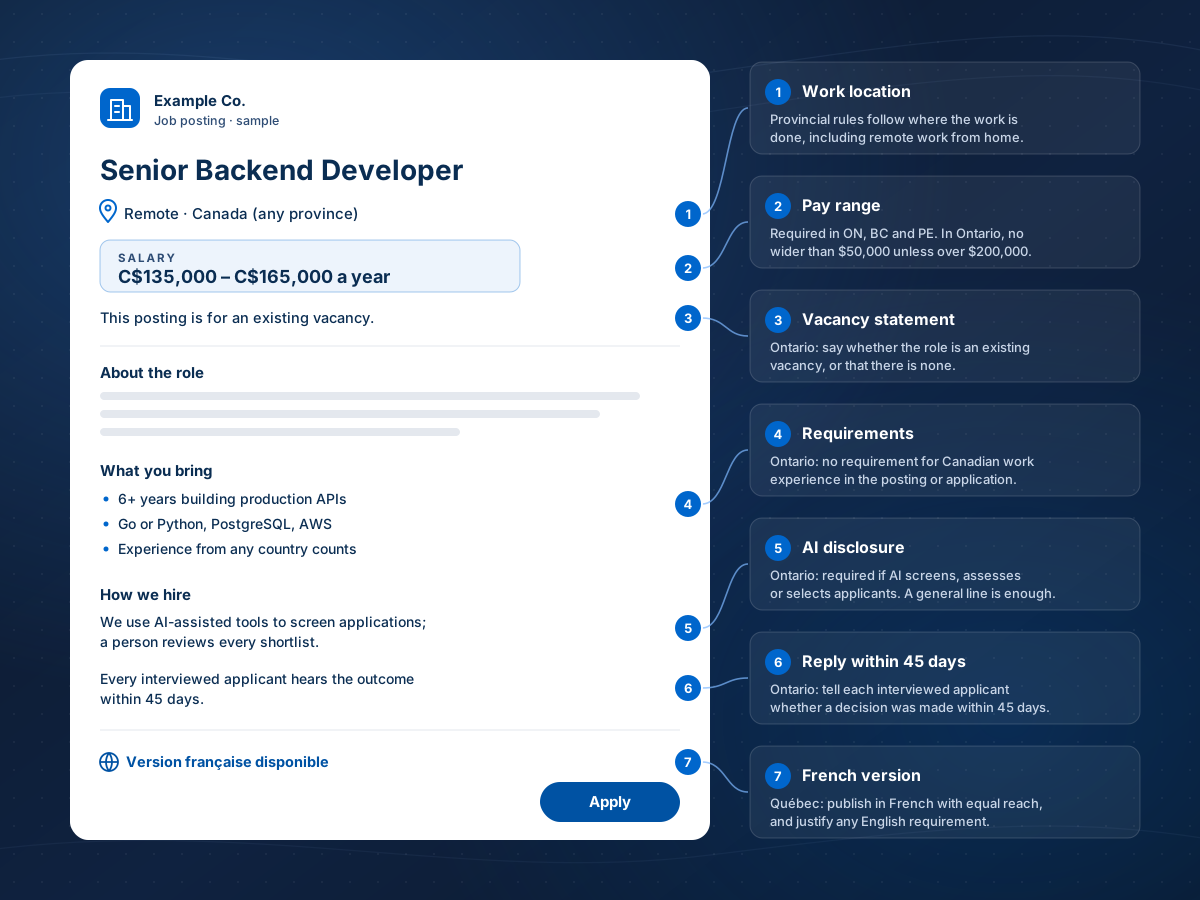
To advertise one role to applicants anywhere in Canada, include:
- A pay range of $50,000 or less in Canadian dollars, or a single figure.
- The work location: “Remote, Canada” or the province, and where the employer is.
- A vacancy statement: “This posting is for an existing vacancy.”
- Requirements without Canadian experience: skills, years of experience and credentials, wherever they were earned.
- An AI statement if any tool screens or ranks applicants, including your applicant tracking system’s scoring.
- A reply commitment: a process that tells every interviewed applicant the outcome within 45 days.
- A French version if the role is open to Québec residents, and a reason for any English requirement.
Then remove pay history questions from the application form and the interview script, and keep each version of the posting for three years.
Who the employer is when an EOR employs the hire
When a U.S. company hires through an employer of record, the EOR is the legal employer in Canada. The posting obligations sit with the employer and anyone advertising on its behalf, so agree with your EOR who writes and approves the posting before it goes live. When InfraDev presents people from its network or recruits for a role, the posting and the process follow the rules of the province where the hire will work, and InfraDev then employs the person there. How it works shows the steps from job description to first pay.
Summary
- Job posting rules in Canada follow the province where the person will work, including remote work.
- Ontario, British Columbia and Prince Edward Island require the expected pay or a range in public job postings.
- Since January 1, 2026, Ontario also requires a range of $50,000 or less, AI disclosure, a vacancy statement, no Canadian-experience requirement, a reply within 45 days of an interview and three years of records, for employers with 25 or more employees.
- British Columbia and Prince Edward Island ban questions about an applicant’s pay history.
- Québec requires the posting in French and a justification for any other language requirement.
Sources
- Ontario: Your guide to the Employment Standards Act, publicly advertised job postings
- British Columbia: Pay transparency in B.C.
- Stewart McKelvey: Pay transparency, recent changes to P.E.I.’s Employment Standards Act
- Québec: Charter of the French language (LégisQuébec)
This article is general information, not legal advice. Rules are as published by each province in November 2026.
Frequently asked questions
Do U.S. companies have to include a salary range in Canadian job postings?
Yes, in Ontario, British Columbia and Prince Edward Island. A U.S. company publicly advertising a job performed in those provinces must state the expected pay or a pay range. Ontario caps the range at $50,000 unless pay exceeds $200,000 a year, and applies its rules to employers with 25 or more employees.
Does Ontario's 2026 job posting law apply to remote jobs?
Yes, when the work is performed in Ontario. Ontario's job posting rules cover publicly advertised postings for work done in the province, which includes remote work from a home in Ontario. Postings for work performed entirely outside Ontario are excluded, so a posting open to remote applicants anywhere in Canada should meet Ontario's rules.
What must an Ontario job posting say when AI screens applicants?
An Ontario job posting must state that artificial intelligence is used to screen, assess or select applicants. Since January 1, 2026, a general statement is enough, and the rule applies even when a recruiter or software vendor runs the screening on the employer's behalf.
How long does an Ontario employer have to reply after a job interview?
45 days. Ontario employers covered by the 2026 job posting rules must tell each interviewed applicant whether a hiring decision has been made within 45 days of the last interview, in person, in writing, by phone or email, or through an applicant portal.
Can an employer in Canada ask a job applicant about their current salary?
Not in British Columbia or Prince Edward Island, where employers may not ask applicants about their pay history. Elsewhere in Canada the question is not banned, but basing an offer on the role's posted pay rather than previous salary is the safer practice and keeps offers consistent with the posted range.
Does a job posting for a role in Québec have to be in French?
Yes. Under Québec's Charter of the French language, a job offer published in another language must also be published in French, with equal reach. Requiring knowledge of English or another language for a Québec role must be justified by the duties of the position.
Related reading
-
Hiring an employee in Québec: what U.S. companies should know
What changes when your Canadian hire lives in Québec: French job offers and contracts, payroll through Revenu Québec, Québec labour standards, and Law 25.
Read the article -
Compliance checklist for U.S. companies employing Canadians
A one-page checklist of what a U.S. company must get right when it employs people in Canada: registrations, payroll, provincial employment standards, workers' compensation, contracts, privacy and classification.
Read the article -
Converting a Canadian contractor to an employee: a guide for U.S. companies
A U.S. company can convert a Canadian contractor to an employee without opening a Canadian entity: an employer of record employs them, or the company registers as an employer with the CRA. The work is in six steps: review the history, set the salary, settle the service date, sign a provincial agreement, close the contract and start payroll on day one.
Read the article
Next steps for hiring in Canada
Hiring for a role in Canada?
Bring the person you've chosen, or send us the job description and we'll present people from our network of more than 1,000 Canadian professionals. We then employ them in Canada.