
Blog
Employer health tax in Canada: the 2026 rates by province, and when a U.S. employer pays
Ontario, British Columbia, Manitoba, Newfoundland and Labrador, and Québec each charge employers a payroll tax for health care in 2026. Where a province spells out the test, the tax follows the employer's place of business, not the employee's home, and four of the five exempt smaller payrolls.
Published November 26, 2026
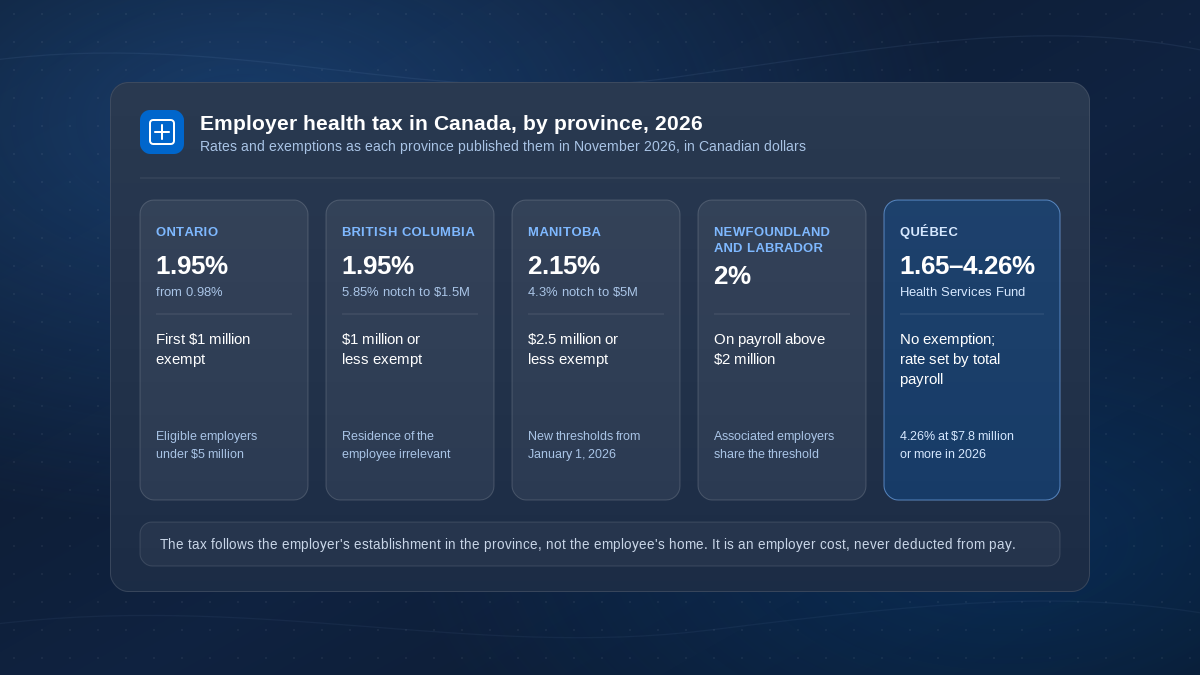
Employer health tax in Canada is a provincial payroll tax that employers pay on top of salary to help fund health care. Ontario, British Columbia, Manitoba, Newfoundland and Labrador, and Québec each charge one in 2026, and four of the five exempt smaller payrolls. Ontario, British Columbia and Québec tie it to the employer’s establishment, not the employee’s home.
What is the employer health tax in Canada?
An employer health tax is a tax an employer pays on its payroll in a province, separate from the federal source deductions. It is not withheld from the employee, and the employee’s public health coverage does not depend on it.
For a U.S. employer, the nearest comparison is the employer’s share of Medicare tax, with one difference that matters. The Canada Pension Plan and Employment Insurance are federal and apply to almost every employee, as the Canadian payroll guide explains. The employer health tax is provincial, is charged by the five provinces covered here, and in four of them only above a payroll threshold.
Ontario’s Ministry of Finance describes its version as “a payroll tax on remuneration” that employers provide to current and former employees, which covers salaries, wages, bonuses, taxable benefits and stock options.
Which provinces charge an employer health tax in 2026?
Five: Ontario, British Columbia, Manitoba, Newfoundland and Labrador, and Québec, each with its own name, rate and exemption. The table sets out the 2026 rules as each province publishes them; amounts are in Canadian dollars, and “payroll” means the payroll that is taxable in that province.
| Province | Name of the tax | Exemption in 2026 | Rate in 2026 |
|---|---|---|---|
| Ontario | Employer Health Tax (EHT) | First $1 million, for eligible employers whose Ontario payroll (with associated employers) is under $5 million | 0.98% on payroll up to $200,000, rising in steps to 1.95% over $400,000 |
| British Columbia | Employer Health Tax | Payroll of $1 million or less | 5.85% of the amount over $1 million, up to $1.5 million; then 1.95% of all B.C. payroll |
| Manitoba | Health and Post-Secondary Education Tax Levy | Payroll of $2.5 million or less | 4.3% of the amount over $2.5 million, up to $5 million; then 2.15% of all payroll |
| Newfoundland and Labrador | Health and Post-Secondary Education Tax | First $2 million | 2% of payroll above $2 million |
| Québec | Contribution to the Health Services Fund | None | 1.65% when total payroll is $1 million or less, rising to 4.26% at $7.8 million or more |
A few details sit behind the table:
- Associated employers share one exemption in Ontario, British Columbia, Manitoba and Newfoundland and Labrador. A U.S. parent and its Canadian subsidiary count as one group.
- The rate band is set before the exemption in Ontario. Ontario’s page says the rate is “based on the level of your Ontario payroll before you have deducted any exemption”.
- Manitoba’s figures are new for 2026. The province’s Bill 46, the Budget Implementation and Tax Statutes Amendment Act, 2025, raised the exemption from $2,250,000 to $2,500,000 and the full-rate threshold from $4,500,000 to $5,000,000, in force January 1, 2026.
- Charities have their own rules in Ontario and British Columbia; this article covers businesses.
- Ontario’s exemption is fixed until 2029. The ministry says the $1 million amount is next scheduled for an inflation adjustment on January 1, 2029.
When does a U.S. employer pay employer health tax on a remote employee?
When the employee reports for work at, or is paid from, the employer’s permanent establishment in the province. Ontario, British Columbia and Québec spell this test out, and Manitoba says its levy is paid by employers with a permanent establishment in Manitoba, so the tax follows the employer’s place of business, not the employee’s home address.
Ontario’s guide says employers pay EHT on remuneration paid to employees who “physically report for work” at a permanent establishment in Ontario, are “attached to” one, or do not report to any establishment but are paid from or through one in Ontario. British Columbia uses the same structure and adds a sentence U.S. employers should read twice: “The residence of an employer’s employees is irrelevant in determining whether an employer has B.C. remuneration.” Québec’s Act respecting the Régie de l’assurance maladie du Québec, section 34, applies the Health Services Fund contribution to employees who report for work at the employer’s establishment in Québec, or are paid from one.
A permanent establishment, for these taxes, is generally a fixed place of business: an office, a branch, a warehouse. It is defined in each provincial act, and it is not the same test as the treaty permanent establishment that decides corporate income tax, covered in the post on permanent establishment in Canada.
“Attached to” is decided by the facts. British Columbia’s guidance lists the factors: where the duties are regularly performed, where the employee was hired from, where instructions come from, where the employee is supervised, and where attendance and expense claims go. A remote employee in Calgary who is hired, supervised and paid by a Vancouver office can be attached to it.
Can a home office count as the employer’s establishment?
Sometimes. Ontario publishes interpretation letters on its permanent establishment scenarios page (updated December 1, 2025), and two of them reach opposite answers on a home office:
- A home office that was an establishment (2016). The employer required two directors to keep offices in their homes as a condition of employment, the rooms were used only for its business, it paid the costs and owned the equipment, and donors and volunteers visited. The ministry found the home offices were permanent establishments outside Ontario, so the directors’ pay was not subject to Ontario EHT.
- A home office that was not (2009). An Ontario company’s sales representative worked from home in Québec, but the home office was not required, not advertised and not paid for by the employer, and the representative was hired, supervised and paid from Ontario. The ministry found the company had no establishment in Québec and owed Ontario EHT on the representative’s pay.
The same page includes a 2016 letter about a U.S. company with no office in Canada whose consultants worked on site at clients in Ontario; the ministry found a permanent establishment at each client location and EHT on those employees’ pay. Interpretation letters apply to the facts of one case, as the ministry’s disclaimer says, but they show how the questions are asked. Ontario also accepts requests for written interpretations, which is the safer route for an unusual arrangement.
What if the U.S. company has no office in Canada?
Then whether any province’s tax applies turns on whether the company has a permanent establishment in that province under its act, and the answer depends on how the work is organised. A U.S. company with one remote employee working from home, supervised and paid from the United States, is a different case from one with staff at client sites or a team large enough to count as carrying on business in the province. The province of employment for remote employees post covers the related CRA rules for source deductions, which use similar ideas but serve a different purpose.
How is the employer health tax calculated?
Total the payroll that is taxable in the province for the calendar year, take off any exemption the employer is entitled to, and apply the province’s rate. Ontario’s own example: an eligible employer with $1,300,000 of Ontario payroll uses the 1.95% rate, deducts the $1 million exemption and owes 1.95% of $300,000, which is $5,850.
A worked example for each province
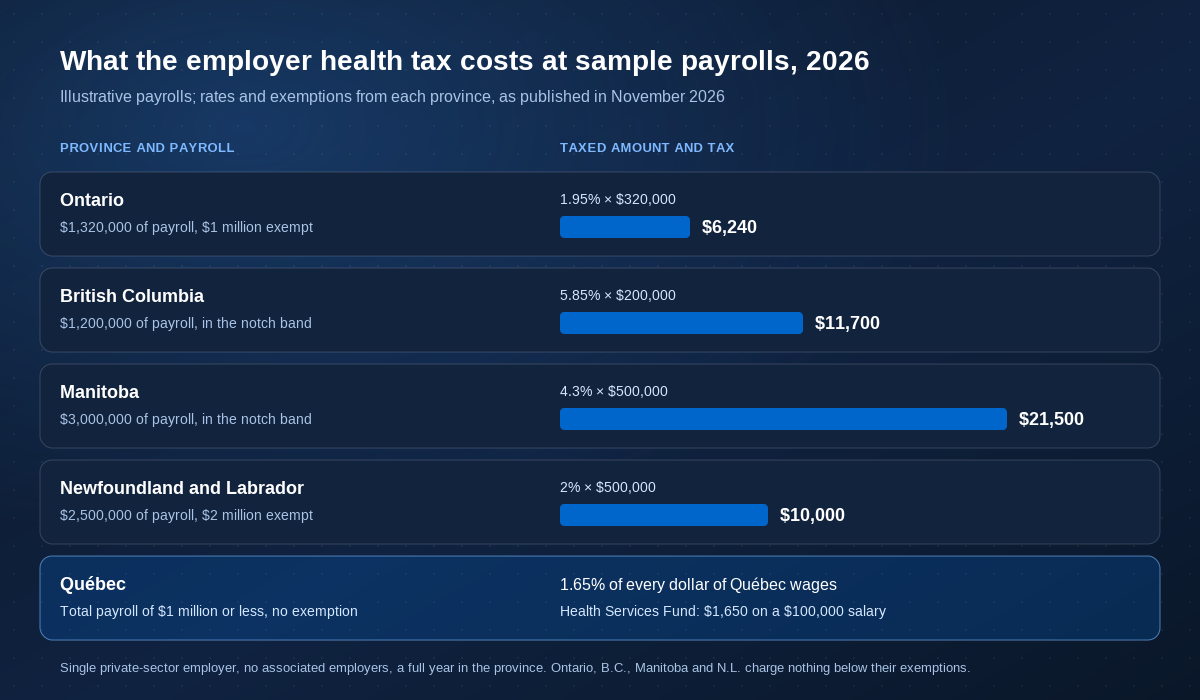
The payroll figures below are illustrative, for a single private-sector business with no associated employers, a full year in the province and no charity status. The calculations use the rules in the table above.
| Province | Payroll taxable in the province | Calculation | Tax for 2026 |
|---|---|---|---|
| Ontario | $1,320,000 (12 employees at $110,000) | 1.95% × ($1,320,000 − $1,000,000) | $6,240 |
| British Columbia | $1,200,000 | 5.85% × ($1,200,000 − $1,000,000) | $11,700 |
| Manitoba | $3,000,000 | 4.3% × ($3,000,000 − $2,500,000) | $21,500 |
| Newfoundland and Labrador | $2,500,000 | 2% × ($2,500,000 − $2,000,000) | $10,000 |
| Québec | $300,000, with total payroll of $3,000,000 | about 2.42% × $300,000 | about $7,250 |
Québec’s rate between $1 million and $7.8 million comes from a formula in section 34 of the Act. For most employers in 2026, it rises in a straight line from 1.65% at $1 million of total payroll to 4.26% at the $7,800,000 total payroll threshold; at $3 million it is about 2.42%. Total payroll, as the Act defines it, includes the wages of associated employers. The lower rates are for what the Act calls a specified employer, which must have an establishment in Québec in the year; in any other case the rate is 4.26%. A separate scale starting at 1.25% applies to employers the Act calls eligible specified employers.
For one hire, these numbers are usually small or zero. A U.S. company with two employees in Ontario, on a total Ontario payroll far below $1 million, owes no EHT and, if it is an eligible employer, does not need to register. To see every employer cost for a salary and province, including CPP or QPP, EI and the Québec contributions, use the employer cost calculator.
How does an employer register, pay and file?
Each province runs its own account, separate from the CRA payroll account. The two largest provinces work like this:
- Ontario: register when the payroll passes the exemption. The ministry says an employer must register if it is not eligible for the exemption, or is eligible but its payroll exceeds its exemption amount. Registration is online or by phone.
- Ontario: pay monthly instalments above $1.2 million. Since the 2021 tax year, an employer whose Ontario payroll is over $1,200,000 pays monthly instalments; below that, it pays once with the return.
- Ontario: file by March 15. The annual return and any balance are due on or before March 15 of the following year.
- British Columbia: register in the first year the payroll passes $1 million. For 2026 that means by December 31, 2026, with the return and final payment due March 31, 2027, according to the province’s overview.
- Québec: pay the Minister of Revenue. Section 34 of the Act requires the Health Services Fund contribution to be paid to the Minister of Revenue, whose agency is Revenu Québec, not to the CRA.
Ontario also tells out-of-province employers that set up a permanent establishment in Ontario for less than 24 months to call the ministry about their registration. If your company is opening a project office or sending staff to a client site, that is the case it describes.
What changes when you hire through an employer of record?
The employer of record becomes the employer for these taxes, so its establishments and its payroll are what the tests look at. An employer of record is a company that legally employs a person on behalf of another business, which directs the day-to-day work.
Three things follow for a U.S. company:
- The registration is not yours. You do not open a provincial account, track the exemption or file the annual return.
- The exemption is not yours either. Whether the tax applies, and at what rate, depends on the employer of record’s payroll in the province, not on your one or two hires.
- The cost shows up on the invoice. Any provincial employer charge for your hire is part of the employer costs, alongside CPP or QPP and EI. InfraDev passes provincial employer charges, such as Québec’s Health Services Fund, through at cost, as the pricing page sets out.
InfraDev has been an employer of record in Canada since 2016, and most hires start within 24–48 hours once terms are agreed. If you are weighing your own Canadian company instead, the comparison of an employer of record vs a Canadian entity covers the registrations an entity takes on, this tax among them. For Québec’s other employer contributions, see hiring an employee in Québec.
Summary
- Ontario, British Columbia, Manitoba, Newfoundland and Labrador, and Québec each charge employers a payroll tax for health care in 2026.
- Ontario deducts the first $1 million for eligible employers with Ontario payroll under $5 million; British Columbia charges nothing on payroll of $1 million or less, Manitoba nothing on $2.5 million or less, and Newfoundland and Labrador taxes only payroll above $2 million. Québec’s rate starts at 1.65% with no exemption.
- Where a province spells out the test, the tax follows the employer’s establishment in the province, not the employee’s home, and whether a home office counts depends on the facts.
- One or two hires rarely cost anything in Ontario, British Columbia, Manitoba or Newfoundland and Labrador, but a Québec hire carries the Health Services Fund from the first dollar.
- With an employer of record, the registration, the calculation and the return are the employer of record’s, and the cost is a line on its invoice.
Sources
- Ontario Ministry of Finance: Employer Health Tax (EHT) (updated September 18, 2026)
- Ontario Ministry of Finance: EHT tax exemption (updated May 22, 2026)
- Ontario Ministry of Finance: EHT in practice, permanent establishment scenarios (updated December 1, 2025)
- British Columbia: Employer health tax overview and B.C. remuneration (each last updated June 17, 2026)
- Manitoba Finance: Health and Post-Secondary Education Tax Levy (read November 26, 2026) and Bill 46, The Budget Implementation and Tax Statutes Amendment Act, 2025, Part 2 and subsection 52(3)
- Newfoundland and Labrador Department of Finance: Health and Post Secondary Education Tax (Payroll Tax) (read November 26, 2026)
- Québec: Act respecting the Régie de l’assurance maladie du Québec, sections 33 and 34 (up to date to October 15, 2026)
This article is general information, not legal or tax advice. It reflects each source as published in November 2026; confirm how a provincial payroll tax applies to a specific employer and employee with the province’s tax administration or a tax adviser before relying on it.
Frequently asked questions
How much is the employer health tax in Ontario for a small U.S. company in 2026?
Ontario's Employer Health Tax charges 0.98% to 1.95% of Ontario payroll, but an eligible employer whose Ontario payroll is under $5 million deducts a $1 million exemption first. An employer with a few remote employees in Ontario usually owes nothing. One whose Ontario payroll passes its exemption registers and files the annual return by March 15.
Does a U.S. company owe employer health tax on a remote employee working from home in Canada?
In Ontario, British Columbia and Québec, a U.S. company owes the tax when the employee reports for work at, or is paid from, the company's permanent establishment in that province. The employee's home province does not decide it. Ontario's interpretation letters show a home office counting as a permanent establishment in some cases and not in others.
Which provinces in Canada charge employers a health tax on payroll in 2026?
In 2026, the provincial payroll taxes for health care are Ontario's Employer Health Tax, British Columbia's Employer Health Tax, Manitoba's Health and Post-Secondary Education Tax Levy, Newfoundland and Labrador's Health and Post-Secondary Education Tax, and Québec's contribution to the Health Services Fund. Each sets its own rate, exemption and filing rules.
How does Québec's Health Services Fund contribution work for an employer in 2026?
Québec's Health Services Fund contribution is a percentage of wages paid to employees who report to, or are paid from, the employer's establishment in Québec. Most employers pay 1.65% when total payroll is $1 million or less, rising in a straight line to 4.26% at the 2026 threshold of $7.8 million.
Who pays the employer health tax when a U.S. company hires in Canada through an employer of record?
The employer of record is the legal employer in Canada, so the provincial employer health tax tests apply to its establishments and its payroll, not to the U.S. company's. Whatever the employer of record pays for your hire is one of the employer costs on its invoice. InfraDev passes provincial employer charges through at cost.
Related reading
-
Canada vs U.S. payroll: what changes for a U.S. employer
The differences a U.S. company meets when it pays employees in Canada: provincial instead of state tax, CPP and EI instead of Social Security and Medicare, TD1 and T4 instead of W-4 and W-2, and stricter remittance deadlines.
Read the article -
Province of employment for remote employees in Canada: what a U.S. employer applies
The province of employment for remote employees in Canada is set by the CRA's payroll rules, not by where the person lives. A fully remote employee takes the province of the employer's establishment they are attached to, or the one that pays them. Employment standards follow the province where the work is done, so the two can differ.
Read the article -
Hiring an employee in Québec: what U.S. companies should know
What changes when your Canadian hire lives in Québec: French job offers and contracts, payroll through Revenu Québec, Québec labour standards, and Law 25.
Read the article -
Permanent establishment in Canada: when a U.S. company's hire creates a taxable presence
A permanent establishment in Canada is a taxable presence under the Canada-U.S. tax treaty. A U.S. company gets one through a fixed place of business, a person in Canada who habitually signs contracts in its name, or services delivered in Canada for 183 days or more. Hiring one remote employee does not create one automatically. What the person does, and where, decides it.
Read the article
Next steps for hiring in Canada
Hiring in a province with an employer health tax?
Tell us the role and the province. We'll explain what the employer pays on top of salary and how it appears on your invoice.