How to get a job in the US from Canada, with or without moving
How to get a job in the US from Canada: move on TN status, or keep living in Canada and work remotely for a U.S. company, employed in Canada. What each route needs, how to present yourself to U.S. employers, and how InfraDev helps you get hired.
Published November 28, 2026
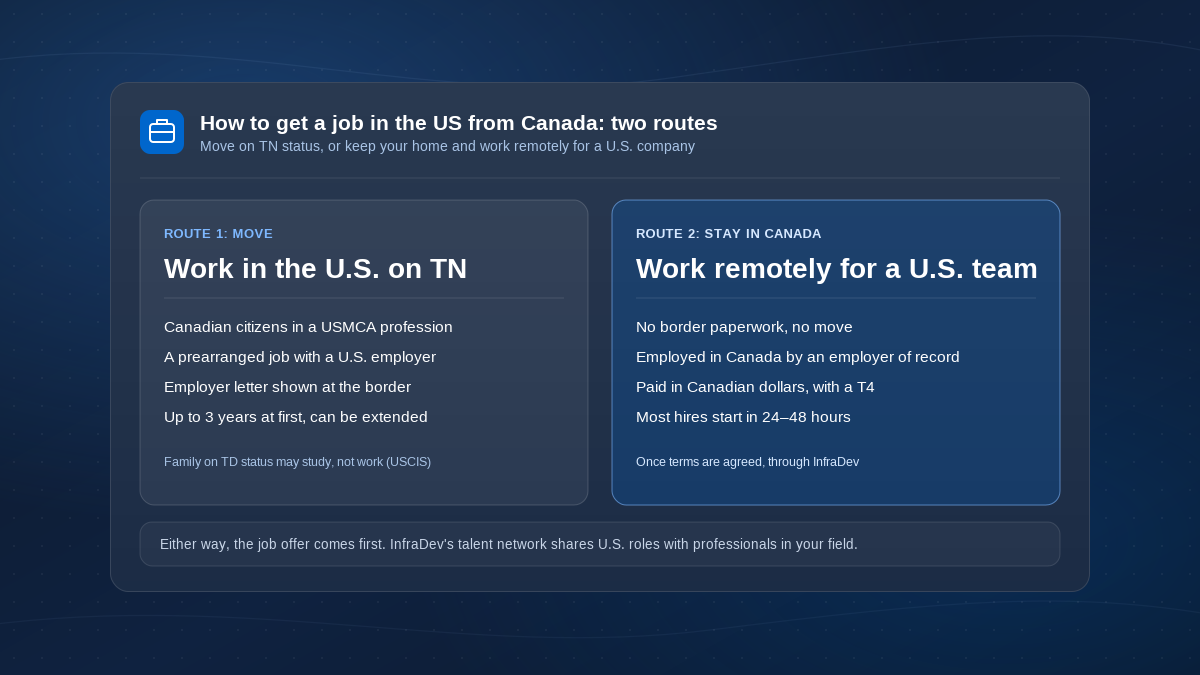
There are two ways to get a job in the US from Canada. You can move, usually on TN status if you are a Canadian citizen in a listed profession with a U.S. job offer. Or you can keep living in Canada and work remotely for a U.S. company, employed in Canada. The second needs no border paperwork, and it is the route InfraDev helps you with.
What are the two ways to get a job in the US from Canada?
The two ways are to move and work in the United States, or to stay in Canada and work for a U.S. employer remotely. They suit different people, and the table shows where they differ.
Move to the U.S. on TN status
Work remotely from Canada
Where you live and work
In the United States
In Canada
Who can use it
Canadian citizens in a USMCA profession, with a prearranged U.S. job
People entitled to work in Canada, in a role that can be done remotely
Who employs you
The U.S. employer
A Canadian employer: usually an employer of record, or the company’s Canadian subsidiary
What you show at the start
Proof of citizenship and an employer letter to a U.S. border officer
Your Canadian employment documents, as for any job in Canada
How long it lasts
Up to 3 years at first, and it can be extended
As long as the job does
Your family
Spouse and children may get TD status: they can study but not work
Nothing changes
The rest of this article covers how each route works, then how to land the job, which is the hard part either way.
How does a Canadian get TN status to work in the U.S.?
TN status lets qualified Canadian and Mexican citizens enter the United States temporarily to work at a professional level, under the United States-Mexico-Canada Agreement (USMCA). The U.S. Citizenship and Immigration Services (USCIS) page on TN USMCA professionals (last reviewed June 4, 2025) sets out five conditions:
You are a citizen of Canada or Mexico.
Your profession is included in the USMCA.
The position in the United States requires a USMCA professional.
You will work in a prearranged full-time or part-time job for a U.S. employer or entity.
You have the qualifications to practise the profession.
For Canadian citizens, USCIS says there is no TN visa to apply for at a consulate. You establish eligibility when you seek admission, at certain designated ports of entry or pre-clearance stations, by giving a U.S. Customs and Border Protection officer proof of citizenship, a letter from the employer describing the role, purpose, length of stay and your qualifications, and a credentials evaluation if one applies. The employer can instead file Form I-129 with USCIS first. The initial stay is up to 3 years, and it can be extended.
Two things to know before you choose this route. Permanent residence in Canada is not enough: TN is for citizens. And the job offer has to come first, because the status is tied to a prearranged job, so the job search below still decides everything. Immigration rules change and depend on your facts, so confirm your profession and documents with USCIS, CBP or an immigration lawyer before you travel.
How do you get a U.S. job while staying in Canada?
You get a U.S. job while staying in Canada the same way you would get any remote job, then have the U.S. company employ you in Canada. The work happens where you are, so you are hired under Canadian payroll and your province’s employment standards, not U.S. immigration rules.
U.S. companies do this in three ways: through a Canadian employer of record, through a Canadian subsidiary if they have one, or by engaging you as an independent contractor for genuinely independent work. Our guide to working for a U.S. company from Canada compares the three and explains which country taxes the income.
An employer of record is a company that legally employs a person on behalf of another business, which directs the day-to-day work. For you, it means a Canadian employment contract, Canadian-dollar pay with tax and contributions deducted, and a T4 at year end, while you work with the U.S. team every day.
Where do Canadians find U.S. employers who will hire them?
Canadians find U.S. employers who will hire them by looking where remote work is already normal, and by being easy to say yes to. A few habits make the search shorter:
Read the location line, not the title. Postings marked remote in “North America”, “Americas time zones” or “U.S. or Canada” are open to you. “U.S. only” often describes where the company’s payroll runs, not a view on Canadian candidates.
Start with companies that already have a distributed team. A U.S. company with people in several states already works across time zones and video calls.
Use your time zone as a selling point. Toronto and Montréal work Eastern time; Winnipeg, Central; Calgary, Mountain; Vancouver, Pacific. You can work the same hours as the team.
Let roles come to you. InfraDev’s talent network shares U.S. roles with professionals in the right field when a client sends us a job description. You are presented only for the roles you say yes to.
Are you a Canadian professional whose work happens on a laptop? Have you worked with people in other cities, over video, without missing a beat? Would you rather keep your home, your health card and your community while you work with a U.S. team? Then you are exactly the kind of candidate U.S. companies hire remotely, and the network is built for you.
How should you present yourself to a U.S. employer?
Present yourself so a U.S. recruiter can see in ten seconds where you are, how you can be hired and what you will cost. A recruiter who has to guess any of the three is more likely to move on to the next résumé.
Put your location and time zone at the top. “Ottawa, Ontario, Eastern time” tells the recruiter you can join the 9 a.m. stand-up.
Say how you can be employed. Add one line: “Can be employed in Canada through an employer of record; no U.S. sponsorship needed.” It answers the question the recruiter was about to ask.
State the currency with every number. Write “US$” or “C$” every time, in applications and in salary conversations. If you will be employed through an employer of record, you are paid in Canadian dollars, so agree the Canadian figure or how a U.S. figure converts.
Name Canadian credentials in full. “CPA (Chartered Professional Accountant, Canada)” or “P.Eng., Professional Engineers Ontario” reads clearly to someone who has never seen the abbreviation.
Match the job’s vocabulary. If the posting says “payroll” and your title said “remuneration”, use their word in your summary.
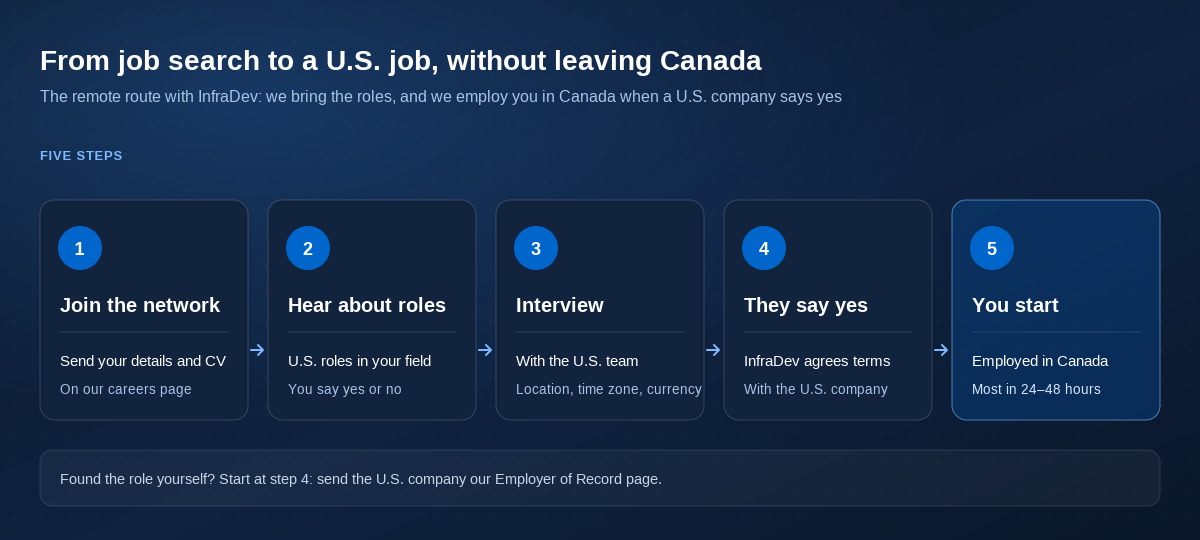
When a U.S. company says yes, what is left is paperwork, and we handle it. With InfraDev as the employer of record, it runs like this:
The company tells us about you. You make the introduction, or the role came through our network.
We agree terms with the company. Salary, start date and what the company chooses to offer in benefits.
We issue your employment contract for your province, and collect your social insurance number and tax forms.
You start work. Most hires start within 24–48 hours once terms are agreed. You work with the U.S. team; we run your payroll.
The remote route with InfraDev. If you found the role yourself, start at step 4.
What you get is an ordinary Canadian job with a U.S. team: pay in Canadian dollars with deductions at source, a T4 slip, and your province’s vacation, holiday and notice rules. Group benefits depend on what the U.S. company chooses to offer. The worked example after this article shows one Canadian pay, line by line. If you work from home, the post on work from home expenses in Canada explains what you may be able to claim.
How do you spot a fake U.S. job offer?
A genuine U.S. job offer never asks you to pay, to deposit a cheque or to move money for the employer. The Canadian Anti-Fraud Centre’s page on job scams describes the common versions: counterfeit cheques sent to people who posted résumés online, “financial agent” roles that turn the victim into a money mule, and online “tasks” paid in crypto that cannot be withdrawn.
A real remote job has a named employer, an interview with people who do the work, and a written contract before your first day. If an offer arrives without those, stop and check.
How InfraDev helps you get a job with a U.S. company
InfraDev finds and employs remote Canadian talent for U.S. companies, and has been an employer of record in Canada since 2016. For you, that means two kinds of help:
Finding the role. Join the talent network. When a U.S. client sends us a job description, we share it with professionals in that field, and present you only for roles you want.
Getting hired. If a U.S. company you found wants to hire you, send them our Employer of Record page. We employ you in Canada, so the company has nothing to set up, and you keep the security of Canadian employment.
Summary
There are two ways to get a job in the US from Canada: move on TN status, or work remotely for a U.S. company from Canada.
TN status is for Canadian citizens in a USMCA profession with a prearranged U.S. job, and family members on TD status cannot work.
Working remotely from Canada keeps you on Canadian payroll, usually through an employer of record, with your province’s employment rules.
Put your location, time zone, how you can be employed and the currency on every application.
InfraDev’s talent network brings U.S. roles to you, and InfraDev employs you in Canada once a U.S. company says yes.
This article is general information, not immigration, legal or tax advice. Immigration rules depend on your citizenship, profession and circumstances; confirm them with U.S. Citizenship and Immigration Services, U.S. Customs and Border Protection or an immigration lawyer before you rely on them.
A worked example: one Canadian pay
One pay for an employee in Ontario earning $100,000 a year, paid every two weeks. Each numbered line is explained beside the stub.
Pay statement · Example
Sample employee, Ontario
Pay frequency
Every two weeks
Pays a year
26
Rates
2026
Earnings and deductions for one pay, with the full-year total
Earnings
This pay
Full year
Regular salary
$3,846.15
$100,000.00
Deductions
1Income tax, federal and Ontario
−$770.17
−$20,024.35
2CPP and CPP2 contributions
−$178.71
−$4,646.45
3EI premiums
−$43.20
−$1,123.07
Net pay
$2,854.08
$74,206.13
4Employer's share, paid on top of salary
Employer contributions for one pay, with the full-year total
CPP and CPP2, employer share
$178.71
$4,646.45
EI, employer share (1.4×)
$60.47
$1,572.30
5Remitted to the CRA
$1,231.25
$32,012.61
Illustrative, in Canadian dollars, using 2026 rates with income tax simplified. CPP and EI stop once the yearly maximums are reached, so per-pay amounts here are averages over the year.
1
Income tax
Federal and provincial tax, based on the province where the employee lives, their earnings and their TD1 forms. Withheld from every pay.
Employee and employer pay equal shares on earnings up to the first ceiling, plus CPP2 between the first and second ceilings. Deductions stop once the yearly maximum is reached. QPP replaces CPP in Québec.
Not deducted from the employee: the employer pays it on top of salary and remits it with the deductions.
5
Remitted to the CRA
Everything withheld plus the employer’s share, usually by the 15th of the following month. In Québec, part goes to Revenu Québec.
Frequently asked questions
How can a Canadian get a job in the US without moving?
A Canadian can work for a U.S. company without moving by doing the job remotely from Canada. The company employs the person in Canada, usually through a Canadian employer of record such as InfraDev, which runs Canadian payroll and applies provincial employment rules while the person works with the U.S. team.
What does a Canadian citizen need to work in the U.S. on TN status?
A Canadian citizen needs a profession listed in the USMCA, a prearranged full-time or part-time job with a U.S. employer that requires that profession, and the qualifications to practise it. USCIS says Canadians living outside the U.S. are not required to apply for a TN visa at a consulate; they present proof of citizenship and an employer letter to a CBP officer.
What should a Canadian put on a résumé for U.S. jobs?
A Canadian applying for U.S. jobs should put the city, province and time zone at the top of the résumé, say how they can be employed, and name Canadian credentials in full. One line such as "Toronto, Ontario, Eastern time, can be employed in Canada through an employer of record" answers the recruiter's first question.
How does InfraDev help Canadians get hired by U.S. companies?
InfraDev helps in two ways. Canadians who join its talent network hear about U.S. roles in their field and are presented only for the roles they want. And when a U.S. company wants to hire a Canadian, InfraDev employs that person in Canada, so most hires start within 24–48 hours once terms are agreed.
Should a Canadian ask a U.S. company for a salary in U.S. or Canadian dollars?
A Canadian should agree the currency before the number. A Canadian employed through an employer of record is paid in Canadian dollars, so either agree a Canadian-dollar salary or agree how a U.S.-dollar figure will be converted. Stating the currency every time avoids an offer that is smaller, or larger, than either side meant.
What status does a Canadian TN worker's family get in the U.S.?
A TN worker's spouse and unmarried children under 21 may be eligible for TD status, for no longer than the TN worker's own stay. USCIS says TD family members may study in the United States but are not permitted to work, which is one reason many families prefer the remote route from Canada.
Payroll, CRA registration and employment law for U.S. companies.
Looking for your next role with a U.S. team?
Join the InfraDev talent network. When a U.S. company sends us a role in your field, we tell you about it, and if you're hired, we employ you in Canada.