
Blog
Remote work policy in Canada: what a U.S. employer has to put in writing
No Canadian law requires a remote work policy by that name, but parts of one are mandatory. In Ontario, an employer with 25 or more employees must have written policies on disconnecting from work and on electronic monitoring. Health and safety law reaches the home office, and regulators in Québec and British Columbia point employers to a written policy.
Published November 22, 2026
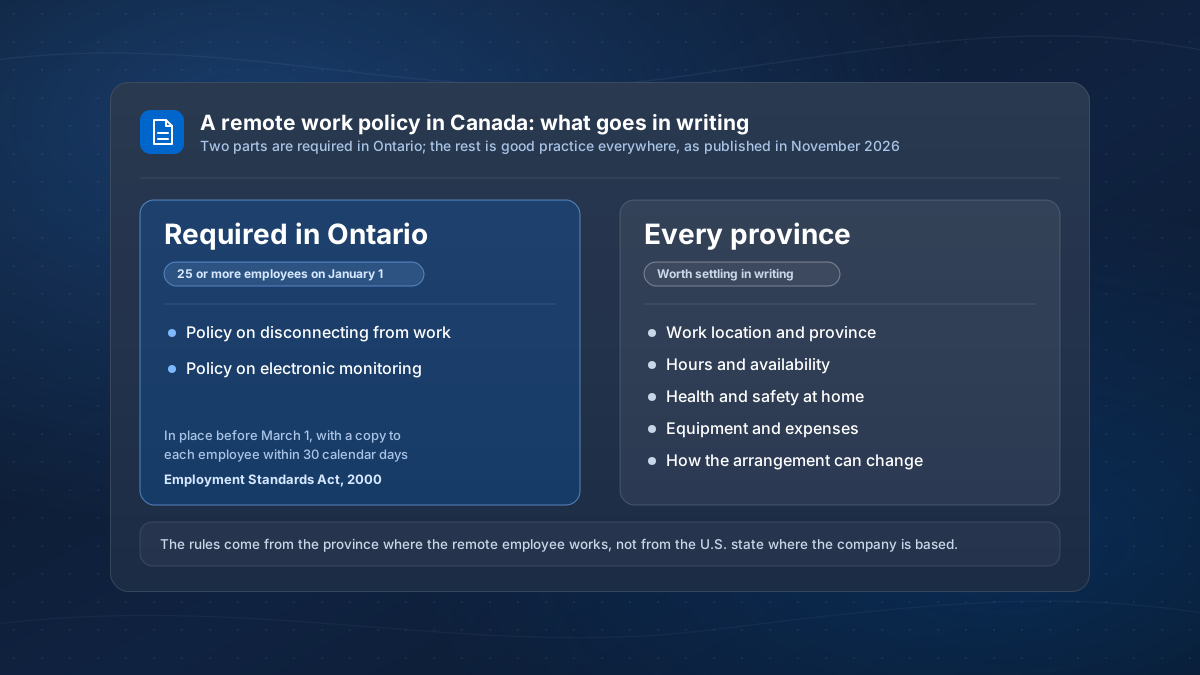
No law requires a remote work policy in Canada by that name, but parts of one are mandatory. In Ontario, an employer with 25 or more employees must have written policies on disconnecting from work and on electronic monitoring. Health and safety law reaches the home office, and regulators in Québec and British Columbia point employers to a written policy.
Is a remote work policy required in Canada?
Not as a single document. Canada has no national law on remote work, and employment standards are set province by province. What exists are specific duties that a remote work policy is the natural place to meet: two written policies in Ontario, health and safety duties that follow the employee home, and privacy rules on monitoring.
A remote work policy is the employer’s written statement of how work done away from its premises is arranged: who may work remotely, from where, during which hours, with what equipment, and under which safety, privacy and security rules. A remote work agreement applies those terms to one employee.
For a U.S. employer, the difference from home is the source of the rules. They come from the province where the remote employee works, not from the state where the company is based. The post on the province of employment for remote employees explains how that province is settled for payroll and for employment standards.
What does Ontario require in writing for remote employees?
Ontario requires two written policies from any employer with 25 or more employees in Ontario on January 1 of a year: one on disconnecting from work and one on electronic monitoring. Both must be in place before March 1 of that year, and both apply whether employees work at home or on site.
| Disconnecting from work | Electronic monitoring | |
|---|---|---|
| Who needs it | Employers with 25 or more employees in Ontario on January 1 | Employers with 25 or more employees in Ontario on January 1 |
| Deadline | Before March 1 of that year | Before March 1 of that year |
| What it must contain | A policy on disconnecting from work, with the date it was prepared and the date of any changes | Whether the employer monitors employees electronically; if so, how, in what circumstances and for what purposes; the date prepared and the date of any changes |
| Who it covers | All of the employer’s employees in Ontario, managers and executives included | All employees in Ontario, and assignment employees placed with the employer |
| Copy to employees | Within 30 calendar days of the policy being prepared or changed, and within 30 days of hire for a new employee | Within 30 calendar days of the date the policy is required or changed, or of hire if later |
| Records | Kept for three years after the policy stops being in effect | Kept for three years after the policy stops being in effect |
Both columns come from Ontario’s guide to the Employment Standards Act, in its chapters on a written policy on disconnecting from work and a written policy on electronic monitoring of employees, each updated July 8, 2024.
Disconnecting from work is defined in the Act as not engaging in work-related communications, including emails, telephone calls, video calls or other messages, so as to be free from the performance of work. Two details matter to a U.S. team working across time zones:
- The policy does not have to grant a right. The guide says the Act does not require an employer to create a new right for employees to disconnect. The employer decides the content.
- After-hours work still counts. The guide says time spent reviewing or drafting emails is generally working time under the Act, even at home after the day is over, and even if the policy says not to. A message sent at 5 p.m. in California reaches Toronto at 8 p.m., and the hours an employee spends answering it count toward the province’s overtime rules.
How is Ontario’s 25-employee threshold counted?
By head, in Ontario, on January 1. The guide counts each part-time and casual employee as one, adds up every location in Ontario, and includes employees on leave or lay-off, probationary employees and homeworkers. Related employers treated as one employer are counted together.
The count is fixed for the year. An employer with 20 employees in Ontario on January 1 that hires five more in May is not covered that year. An employer with 25 on January 1 that later drops to 20 stays covered until the next January 1.
Does health and safety law apply to a remote employee’s home in Canada?
Yes, in the three provinces checked for this article. The employer’s health and safety duties do not stop at the office door, and each regulator expects the employer to address the home workspace in some form.
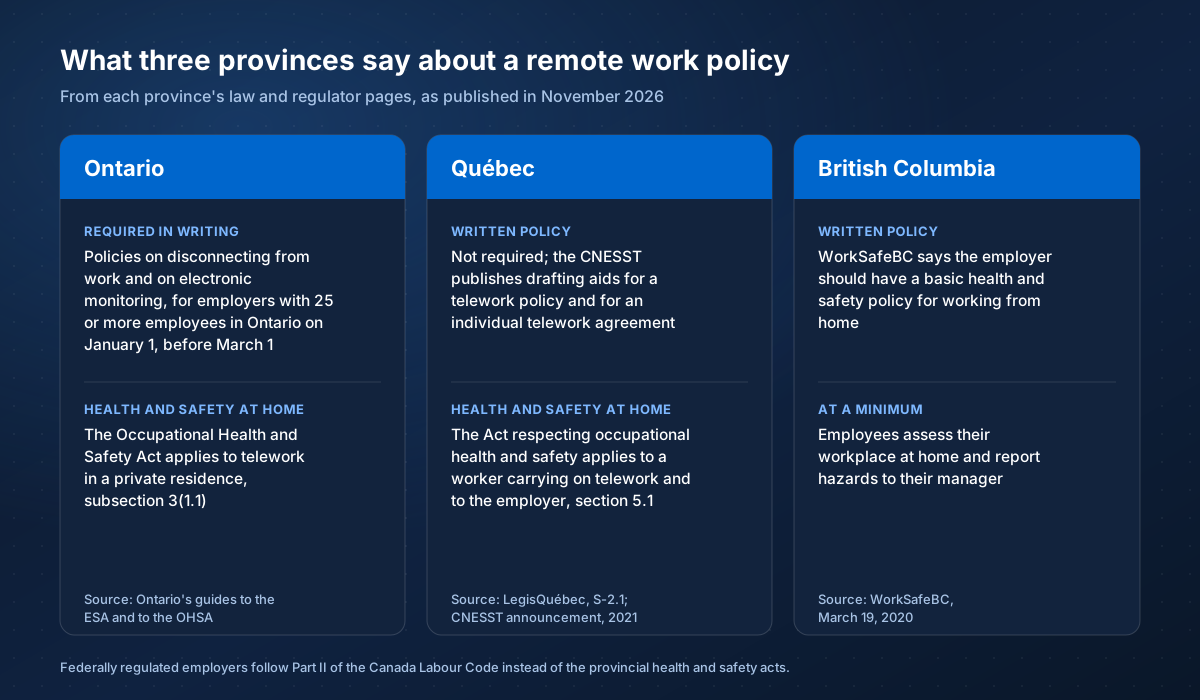
- Ontario. The Occupational Health and Safety Act generally does not cover work done by an owner or occupant in a private residence, but Ontario’s guide to the Act (updated March 24, 2025) states the exception: telework performed in or about a private residence is covered, under subsection 3(1.1).
- Québec. Section 5.1 of the Act respecting occupational health and safety, added in October 2021, says the Act applies to a worker carrying on telework and to the employer, subject to any incompatible provision, in particular with respect to the workplace. Section 179.1 adds a limit: an inspector may not enter a telework place in a dwelling without the worker’s consent or a court order.
- British Columbia. WorkSafeBC’s guidance on health and safety responsibilities when working from home, published March 19, 2020, says the employer should have a basic health and safety policy for working from home. At a minimum, the policy should have employees assess their workplace at home and report hazards to their manager.
Federally regulated employers, such as banks, airlines and telecommunication companies, are outside the provincial acts. Ontario’s guide points them to Part II of the Canada Labour Code.
In Québec, a written policy is a tool rather than a legal requirement. The province’s labour standards and health and safety regulator, the CNESST, published two drafting aids in October 2021, one for a telework policy and one for an individual telework agreement, with a checklist for spotting telework risks. Its announcement on Québec.ca (in French) adds that telework does not change the rights and obligations of employers and workers, and that labour laws apply at all times. A policy given to an employee in Québec raises a language question as well, covered in hiring an employee in Québec.
Can an employer monitor remote employees in Canada?
Yes, but openly and for a stated purpose. In Ontario, the written electronic monitoring policy has to describe the monitoring. Across Canada, the federal privacy regulator says employers must make employees aware of the purpose, nature, extent and reasons for monitoring, apart from exceptional circumstances.
Ontario’s rule is about transparency. The guide says the policy must capture monitoring wherever it happens, including on an employee’s own computer used for work, and that it applies equally at home, at the workplace or under a hybrid model. If the employer does not monitor, the policy must say so. The guide is also clear about the limit: the requirement does not give employees a right not to be monitored and creates no new privacy rights.
Privacy law is a separate layer, and it varies by employer and province. The Office of the Privacy Commissioner of Canada’s page on privacy in the workplace (modified May 29, 2025) says the federal private-sector law, PIPEDA, applies to employee information in federally regulated businesses, and that several provinces have privacy legislation applying to employee information. Its summary of privacy laws names Alberta, British Columbia and Québec as the provinces with their own private-sector laws.
The same page describes what reasonable monitoring looks like: limited to purposes that are specific, targeted and appropriate, using the least privacy-invasive measure that works, with retention limits and a way for employees to see what was collected. A U.S. company that installs the same endpoint and activity-tracking tools on every laptop should list what those tools record before a Canadian employee starts.
What should a remote work policy in Canada include?
A remote work policy in Canada should settle eight points: where the work is done, the hours, disconnecting, monitoring, health and safety, equipment and expenses, confidentiality, and how the arrangement can change. The first five carry legal weight in at least one province. The rest prevent disputes.
| Clause | What to settle | Where the rule comes from |
|---|---|---|
| Work location | The home address and province; approval before the employee moves province or works from another country | The province decides employment standards and payroll, and the CRA’s remote work test looks for a full-time remote work agreement |
| Hours and availability | Core hours in the employee’s time zone; how overtime is approved | The province’s hours of work and overtime rules |
| Disconnecting from work | Expectations for after-hours emails, calls and messages | Required in writing in Ontario for employers with 25 or more employees |
| Electronic monitoring | Whether monitoring happens, how, when and why | Required in writing in Ontario for employers with 25 or more employees; privacy law elsewhere |
| Health and safety | Workspace self-assessment, reporting hazards and injuries, an emergency contact | Provincial health and safety law and each regulator’s guidance |
| Equipment and expenses | Who supplies the laptop and furniture; which costs are reimbursed, and how | The employment contract; the CRA’s Form T2200 if the employee claims home office expenses |
| Confidentiality and security | Device use, storage of company data, who else may use the equipment | The employment contract |
| Changing the arrangement | Whether remote work is a term of the job or can be reviewed, and the notice for a change | The employment contract and the province’s employment standards |
Two of these need a note.
Equipment and expenses. Say plainly what the company provides and what it reimburses. An employee in Canada who deducts home office expenses needs a completed and signed Form T2200, Declaration of Conditions of Employment, from the employer, according to the CRA’s page on how to claim home office expenses (page details dated January 20, 2026). The employee keeps the form and does not file it with the return. Decide who will sign it before the first tax season.
Confidentiality and security. A policy can set the rules for devices and data, but protection of confidential information and intellectual property belongs in the contract. The post on non-compete agreements in Canada covers the clauses that hold up.
A worked example: one U.S. company, six remote employees
The scenario is illustrative. A U.S. software company employs six fully remote people in Canada directly, through its own Canadian payroll account: four in Ontario, one in Québec and one in British Columbia. It counts its employees on January 1, 2027.
- Ontario’s written policies. With four employees in Ontario, the company is under the 25-employee threshold, so the Employment Standards Act does not require the disconnecting or monitoring policies for 2027. Employees in other provinces and in the United States are not part of the Ontario count.
- Health and safety. The threshold does not affect this. Ontario’s Occupational Health and Safety Act applies to the four employees’ telework at home. For the Québec employee, the province’s Act respecting occupational health and safety applies to the telework. For the employee in British Columbia, WorkSafeBC’s guidance calls for a basic policy with a workspace assessment.
- Monitoring. The company’s laptops log sign-in times and block some websites. No Ontario policy is required at this size, but the federal privacy regulator’s guidance still points to telling all six employees what is collected and why.
- The company grows. If it has 25 employees in Ontario on January 1, 2028, both written policies must be in place before March 1, 2028, with copies to every Ontario employee within 30 calendar days.
A single document can cover all six people: one set of common terms, with a short schedule for each province.
Who writes the remote work policy when you hire through an employer of record?
The employer of record does, for the parts the law places on the employer. It is the legal employer in Canada, so required written policies, health and safety duties and the employment contract rest with it. Your company directs the daily work, so the practical terms come from you.
That split works when both sides describe the same arrangement. Share your working hours, the equipment you ship, your security rules and what your systems monitor, so the documents the employee receives match what happens on your team.
InfraDev has been an employer of record in Canada since 2016, and most hires start within 24–48 hours once terms are agreed. We issue the employment contract for the employee’s province and run payroll; you manage the work. The Employer of Record page sets out what we handle as the employer, and the Canadian employment law basics page lists the provincial standards behind the contract.
If your candidate is still weighing the offer, the page on working remotely for a U.S. company from Canada explains the arrangement from their side.
Summary
- No law requires a remote work policy in Canada by that name, but specific duties make a written one the practical answer.
- Ontario requires written policies on disconnecting from work and on electronic monitoring from employers with 25 or more employees in Ontario on January 1, in place before March 1.
- Health and safety law reaches the home: Ontario’s Act covers telework in a private residence, and regulators in Québec and British Columbia expect the home workspace to be addressed.
- Monitoring of remote employees has to be transparent, limited to stated purposes and proportionate.
- Location, hours, equipment, expenses and how the arrangement can change belong in writing in every province.
Sources
- Ontario: Your guide to the Employment Standards Act, written policy on disconnecting from work (updated July 8, 2024)
- Ontario: Your guide to the Employment Standards Act, written policy on electronic monitoring of employees (updated July 8, 2024)
- Ontario: Guide to the Occupational Health and Safety Act, Part I: Application (updated March 24, 2025)
- Québec: Act respecting occupational health and safety, sections 5.1 and 179.1 (up to date to October 15, 2026)
- Gouvernement du Québec: Télétravail, de nouveaux outils pratiques mis au point par la CNESST (October 7, 2021, in French)
- WorkSafeBC: Health and safety responsibilities when working from home (published March 19, 2020)
- Office of the Privacy Commissioner of Canada: Privacy in the workplace (modified May 29, 2025) and Summary of privacy laws in Canada (modified January 31, 2018)
- Canada Revenue Agency: How to claim, home office expenses for employees (page details dated January 20, 2026)
- Canada Revenue Agency: Determine the province of employment (POE) (page details dated March 10, 2026)
This article is general information, not legal or tax advice. It reflects each source as published in November 2026; confirm the requirements for a specific employee and province with the regulator or an employment lawyer before relying on a policy.
Frequently asked questions
Is a remote work policy required by law in Canada?
No single Canadian law requires a remote work policy by that name. Ontario requires employers with 25 or more employees in Ontario on January 1 to have written policies on disconnecting from work and on electronic monitoring. Québec's CNESST offers drafting aids for a telework policy, and WorkSafeBC expects a basic work-from-home policy in British Columbia.
Does Canada have a right to disconnect for remote employees?
Ontario requires a written policy on disconnecting from work from employers with 25 or more employees, but the province's guide says the law does not create a new right to disconnect. Time a remote employee spends on work email after hours is generally working time under Ontario's Employment Standards Act, so hours of work and overtime rules still apply.
Can a U.S. employer monitor a remote employee in Canada?
A U.S. employer can monitor a remote employee in Canada, provided it is open about it. In Ontario, employers with 25 or more employees need a written electronic monitoring policy that covers work done at home. The Office of the Privacy Commissioner of Canada says monitoring should be limited to specific purposes and explained to employees.
Is an employer responsible for health and safety when an employee in Canada works from home?
The employer keeps its health and safety duties when an employee works from home, in each province checked for this article. Ontario's Occupational Health and Safety Act applies to telework performed in a private residence. Québec's Act respecting occupational health and safety applies to a worker carrying on telework and to the employer, and WorkSafeBC says an employer in British Columbia should have a basic health and safety policy for working from home.
What should a remote work policy for employees in Canada include?
A remote work policy for employees in Canada should cover the work location and province, hours and availability, disconnecting from work, electronic monitoring, health and safety at home, equipment and expenses, confidentiality, and how the arrangement can change. In Ontario, the disconnecting and monitoring parts must show the date the policy was prepared and the date of any changes.
Who writes the remote work policy when a U.S. company hires through an employer of record in Canada?
The employer of record is the legal employer in Canada, so the employer's duties under provincial law, including any required written policies, rest with it. The U.S. company directs the daily work, so it supplies the practical terms: working hours, tools, security rules and any monitoring its systems perform. Both should describe the same arrangement.
Related reading
-
Province of employment for remote employees in Canada: what a U.S. employer applies
The province of employment for remote employees in Canada is set by the CRA's payroll rules, not by where the person lives. A fully remote employee takes the province of the employer's establishment they are attached to, or the one that pays them. Employment standards follow the province where the work is done, so the two can differ.
Read the article -
Overtime rules in Canada: thresholds by province, and who is exempt
Overtime rules in Canada follow the province where the employee works. Most employees earn overtime after 40 or 44 hours a week, and in several provinces after 8 hours a day, at 1.5 times their wage. A salary does not remove the right, and certain IT professionals are exempt in Ontario, British Columbia and Alberta.
Read the article -
Non-compete agreements in Canada: what a U.S. employer can still enforce
Non-compete agreements in Canada are mostly unenforceable for employees. Ontario has banned them since October 25, 2021, except for executives and the sale of a business. Québec allows one only in writing and within strict limits. Elsewhere, courts presume them unenforceable unless the employer proves they are reasonable.
Read the article
Next steps for hiring in Canada
Hiring remotely in Canada?
Tell us the role and the province. We'll explain how we would employ your remote hire, and how the working terms would be put in writing.