
Blog
Sick leave in Canada: the rules by province for U.S. employers
Sick leave in Canada depends on the province where your employee works: three unpaid days in Ontario, five paid and three unpaid in British Columbia, five unpaid in Alberta, two paid in Québec, and ten paid days for federally regulated employers. Several provinces now limit when you can ask for a doctor's note.
Published November 28, 2026
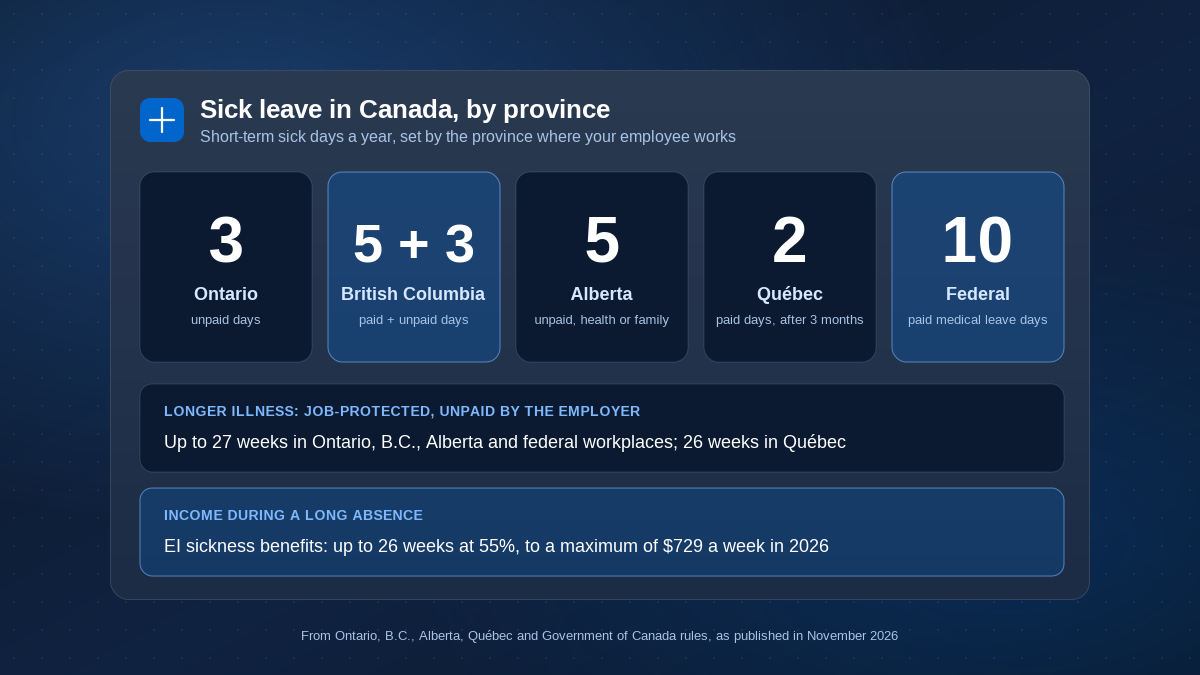
Sick leave in Canada is set by the province where your employee works. Ontario gives three unpaid days a year, British Columbia five paid and three unpaid, Alberta five unpaid, and Québec two paid days, while federally regulated employers owe up to ten paid days. Several provinces, including Ontario, British Columbia and Québec, limit doctor’s notes.
How does sick leave in Canada work?
Sick leave in Canada is a minimum set by each province’s employment standards law, not by a national rule. Sick leave is time off for the employee’s own illness or injury that the employer must allow without penalty; whether it is paid depends on the province. Federally regulated industries, such as banks, airlines and telecommunications, follow the Canada Labour Code instead.
There are two layers. Short-term sick days cover a few days of illness a year. Longer illness leaves protect the job for weeks or months, without pay from the employer, while the employee may claim Employment Insurance (EI) sickness benefits from the federal government. A U.S. company can always give more than the minimum, and many do through paid sick days or a disability insurance plan.
This is different from the United States, where the U.S. Department of Labor says there are currently no federal legal requirements for paid sick leave. In Canada, the minimum comes with the employee’s province, whether or not your company has a sick leave policy.
What are the sick leave rules by province?
The table shows the short-term and long-term minimums for the four largest provinces and the federal code, as each government published them in November 2026. The other provinces and territories set their own rules; the Government of Canada’s list of federally regulated industries links to each one’s employment standards page.
| Jurisdiction | Short-term sick days | Paid by the employer? | Who qualifies | Longer illness leave |
|---|---|---|---|---|
| Ontario | 3 days a calendar year | No | After 2 consecutive weeks of employment | Up to 27 weeks in 52 weeks, after 13 consecutive weeks, with a certificate of a serious medical condition |
| British Columbia | 8 days a calendar year | 5 paid, 3 unpaid | After 90 days of employment | Up to 27 weeks in 52 weeks, from the first day of employment, with a doctor’s or nurse practitioner’s certificate |
| Alberta | 5 days a calendar year, for health or family needs | No | After 90 days with the same employer | Up to 27 weeks a calendar year, after 90 days, with a medical certificate |
| Québec | Part of up to 26 weeks of absence in 12 months | First 2 days a calendar year | Paid days after 3 months of uninterrupted service | Up to 26 weeks in 12 months |
| Federal | Up to 10 paid medical leave days a year | Yes | 3 days after 30 days, then 1 more day a month | Up to 27 weeks of medical leave |
A few details sit behind the table:
- Ontario counts contractual sick days. If your contract gives paid sick days and the employee takes one, Ontario’s guide says it also counts as one of the three days under the Employment Standards Act (ESA). A part day can be counted as a full day, and unused days do not carry over.
- British Columbia pays an average day’s pay. The paid days are calculated from wages in the 30 calendar days before the leave, divided by the days worked in that period. Unused days do not carry over.
- Alberta’s five days are shared. The same five unpaid days cover the employee’s own health and family needs, and they cannot be carried into a new year.
- Québec’s two paid days are shared too. The CNESST says the two paid days a year cover absences for illness, family obligations, and domestic violence or a criminal offence together.
- Federal days can carry over. Under the Canada Labour Code, an employer can carry over up to 10 unused paid days, which count toward the next year’s maximum.
What are the sick leave rules in the other provinces?
The other provinces and territories set their own minimums, and three of them have also limited sick notes. Their government pages, read in November 2026, say:
- Saskatchewan: paid sick leave is not provided for in The Saskatchewan Employment Act. After 13 consecutive weeks of employment, the job is protected for absences of up to 12 days a calendar year for an illness or injury that is not serious, and up to 27 weeks in 52 weeks for a serious one. An employer cannot require a medical note unless the absence lasts more than five consecutive working days, or the employee has had non-consecutive absences of two or more working days for illness or injury in the preceding 12 months, and the request must be in writing.
- Manitoba: long-term leave for a serious injury or illness protects the job for up to 27 weeks in a 52-week period, after 90 days with the same employer, for an illness or injury that keeps the employee off work for at least two weeks. The province’s fact sheet says that from October 1, 2026, an employer cannot ask for a sick note when the employee misses a week or less, or 10 days or less in the same calendar year.
- Nova Scotia: employees can take up to five unpaid days a year for their own illness or injury, and up to 27 weeks of unpaid serious illness or injury leave after three months of employment. An employer cannot require a medical note unless the employee has missed more than five consecutive working days, or has had at least two non-consecutive absences of five or fewer days in the preceding 12 months.
For Prince Edward Island, New Brunswick, Newfoundland and Labrador and the territories, check the employment standards page that the federal list above links to.
For vacation and statutory holidays beside these rules, see employee benefits in Canada. Ontario’s other minimums are summarized in the Ontario employment standards guide.
Which province’s sick leave rules apply to a remote employee?
The province where the employee does the work. Employment standards follow the place of work, so a remote employee working from home in Calgary follows Alberta’s rules, and a colleague in Vancouver gets British Columbia’s five paid days, even if both report to the same manager in Chicago.
Payroll can follow a different test. The CRA’s province of employment rules for source deductions look at the employer’s establishment where the employee reports for work. The post on province of employment for remote employees explains both tests and what changes when an employee moves province.
A single U.S. sick leave policy can still work for a team spread across provinces, as long as it gives at least the most generous minimum that applies to each person. In practice, that means paid days for anyone in British Columbia and Québec, and up to ten paid days in a federally regulated business.
Can you ask an employee in Canada for a doctor’s note?
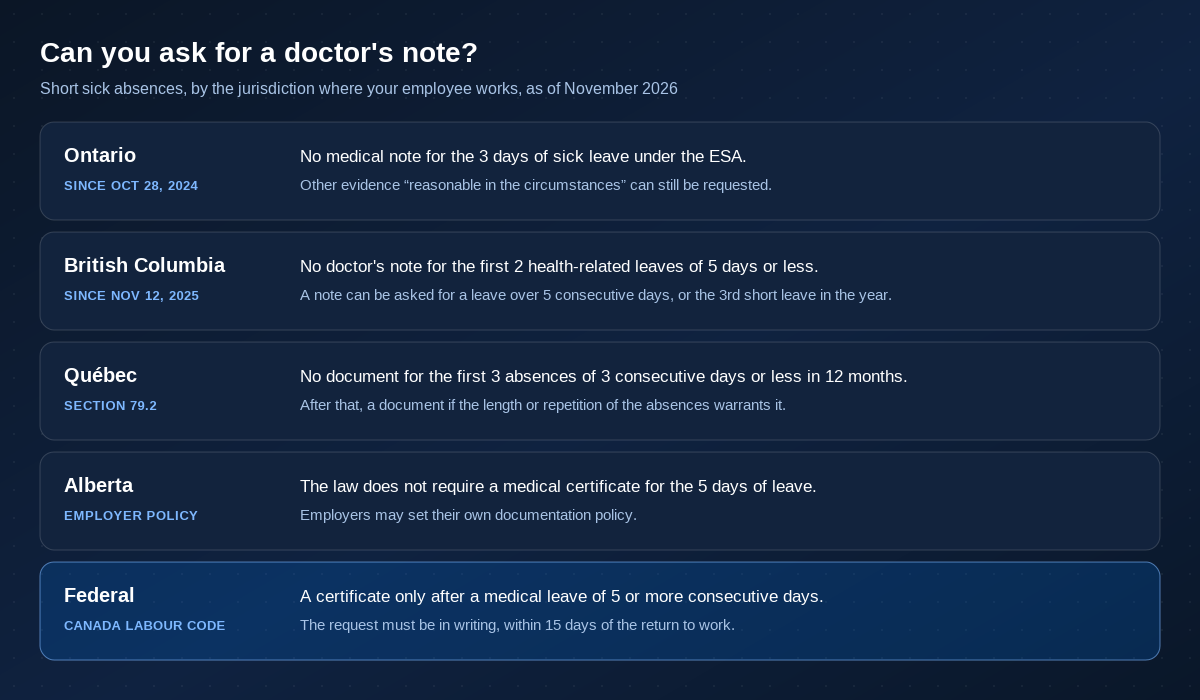
For a short absence, often not. Ontario, British Columbia and Québec now limit sick notes for short absences, as do Saskatchewan, Manitoba and Nova Scotia, so a U.S. habit of asking for a doctor’s note after one or two days can break provincial law. Alberta’s law does not require one either, and the Canada Labour Code allows a certificate only after a longer leave.
What each rule allows:
- Ontario: since October 28, 2024, an employer cannot require a certificate from a physician, registered nurse or psychologist for ESA sick leave. It can still ask for evidence that is reasonable in the circumstances, such as a short written statement from the employee.
- British Columbia: since November 12, 2025, an employer can’t request a doctor’s note unless the leave lasts longer than 5 consecutive days, or the employee has had more than 2 health-related leaves of 5 days or less in the calendar year. The province gives a signed confirmation from the employee as an example of reasonable proof.
- Québec: section 79.2 of the Act respecting labour standards bars any supporting document for the first three periods of absence of three consecutive days or less over 12 months. After that, a document can be requested if the length or repetition of the absences warrants it.
- Federal: the employer may require a certificate in writing, within 15 days of the employee’s return, after a medical leave of at least five consecutive days.
These limits apply to the short-term sick leave minimums. Ontario’s guide notes that a medical note can still be required for other purposes, such as accommodating an employee or a return to work, and Ontario’s long-term illness leave requires a certificate.
A worked example: three absences in British Columbia
Take an employee in Vancouver who has worked for you for six months. In the 30 calendar days before a sick day in March, they earned $8,400 and worked 21 days, with no overtime.
- Average day’s pay. $8,400 ÷ 21 days = $400.
- First absence, two days in March. You pay $800 for two paid sick days. You can’t ask for a doctor’s note, but you can ask for reasonable proof, such as a signed confirmation.
- Second absence, one day in June. You pay one more day at that month’s average day’s pay. Still no doctor’s note, because it is only the second short leave of the year.
- Third absence, two days in October. You pay two more days at October’s average day’s pay, which uses the last of the five paid days; any later sick day this year is one of the three unpaid days. Because this is the third health-related leave of 5 days or less in the year, a doctor’s note can now be requested.
To see what an employee in each province costs on top of salary, including pension and EI contributions, use the employer cost calculator.
What happens when an employee is sick for weeks or months?
The job is protected, but the employer does not have to keep paying salary. Ontario’s long-term illness leave, in effect since June 19, 2025, allows up to 27 weeks in a 52-week period; British Columbia’s serious personal illness or injury leave also allows up to 27 weeks in 52 weeks; Alberta’s long-term illness and injury leave allows up to 27 weeks a calendar year; the Canada Labour Code allows up to 27 weeks of medical leave; and Québec protects the job for up to 26 weeks in 12 months.
During that time, the employee’s income usually comes from EI sickness benefits, a federal program that pays up to 26 weeks of benefits to people who can’t work for medical reasons. Service Canada sets these conditions:
- Amount: 55% of insurable earnings, to a maximum of $729 a week in 2026.
- Hours: 600 insured hours of work in the 52 weeks before the claim.
- Earnings drop: regular weekly earnings must fall by more than 40% for at least one week.
- Medical certificate: required with the application.
When illness cuts the employee’s pay below 60% of their regular weekly earnings, the employer must issue a Record of Employment, which Service Canada uses to process the claim. Many employers also offer short-term or long-term disability insurance through a group benefits plan to top up or replace EI. That is a choice, not a legal minimum. The post on maternity leave in Canada explains how EI benefits and an employer’s job protection work together for another kind of leave.
How should a U.S. company set sick leave for employees in Canada?
Start from the provincial minimum and decide what to add. Most U.S. companies hiring in Canada write one policy that meets every province’s rules, then add paid days for consistency with their U.S. team.
- Find each employee’s province of work and note the sick days, pay and qualifying period that apply.
- Decide on paid days. If you give U.S. staff paid sick time, consider the same for Canadian staff; in British Columbia and Québec, part of it is already required.
- Write a proof rule that fits the strictest province. Ask for a short written confirmation for short absences, and save medical notes for the cases each province allows.
- Separate short sick days from long illness. Explain the long-term leave, EI sickness benefits and any disability insurance you offer.
- Record every absence by type, so you can show which minimum it counted against.
For a hire in Québec, where the paid days, the absence rules and the French-language requirements differ, see hiring an employee in Québec.
Who handles sick leave when you hire through an employer of record?
The employer of record does. An employer of record is a company that legally employs a person on behalf of another business, which directs the day-to-day work. As the legal employer in Canada, it applies the province’s sick leave minimum, pays sick days through payroll and issues the Record of Employment if a long absence begins.
You still approve time off with your hire and choose whether to offer more than the minimum. Group benefits, such as disability insurance, depend on what your company chooses to offer. InfraDev has been an employer of record in Canada since 2016, and most hires start within 24–48 hours once terms are agreed.
Summary
- Sick leave in Canada follows the province where the employee works: 3 unpaid days in Ontario, 5 paid and 3 unpaid in British Columbia, 5 unpaid in Alberta, 2 paid in Québec, and up to 10 paid days under the Canada Labour Code.
- Ontario, British Columbia, Québec, Saskatchewan, Manitoba and Nova Scotia restrict doctor’s notes for short absences; federal employers can ask for a certificate only after five consecutive days.
- Long illness is job-protected for up to 27 weeks in Ontario, British Columbia, Alberta and federal workplaces and 26 weeks in Québec, without salary from the employer.
- EI sickness benefits pay 55% of earnings for up to 26 weeks, to a maximum of $729 a week in 2026.
- A single policy for a team in Canada should meet the most generous rule that applies to each employee.
Sources
- Ontario: Your guide to the Employment Standards Act, sick leave (updated February 5, 2026) and long-term illness leave (updated January 9, 2026)
- British Columbia: Leaves of absence, illness or injury leave (updated August 13, 2026) and New rules on sick notes eliminate unnecessary paperwork (November 12, 2025)
- Alberta: Personal and family responsibility leave and Long-term illness and injury leave (read November 28, 2026)
- CNESST: Non-work-related accident or illness and Act respecting labour standards, sections 79.1 and 79.2 (read November 28, 2026)
- Government of Canada: Leaves for federally regulated employees, Medical leave with pay (IPG-118) and Canada Labour Code, section 239 (read November 28, 2026)
- Government of Canada: EI sickness benefits, who qualifies and how much you could receive, and the Record of Employment guide (read November 28, 2026)
- Saskatchewan: Illness, injury and accommodation in the workplace, Manitoba: Sick notes for employee absences (published July 29, 2026) and Long-term leave for serious injury or illness (published March 2, 2026), Nova Scotia: Leaves from work and Medical certificates for employee absence (read November 28, 2026)
- U.S. Department of Labor: Sick leave (read November 28, 2026)
This article is general information, not legal or tax advice. It reflects each source as published in November 2026; confirm how the sick leave rules apply to a specific employee with the province’s employment standards office or an employment lawyer before relying on it.
Frequently asked questions
Do I have to pay my employee in Ontario when they take a sick day?
Not under Ontario's Employment Standards Act, which gives 3 unpaid, job-protected sick days each calendar year after two consecutive weeks of employment. Many employers add paid sick days by contract. If the employee takes a contractual sick day, it also counts against the 3 days under the Act.
Can I ask my remote employee in Canada for a doctor's note after a sick day?
Usually not for a short absence. Ontario bars medical notes for its 3 sick days, British Columbia for the first two leaves of 5 days or less each year, and Québec for the first three absences of 3 days or less in 12 months. Longer or repeated absences can justify a request.
How many paid sick days does an employee in British Columbia get?
Five paid days and three unpaid days of illness or injury leave each calendar year, once the employee has worked for you for 90 days. Paid days are paid at an average day's pay: wages in the 30 calendar days before the leave divided by the days worked. Unused days do not carry over.
My employee in Canada is off sick for months. Do I keep paying their salary?
The law does not require it. The job is protected for up to 27 weeks in Ontario, British Columbia, Alberta and federal workplaces and 26 weeks in Québec, without pay. Employment Insurance sickness benefits can replace 55% of earnings for up to 26 weeks, to a maximum of $729 a week in 2026.
Which province's sick leave rules apply to an employee who works from home?
The rules of the province where the employee does the work. A remote employee working from home in Calgary follows Alberta's leave rules, and a colleague in Vancouver follows British Columbia's, even if both report to a manager in the United States. Federally regulated industries follow the Canada Labour Code instead.
Who manages sick leave when we hire through an employer of record?
The employer of record is the legal employer in Canada, so it applies the province's sick leave minimum, pays any paid sick days on payroll and keeps the records. You approve the time off day to day and decide whether to offer more than the minimum, such as extra paid days.
Related reading
-
Employee benefits in Canada: what a U.S. employer must provide and what Canadians expect
Employee benefits in Canada come in three layers. The law requires employer contributions to the Canada Pension Plan and Employment Insurance, workers' compensation, paid vacation, paid public holidays and job-protected leaves. Public programs cover doctor and hospital care and pay parental leave. Supplementary health and dental cover, a retirement plan match and extra vacation are optional, and most candidates expect them.
Read the article -
Province of employment for remote employees in Canada: what a U.S. employer applies
The province of employment for remote employees in Canada is set by the CRA's payroll rules, not by where the person lives. A fully remote employee takes the province of the employer's establishment they are attached to, or the one that pays them. Employment standards follow the province where the work is done, so the two can differ.
Read the article -
Maternity leave in Canada: what a U.S. employer owes, and what Employment Insurance pays
Maternity leave in Canada is unpaid, job-protected leave set by the province where the employee works: 16 to 19 weeks for the birth mother, then parental leave that brings the total to about 18 months. The employer holds the job and does not pay wages. Employment Insurance, or Québec's own plan, pays the employee.
Read the article -
Hiring an employee in Québec: what U.S. companies should know
What changes when your Canadian hire lives in Québec: French job offers and contracts, payroll through Revenu Québec, Québec labour standards, and Law 25.
Read the article
Next steps for hiring in Canada
Hiring in Canada and want sick leave handled right?
Tell us the province and the role. We'll explain the sick leave rules that apply and how they show up on payroll.