
Blog
Statutory holidays in Canada 2027: the dates by province for U.S. employers
Statutory holidays in Canada in 2027 depend on the province where your employee works: nine in Ontario and Alberta, eleven in British Columbia, eight in Québec, and ten for federally regulated employers. Christmas falls on a Saturday and Boxing Day on a Sunday, and each province handles that differently.
Published November 27, 2026
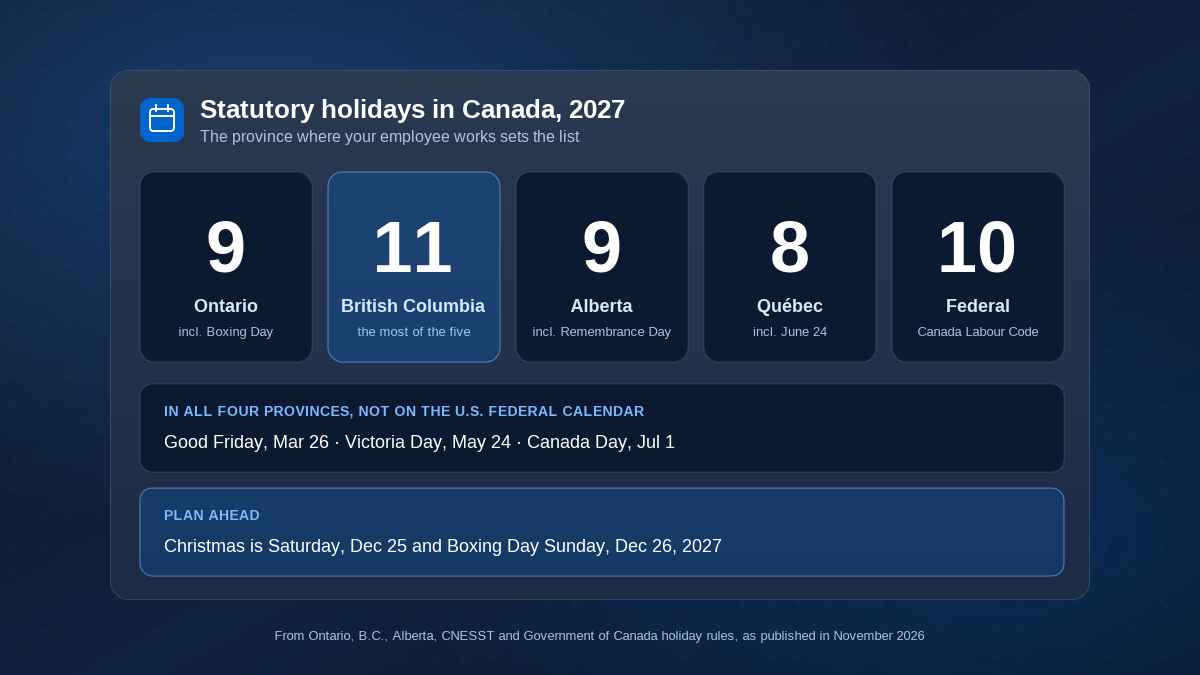
Statutory holidays in Canada in 2027 follow the province where your employee works, not your U.S. headquarters. Ontario and Alberta have nine, British Columbia eleven, Québec eight, and federally regulated employers ten. Several Canadian holidays are working days on the U.S. federal calendar, and Christmas Day and Boxing Day fall on a weekend, which each province treats differently.
What are the statutory holidays in Canada in 2027?
A statutory holiday is a day the law gives employees off with pay, or extra pay if they work it. In Canada, each province sets its own list in its employment standards law, so the statutory holidays in Canada in 2027 depend on where your employee works. Federally regulated industries, such as banks, airlines and telecommunications, follow the Canada Labour Code instead.
Ontario calls them public holidays, Alberta general holidays, and British Columbia and Québec statutory holidays. The table shows the 2027 dates for the four largest provinces and the federal code, taken from each government’s published list. British Columbia publishes its own 2027 dates; the others are the same named days applied to the 2027 calendar.
| Holiday, 2027 | Ontario | British Columbia | Alberta | Québec | Federal |
|---|---|---|---|---|---|
| New Year’s Day, Fri Jan 1 | ✓ | ✓ | ✓ | ✓ | ✓ |
| Family Day, Mon Feb 15 | ✓ | ✓ | ✓ | ||
| Good Friday, Fri Mar 26 | ✓ | ✓ | ✓ | ✓ or Easter Monday, Mar 29 | ✓ |
| Victoria Day, Mon May 24 | ✓ | ✓ | ✓ | ✓ (National Patriots’ Day) | ✓ |
| National Holiday, Thu Jun 24 | ✓ | ||||
| Canada Day, Thu Jul 1 | ✓ | ✓ | ✓ | ✓ | ✓ |
| B.C. Day, Mon Aug 2 | ✓ | ||||
| Labour Day, Mon Sep 6 | ✓ | ✓ | ✓ | ✓ | ✓ |
| National Day for Truth and Reconciliation, Thu Sep 30 | ✓ | ✓ | |||
| Thanksgiving, Mon Oct 11 | ✓ | ✓ | ✓ | ✓ | ✓ |
| Remembrance Day, Thu Nov 11 | ✓ | ✓ | ✓ | ||
| Christmas Day, Sat Dec 25 | ✓ | ✓ | ✓ | ✓ | ✓ |
| Boxing Day, Sun Dec 26 | ✓ | ✓ | |||
| Total | 9 | 11 | 9 | 8 | 10 |
Three details behind the table:
- Québec employers choose Good Friday or Easter Monday. The CNESST lists the holiday as “Good Friday or Easter Monday, at the employer’s option.”
- Ontario does not require the August civic holiday or Remembrance Day. The Ontario guide says some employers give Easter Monday, the first Monday in August or Remembrance Day, but the Employment Standards Act does not require it.
- Alberta lists optional holidays. Alberta’s page names Easter Monday, Heritage Day in August, the National Day for Truth and Reconciliation and Boxing Day as optional; if an employer recognizes one, the holiday pay rules apply to it.
Other provinces and territories set their own lists; the Government of Canada’s list of federally regulated industries links to each one’s employment standards page. For vacation minimums and sick days alongside these holidays, see employee benefits in Canada.
Which province’s holidays apply to a remote employee?
The province where the employee does the work. Employment standards follow the place of work, so a remote employee working from home in Vancouver gets British Columbia’s eleven holidays, and a colleague in Montréal gets Québec’s eight, even if both report to the same manager in Chicago.
Payroll can follow a different test. The CRA’s province of employment rules for source deductions look at the employer’s establishment where the employee reports for work, which can differ from where the employee lives. The post on province of employment for remote employees explains both tests and what changes when an employee moves province mid-year.
How do Canadian holidays compare with U.S. holidays in 2027?
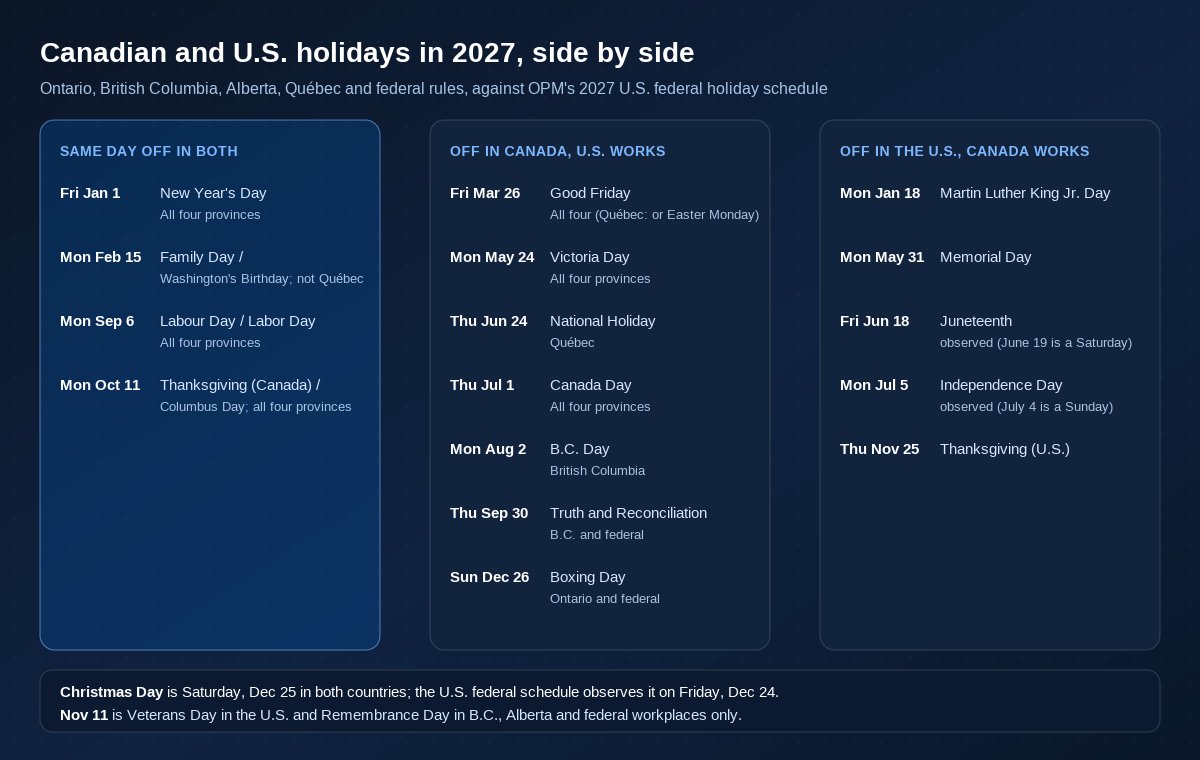
They share four dates and differ on the rest. On the 2027 U.S. federal holiday schedule published by the Office of Personnel Management (OPM), New Year’s Day (January 1), Washington’s Birthday (February 15), Labor Day (September 6) and Columbus Day (October 11) fall on the same day as a holiday in the four largest provinces, except that Québec has no February holiday. Christmas is observed on Friday, December 24 in the U.S. federal schedule, and Veterans Day matches Remembrance Day only in British Columbia, Alberta and federal workplaces.
Two points matter when you plan a cross-border team calendar:
- Your Canadian employee will be off when your U.S. team is working on Good Friday, Victoria Day and Canada Day in every one of the four provinces, plus provincial days such as B.C. Day and Québec’s June 24. Plan releases and on-call rotations around them.
- Your Canadian employee will be working when your U.S. team is off on Martin Luther King Jr. Day, Memorial Day, Juneteenth, Independence Day and U.S. Thanksgiving. OPM’s schedule is for federal employees; private U.S. employers set their own holidays, so compare with your company’s own calendar.
Can a U.S. company give U.S. holidays instead of Canadian ones?
It can add U.S. holidays, but it cannot swap them for the provincial ones. The provincial list is a minimum, so a company that closes for U.S. Thanksgiving can give the Canadian employee that day off with pay as well. Replacing Canada Day with July 4 is a different matter: it works only through each province’s own rules for working a holiday, set out below, and Québec’s CNESST says plainly that “an employer may not change the official date of a statutory holiday.”
How is holiday pay calculated in Canada?
Holiday pay in Canada is set by a formula in each province’s law, usually 1/20 of the wages earned in the four weeks before the week of the holiday, which comes to an average day’s pay. The formula matters most for hourly, part-time and commission staff; for a salaried employee on a regular schedule, it usually equals a normal day’s salary.
| Jurisdiction | Who qualifies | Holiday pay | Working the holiday |
|---|---|---|---|
| Ontario | Any employee who works the last scheduled day before and first after the holiday, or has reasonable cause; no minimum service | (Regular wages + vacation pay payable in the 4 work weeks before the holiday’s week) ÷ 20 | With written or electronic agreement: regular wages plus a substitute day off, or holiday pay plus 1.5 times the regular rate |
| British Columbia | Employed 30 calendar days and worked or earned wages on 15 of the 30 days before the holiday | Average day’s pay: wages in the 30 calendar days before ÷ days worked | 1.5 times for hours worked (2 times over 12 hours), plus the average day’s pay |
| Alberta | 30 workdays in the 12 months before the holiday | Average daily wage over one of two 4-week periods the employer chooses | On a regular workday: 1.5 times plus the average daily wage, or regular pay plus a paid day off later |
| Québec | Every employee, full or part time; no minimum service | 1/20 of wages in the 4 complete weeks of pay before the holiday’s week | Pay for the day worked, plus the indemnity or a compensatory day off within 3 weeks |
| Federal | Employees of federally regulated employers | At least 1/20 of wages, excluding overtime, in the 4 weeks before the holiday’s week | Most employees: at least 1.5 times for time worked, plus holiday pay; managers and professionals: regular pay plus a substitute paid holiday |
A few rules sit outside the table. Overtime pay is left out of the wages in every one of the five formulas. In Ontario, Alberta and Québec, missing the last scheduled shift before or the first one after the holiday without a valid reason or consent can cost the holiday pay, although Québec does not apply that rule to June 24. British Columbia excludes several groups from statutory holiday pay, including managers and, under section 37.8 of its Employment Standards Regulation, high technology professionals; the overtime rules in Canada post explains who fits that definition.
A worked example: Canada Day in Ontario
Take an employee in Ontario on a salary of $104,000 a year, working 40 hours a week, which converts to $50 an hour or $400 a day. They took no vacation in the four work weeks before the week of July 1, 2027.
- Holiday pay. Regular wages for the four work weeks: $400 × 20 days = $8,000. Divided by 20: $400.
- If they take Canada Day off, they receive $400 of holiday pay for the day, the same as a normal day’s salary.
- If they agree in writing to work it for premium pay, they receive $400 of holiday pay plus 8 hours × $75 premium pay = $600, a total of $1,000, and no substitute day.
- If they agree in writing to work it for a substitute day, they receive $400 of regular wages for the day worked, plus another day off with $400 of holiday pay, scheduled within three months (or up to 12 months if they agree), and a written statement before the holiday.
To see what an employee in each province costs on top of salary, including pension and Employment Insurance contributions, use the employer cost calculator.
What happens when Christmas and Boxing Day 2027 fall on a weekend?
Christmas Day is Saturday, December 25, 2027, and Boxing Day is Sunday, December 26. For an employee who works Monday to Friday, each jurisdiction handles a holiday on a non-working day in its own way:
- Ontario: for both Christmas and Boxing Day, a substitute day off with holiday pay, or holiday pay alone if the employee agrees electronically or in writing.
- British Columbia: an average day’s pay for Christmas; the province’s guidance says a regular or scheduled day off that falls on a statutory holiday is paid. Boxing Day is not a statutory holiday in British Columbia.
- Alberta: nothing is owed for a holiday that is not a regular day of work unless the employee works it, in which case they are paid 1.5 times.
- Québec: for Christmas, the employer chooses between an indemnity added to that week’s pay or a compensatory day off on a date agreed with the employee.
- Federal: for Christmas and Boxing Day, a holiday with pay on the scheduled working day immediately before or after.
For federally regulated employers, the Canada Labour Code points to Friday, December 24 and Monday, December 27, 2027 for a Monday-to-Friday employee. In Ontario, each substitute day must fall no later than three months after the holiday (or 12 months if the employee agrees), and the employee must get a written statement before the holiday, so days off soon after, such as Monday, December 27 and Tuesday, December 28, settle both holidays.
Who applies the holidays when you hire through an employer of record?
The employer of record does. An employer of record is a company that legally employs a person on behalf of another business, which directs the day-to-day work. As the legal employer in Canada, it applies the province’s holiday list, calculates holiday pay on payroll, and pays any premium if your hire works a holiday.
You still decide the working calendar with your hire: whether they also take U.S. holidays, which substitute days they use, and who covers when the two countries’ calendars split. InfraDev has been an employer of record in Canada since 2016, and most hires start within 24–48 hours once terms are agreed. For a hire in Québec, where the holiday list, the French-language rules and the payroll differ, see hiring an employee in Québec. The employment law basics guide covers the other provincial minimums.
Summary
- Statutory holidays in Canada in 2027 follow the province of work: nine in Ontario and Alberta, eleven in British Columbia, eight in Québec, and ten under the Canada Labour Code.
- Good Friday (March 26), Victoria Day (May 24) and Canada Day (July 1) are holidays in all four large provinces but working days on the U.S. federal schedule.
- U.S. holidays such as Memorial Day, Independence Day and U.S. Thanksgiving are not required in Canada; you can add them, but not use them to replace the provincial list.
- Holiday pay is usually 1/20 of the four weeks’ wages before the holiday’s week, or an average day’s pay, and working a holiday brings premium pay or a substitute day.
- Christmas and Boxing Day 2027 fall on a weekend, so decide the substitute days before you publish your 2027 calendar.
Sources
- Ontario: Your guide to the Employment Standards Act, public holidays (updated July 8, 2024)
- British Columbia: Statutory holidays (read November 27, 2026), Qualify for statutory holiday pay and Calculate statutory holiday pay
- Alberta: Employment standards, general holidays and pay (read November 27, 2026)
- CNESST: Statutory holidays and Calculating the indemnity for a statutory holiday (read November 27, 2026)
- Canada Revenue Agency: Determine the province of employment (read November 27, 2026)
- Government of Canada: Annual vacations and general holidays for federally regulated employers and List of federally regulated industries and workplaces (read November 27, 2026)
- U.S. Office of Personnel Management: Federal holidays, 2027 schedule (read November 27, 2026)
This article is general information, not legal or tax advice. It reflects each source as published in November 2026; confirm how the holiday rules apply to a specific employee with the province’s employment standards office or an employment lawyer before relying on it.
Frequently asked questions
Which statutory holidays will my employee in Ontario get in 2027?
Nine: New Year's Day (January 1), Family Day (February 15), Good Friday (March 26), Victoria Day (May 24), Canada Day (July 1), Labour Day (September 6), Thanksgiving (October 11), Christmas Day (December 25) and Boxing Day (December 26). The first Monday in August and Remembrance Day are not required in Ontario.
Do I have to give my remote employee in Canada the U.S. holidays our team takes?
No province requires U.S. holidays such as Memorial Day, Independence Day or U.S. Thanksgiving. The employee's own province sets the statutory holidays, and those are the minimum. A U.S. company can add U.S. days so the whole team is off together, because that gives more than the law requires.
How do I calculate holiday pay for an employee in Ontario?
Add the employee's regular wages from the four work weeks before the week of the holiday, plus any vacation pay payable for those weeks, and divide by 20. For a salaried employee on a regular five-day schedule with no vacation in that period, the result usually equals a normal day's pay.
What happens to Christmas and Boxing Day 2027 when they fall on a weekend?
In Ontario, a Monday-to-Friday employee gets a substitute day off with holiday pay for each, or holiday pay alone if they agree electronically or in writing. British Columbia pays an average day's pay for Christmas. Alberta owes nothing unless they work. Federally regulated employees get a paid holiday on the scheduled working day immediately before or after.
Can my employee in Canada work a statutory holiday and take another day instead?
Usually, if the province's rules are followed. Ontario requires the employee's electronic or written agreement and a written statement before the holiday. British Columbia allows a written agreement to substitute another day. Québec does not let an employer move the date, but pays an indemnity or gives a compensatory day off.
Who applies the statutory holidays when we hire through an employer of record?
The employer of record is the legal employer in Canada, so it applies the province's holiday list, calculates holiday pay and pays any premium for work on a holiday. You decide the working calendar with your hire, including any extra U.S. days off, and the employer of record makes sure the statutory minimum is met.
Related reading
-
Employee benefits in Canada: what a U.S. employer must provide and what Canadians expect
Employee benefits in Canada come in three layers. The law requires employer contributions to the Canada Pension Plan and Employment Insurance, workers' compensation, paid vacation, paid public holidays and job-protected leaves. Public programs cover doctor and hospital care and pay parental leave. Supplementary health and dental cover, a retirement plan match and extra vacation are optional, and most candidates expect them.
Read the article -
Province of employment for remote employees in Canada: what a U.S. employer applies
The province of employment for remote employees in Canada is set by the CRA's payroll rules, not by where the person lives. A fully remote employee takes the province of the employer's establishment they are attached to, or the one that pays them. Employment standards follow the province where the work is done, so the two can differ.
Read the article -
Overtime rules in Canada: thresholds by province, and who is exempt
Overtime rules in Canada follow the province where the employee works. Most employees earn overtime after 40 or 44 hours a week, and in several provinces after 8 hours a day, at 1.5 times their wage. A salary does not remove the right, and certain IT professionals are exempt in Ontario, British Columbia and Alberta.
Read the article -
Hiring an employee in Québec: what U.S. companies should know
What changes when your Canadian hire lives in Québec: French job offers and contracts, payroll through Revenu Québec, Québec labour standards, and Law 25.
Read the article
Next steps for hiring in Canada
Planning 2027 for a team in Canada?
Tell us the province and the role. We'll explain which holidays apply and how holiday pay shows up on your invoice.