
Blog
Bereavement leave in Canada: the rules by province for U.S. employers
Bereavement leave in Canada depends on where your employee works: 2 unpaid days a year in Ontario, 3 unpaid days per death in British Columbia, 3 unpaid days a year in Alberta, 2 paid and 3 unpaid days in Québec, and up to 10 days for federally regulated employers, the first 3 paid.
Published November 29, 2026
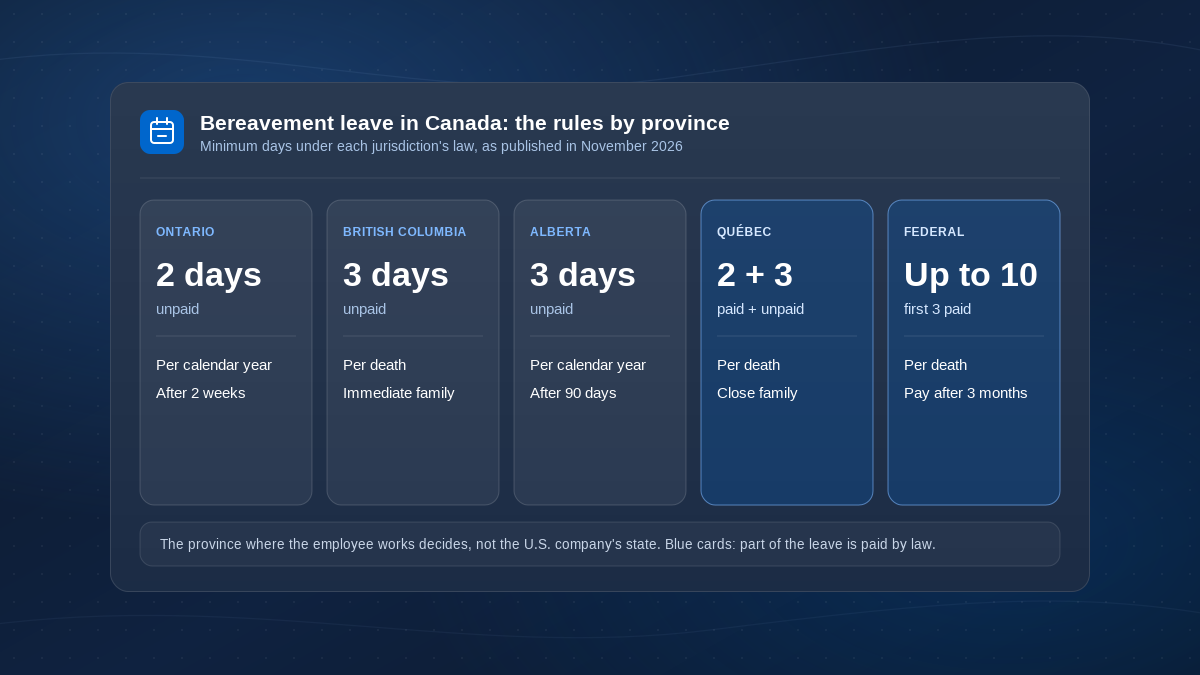
Bereavement leave in Canada is set by the province where your employee works. Ontario gives 2 unpaid days a year, British Columbia 3 unpaid days per death, Alberta 3 unpaid days a year, and Québec 2 paid and 3 unpaid days for close family. Federally regulated employers give up to 10 days, the first 3 paid.
What is bereavement leave in Canada?
Bereavement leave is time off work, protected by law, that an employee can take after the death of a family member. In Canada, every province and the federal government set a minimum. The employee’s job is protected during the leave, and in some places part of it is paid.
For a U.S. employer, the starting point is different from home. The U.S. Department of Labor’s page on funeral leave says the Fair Labor Standards Act does not require payment for time not worked, including attending a funeral, and treats it as a matter of agreement between employer and employee. In Canada, the leave itself is a legal right, so your policy starts from the province’s minimum and builds up.
What are the bereavement leave rules by province?
The table shows the four largest provinces and federally regulated employers, from each government’s own pages and statutes as published in November 2026.
| Jurisdiction | Days | Paid by the employer? | Counted | Who qualifies |
|---|---|---|---|---|
| Ontario | Up to 2 days | No | Per calendar year | After 2 consecutive weeks of employment |
| British Columbia | Up to 3 days | No | Per death of an immediate family member | No service requirement in section 53 |
| Alberta | Up to 3 days | No | Per calendar year | After 90 days with the same employer |
| Québec | Up to 5 days for a spouse, child, parent or sibling; 1 day for other listed relatives | First 2 days, for close family only | Per death | No service requirement in section 80 |
| Federal (Canada Labour Code) | Up to 10 days; up to 8 weeks on the death of a child | First 3 days, after 3 months | Per death | Pay after 3 consecutive months of continuous employment |
The other provinces and territories set their own minimums, so check the employment standards office where your employee works. Our guide to employment law basics explains how the provincial system works.
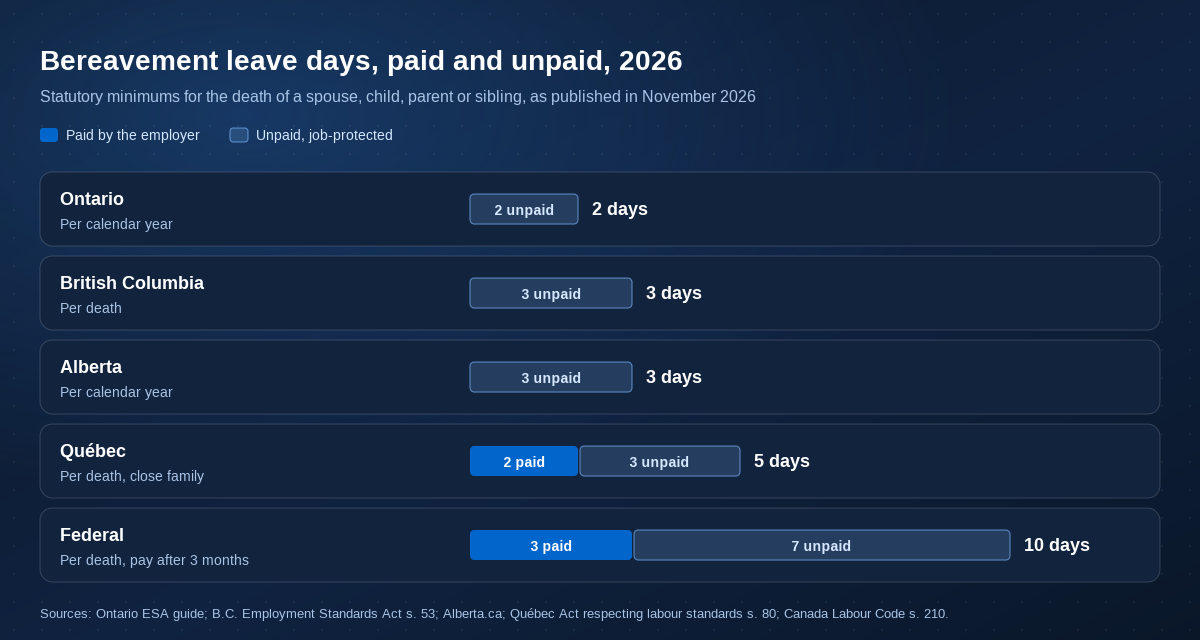
Bereavement leave in Ontario
Ontario gives most employees up to 2 days of unpaid, job-protected bereavement leave each calendar year, once they have worked for the employer for at least 2 consecutive weeks. Ontario’s guide to the Employment Standards Act sets out the details on its bereavement leave page (updated February 5, 2026):
- Who counts. A spouse; a parent, step-parent, foster parent, child, step-child, foster child, grandparent, step-grandparent, grandchild or step-grandchild of the employee or the employee’s spouse; the spouse of the employee’s child; a brother or sister; and a relative who depends on the employee for care.
- When it can be taken. At the time of the death, later for a funeral or memorial service, or to attend to estate matters.
- How it is counted. The 2 days are not pro-rated for someone who starts mid-year, do not carry over, and can be taken as part days. An employer can count a part day as a full day of leave.
- Contracts. A paid bereavement day under a contract also counts as an Employment Standards Act day, unless the contract gives a greater benefit overall.
- Notice and proof. The employee tells the employer before the leave, or as soon as possible after, and oral notice is enough. The employer may ask for evidence “reasonable in the circumstances”, such as a funeral home notice, an obituary or a memorial program.
Ontario’s guide also lists a separate child death leave among the leaves under the Act, so a parent who loses a child has more than the 2 days.
Bereavement leave in British Columbia
British Columbia gives an employee up to 3 days of unpaid leave on the death of a member of their immediate family. Section 53 of the Employment Standards Act sets the leave, and the Act’s definition of immediate family covers a spouse, child, parent, guardian, sibling, grandchild or grandparent, the child or parent of a spouse, and anyone who lives with the employee as a member of the family.
The difference that matters for planning: British Columbia counts the leave per death, not per year. An employee who loses two family members in one year can take up to 3 days each time. The employer must give the leave when it is requested, return the employee to the same or a comparable position, and cannot end the employment, or change a condition of it without the employee’s written consent, because of the leave.
Bereavement leave in Alberta
Alberta gives up to 3 days of unpaid, job-protected bereavement leave each calendar year to employees who have worked at least 90 days for the same employer. The Alberta government’s bereavement leave page adds three points worth knowing:
- A wide circle of family. Aunts, uncles, nieces and nephews count, and so does a person the employee is not related to but considers a close relative.
- Pregnancy loss is included. The person who was pregnant, their spouse or partner, and anyone else who would have been a parent can take the leave.
- No proof required. The employee gives notice as soon as is reasonable, and the government says a medical certificate or other documentation is not required by legislation.
Unused days do not carry over and do not have to be paid out when employment ends.
Bereavement leave in Québec
Québec is one of the two places in this article where part of bereavement leave is paid. Under section 80 of the Act respecting labour standards (up to date to October 15, 2026), an employee may be absent for 2 days without reduction of wages on the death or funeral of their spouse, child, spouse’s child, brother, sister, father, mother or one of their parents, and for 3 more days without pay.
Section 80.1 adds 1 unpaid day for the death or funeral of a son-in-law or daughter-in-law, a grandparent or grandchild, or the spouse’s brother, sister or parent. In both cases the employee advises the employer as soon as possible. Québec has other rules worth reading before you hire there, and our post on hiring an employee in Québec covers them.
Bereavement leave for federally regulated employers
The Canada Labour Code applies to federally regulated industries such as banking, telecommunications and interprovincial transport, not to most U.S. companies hiring in Canada. Section 210 of the Canada Labour Code gives up to 10 days of leave on the death of an immediate family member, and the first 3 days are paid at the regular rate once the employee has 3 consecutive months of continuous employment.
The leave can be taken from the day of the death until 6 weeks after the funeral, burial or memorial service, in one or two periods. On the death of the employee’s child, or their spouse’s child, the Code now provides up to 8 weeks.
Which province’s bereavement leave applies to a remote employee?
The province where the employee does the work. Employment standards follow the place of work, so a remote employee in Vancouver has British Columbia’s leave and a remote employee in Montréal has Québec’s, whatever state the U.S. company is in. Our post on the province of employment for remote employees explains how to settle it when someone works from home or moves.
For a U.S. company with people in several provinces, that means up to four different rules for the same event. Most companies solve it with one policy that meets the highest minimum.
How should a U.S. company set bereavement leave for employees in Canada?
Start from the minimum of each province you hire in, then decide how generous you want to be. Bereavement leave is rarely used, costs little and is remembered for years, so most employers choose a policy above the minimum.
- List the provinces your people work in. Each one sets its own minimum, as the table shows.
- Cover the highest minimum everywhere. For a team in Ontario, British Columbia, Alberta and Québec, that is at least 5 days per death, with 2 of them paid.
- Decide how many days you pay. Paying the days the law leaves unpaid is the simplest way to make the policy feel the same in every province.
- Define family generously. Alberta’s list, which includes aunts, uncles and a person the employee considers a close relative, is a good model.
- Keep proof light. Ontario and British Columbia allow a reasonable request; Alberta requires none. A short note to the manager is usually enough.
- Put it in writing. Write the policy into the employment contract or handbook so the employee knows it before they need it.
It sits naturally beside your sick leave and holiday rules: see our posts on sick leave in Canada and statutory holidays in Canada in 2027.
Who handles bereavement leave when you hire through an employer of record?
The employer of record handles the legal side, and you handle the human side. An employer of record is a company that legally employs a person on behalf of another business, which directs the day-to-day work.
| Task | Employer of record | U.S. company |
|---|---|---|
| Apply the province’s minimum | Yes | |
| Write your chosen policy into the contract | Yes | Chooses the policy |
| Record the absence and run paid days through payroll | Yes | |
| Approve the time off and cover the work | Yes | |
| Support the employee and the team | Yes |
InfraDev has been an employer of record in Canada since 2016, in every province. We write the leave policy you choose into the employment contract for the employee’s province and run any paid days through Canadian payroll. The Employer of Record page sets out everything we handle, and the employee benefits in Canada post covers what else teams usually offer.
Summary
- Bereavement leave in Canada follows the province where the employee works.
- Ontario gives 2 unpaid days a calendar year after 2 weeks; British Columbia 3 unpaid days per death; Alberta 3 unpaid days a calendar year after 90 days.
- Québec pays 2 of up to 5 days for close family; the Canada Labour Code pays 3 of up to 10 days after 3 months.
- U.S. federal law does not require funeral leave, so a Canadian policy starts from the provincial minimum.
- One written policy that meets the highest minimum, with the days paid, covers a team in every province.
Sources
- Ontario: Your guide to the Employment Standards Act, bereavement leave (updated February 5, 2026)
- British Columbia: Employment Standards Act, section 1 (definition of immediate family), section 53 and section 54 (current to November 24, 2026)
- Alberta: Bereavement leave (read November 29, 2026)
- Québec: Act respecting labour standards, sections 80 to 80.2 (up to date to October 15, 2026)
- Canada Labour Code, section 210 (current to November 12, 2026)
- U.S. Department of Labor: Funeral leave (read November 29, 2026)
This article is general information, not legal advice. It reflects each source as published in November 2026; confirm how the bereavement leave rules apply to a specific employee with the province’s employment standards office or an employment lawyer before relying on it.
Frequently asked questions
How many days of bereavement leave does an employee in Canada get?
Bereavement leave in Canada depends on the province where the employee works. Ontario gives 2 unpaid days a calendar year, British Columbia 3 unpaid days on each death of an immediate family member, Alberta 3 unpaid days a calendar year, and Québec up to 5 days for close family. Federally regulated employers give up to 10 days.
Is bereavement leave paid in Canada?
Paid bereavement leave in Canada is required in two places. Québec's Act respecting labour standards pays the first 2 days on the death of a spouse, child, parent, brother or sister, and the Canada Labour Code pays the first 3 days after 3 months of employment. Ontario, British Columbia and Alberta require the leave but not the pay.
Which province's bereavement leave applies to a remote employee working for a U.S. company?
Employment standards in Canada follow the province where the employee does the work, so a remote employee working from home in Calgary has Alberta's bereavement leave, whatever the U.S. company's location. A U.S. company with remote employees in several provinces can apply one generous policy that meets the highest minimum.
What proof of a death can an employer in Canada ask for?
Ontario allows an employer to ask for evidence reasonable in the circumstances, such as a funeral home notice, a published obituary or a memorial service program. British Columbia allows a request for reasonably sufficient proof. Alberta's government says its legislation does not require a medical note or other proof for bereavement leave.
Does the U.S. company have to offer more bereavement leave than the provincial minimum?
A U.S. company only has to meet the minimum of the province where the employee works, and many offer more because it costs little and matters a great deal. A contract that gives at least the statutory days, with some or all of them paid, replaces the minimum, while the job protection stays in place.
Who handles bereavement leave when a U.S. company hires through an employer of record?
The employer of record is the legal employer in Canada, so it applies the province's bereavement leave, records the absence and runs any paid days through payroll. The U.S. company approves the time off, covers the work and supports the employee. With InfraDev, the policy you choose for the role is written into the employment contract.
Related reading
-
Sick leave in Canada: the rules by province for U.S. employers
Sick leave in Canada depends on the province where your employee works: three unpaid days in Ontario, five paid and three unpaid in British Columbia, five unpaid in Alberta, two paid in Québec, and ten paid days for federally regulated employers. Several provinces now limit when you can ask for a doctor's note.
Read the article -
Statutory holidays in Canada 2027: the dates by province for U.S. employers
Statutory holidays in Canada in 2027 depend on the province where your employee works: nine in Ontario and Alberta, eleven in British Columbia, eight in Québec, and ten for federally regulated employers. Christmas falls on a Saturday and Boxing Day on a Sunday, and each province handles that differently.
Read the article -
Province of employment for remote employees in Canada: what a U.S. employer applies
The province of employment for remote employees in Canada is set by the CRA's payroll rules, not by where the person lives. A fully remote employee takes the province of the employer's establishment they are attached to, or the one that pays them. Employment standards follow the province where the work is done, so the two can differ.
Read the article -
Employee benefits in Canada: what a U.S. employer must provide and what Canadians expect
Employee benefits in Canada come in three layers. The law requires employer contributions to the Canada Pension Plan and Employment Insurance, workers' compensation, paid vacation, paid public holidays and job-protected leaves. Public programs cover doctor and hospital care and pay parental leave. Supplementary health and dental cover, a retirement plan match and extra vacation are optional, and most candidates expect them.
Read the article
Next steps for hiring in Canada
Want bereavement leave handled with care for your team in Canada?
Tell us the provinces your people work in. We'll explain the minimums that apply and how a leave shows up on payroll, so the moment is simple for everyone.