Remote work savings for employers: how much a company saves by hiring remotely
Where remote work savings for employers come from: office space, lower turnover and a wider hiring market. What the research measured, how hiring remotely in Canada typically lowers the cost of comparable roles by 10–40%, and seven ways to keep more of the saving.
Published November 27, 2026
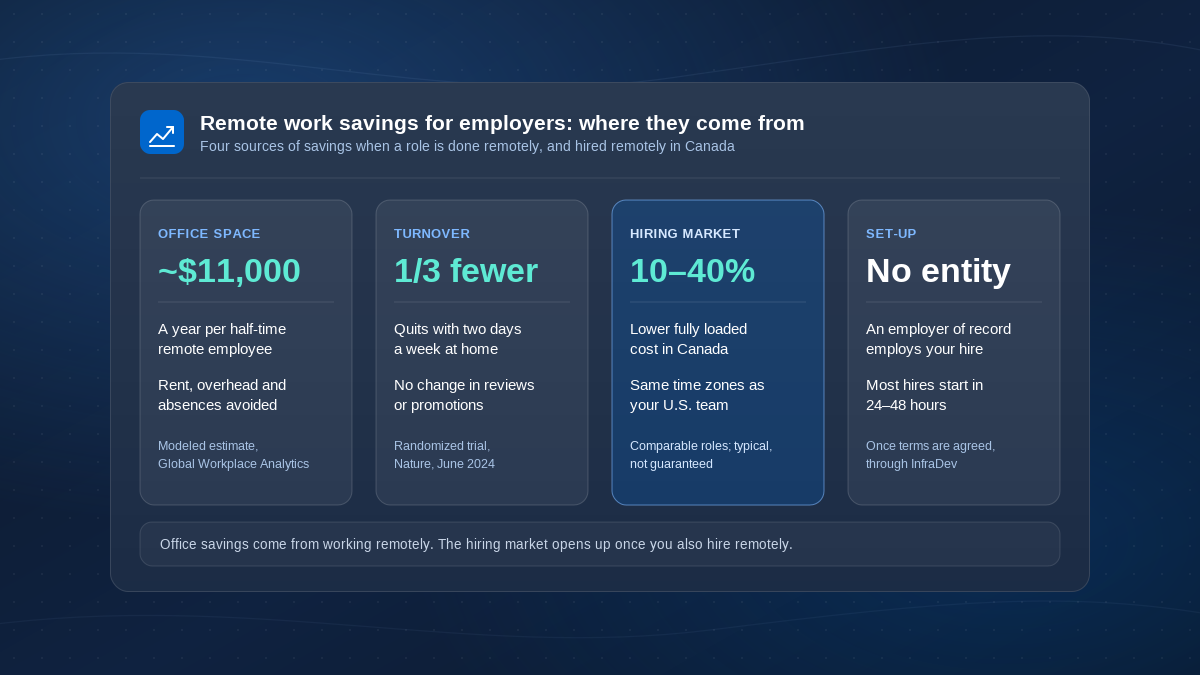
Remote work savings for employers come from four places: the office seat you no longer pay for, people who stay longer, a hiring market that is no longer limited to commuting distance, and roles that are filled sooner. For a U.S. company, hiring remotely in Canada adds a fifth: comparable roles typically cost 10–40% less.
What are remote work savings for employers?
Remote work savings are the costs a company stops carrying, or never takes on, when people do their work away from a company office. Some are direct, such as rent and equipment for a desk. Others show up over time, such as fewer resignations to replace and a shorter wait to fill an open role.
There are two decisions behind them, and most companies make only the first:
Where the work happens. Letting people work remotely, all or part of the week, reduces the office space and overhead each person needs.
Who you can hire. Once a role does not need a commute, the candidate does not need to live near your office, or even in your country. That decision changes the salary, the talent pool and the time it takes to hire.
The first is a facilities saving. The second is a workforce saving, and it is often the bigger number.
Where does a company save money with remote work?
A company saves money with remote work in four main ways: office space and overhead, turnover, the hiring market and time to hire. The table sets out each one, what the evidence says, and how a remote hire in Canada through InfraDev fits.
Where the saving comes from
What it covers
What the evidence says
With a remote hire in Canada
Office space and overhead
Rent, utilities, furniture, on-site services
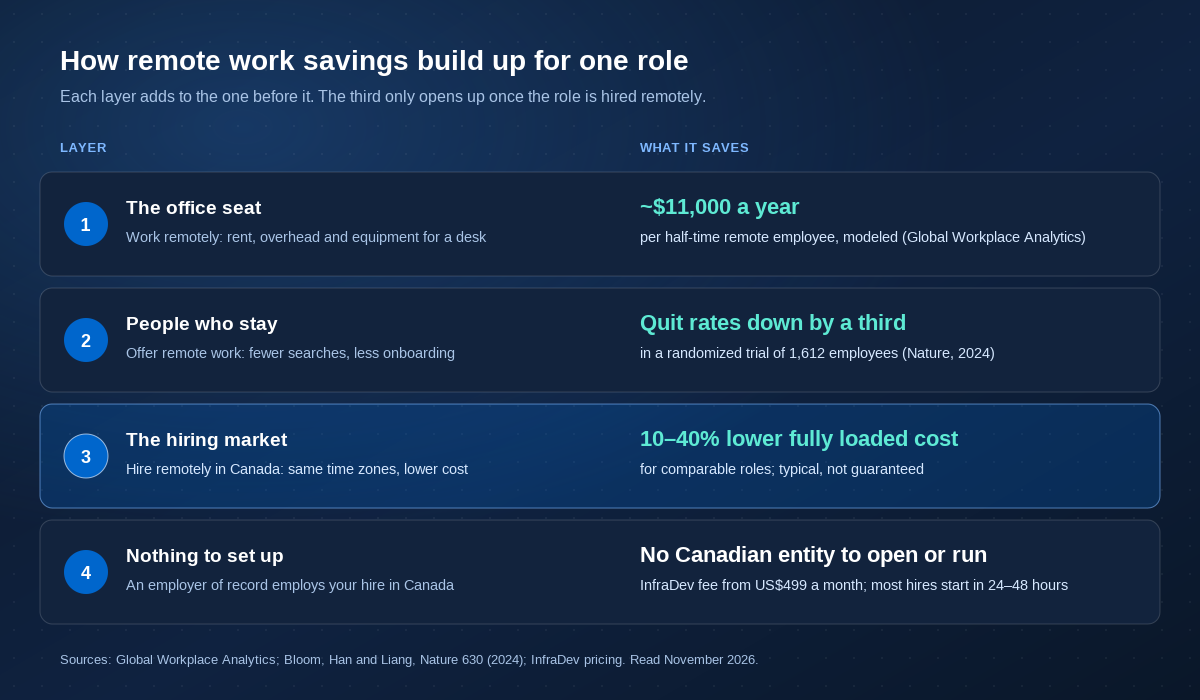
About $11,000 a year per half-time remote employee, modeled estimate (Global Workplace Analytics)
No desk to provide; an office in Beaconsfield, Québec is available when a role needs one
Turnover and rehiring
Recruiting, onboarding and lost output when someone leaves
Quit rates down by a third with two days a week at home (Nature, 2024)
Remote work is part of the offer from day one
The hiring market
Salary and benefits for the same role
Comparable roles in Canada typically cost 10–40% less, not guaranteed
Employed in Canada, paid in Canadian dollars
Time to hire
Work left undone while a seat stays empty
Depends on the role and the market
Candidates usually presented within a week; most hires start within 24–48 hours of agreeing terms
How much does a company save on office space with remote work?
Office savings depend on how much space you actually give up. Global Workplace Analytics, a research and consulting firm focused on remote work, estimates on its telecommuting statistics page that a typical U.S. employer can save about $11,000 a year for each employee who works remotely half the time. The firm describes its assumptions as conservative, and attributes the saving to productivity, real estate, lower absenteeism and turnover, and disaster preparedness.
Treat that figure as a modeled estimate, not a promise. A company that lets people work from home but keeps the same lease saves little on space. The saving becomes real when seats are consolidated, a floor is released at renewal, or a new hire never needs a desk at all, which is the case for a fully remote hire in another country.
How does remote work reduce turnover costs?
Remote and hybrid work make people less likely to leave, and every resignation you avoid is a search you do not have to pay for. The strongest evidence comes from a randomized trial at Trip.com, a large travel technology company, published in Nature in June 2024: Hybrid working from home improves retention without damaging performance, by Nicholas Bloom, Ruobing Han and James Liang.
The design. 1,612 engineering, marketing and finance employees were randomly assigned either to work from home on Wednesdays and Fridays or to come in five days a week.
Retention. Attrition in the hybrid group fell from 7.2% to 4.8%, a reduction of one-third. The effect was strongest for non-managers, women and people with long commutes.
Performance. The researchers found no effect on performance reviews and no difference in promotions over the next two years.
The cost. The paper reports that the company’s executives estimated each quit cost about US$20,000 in recruitment and training, which is why they extended hybrid work to the whole company.
The study covers one company, so the size of the effect will vary. The direction is the useful part: offering remote work keeps people who would otherwise leave, without a cost in output.
How does hiring remotely widen your talent pool and lower salary costs?
Hiring remotely removes the commute from the job description, so the candidate pool becomes everyone who can do the work rather than everyone who lives nearby. For a U.S. company, the nearest and most practical wider pool is Canada: the same time zones, close business ties, and no U.S. visa for a Canadian who works from home in Canada.
The cost difference is where remote hiring pays most. For comparable roles, the fully loaded cost of an employee in Canada typically runs 10–40% below a U.S. hire, counting salary, employer contributions and benefits. That range is typical, not guaranteed; seniority, the U.S. city you compare against, the province and the exchange rate all move it. The Canada vs U.S. hiring costs comparison shows what to count on each side, and the worked example after this article puts one senior developer through both.
What does a long vacancy cost while you hire?
An open seat costs the work that does not get done, the overtime others absorb and, in a revenue role, the revenue that waits. There is no reliable single figure for it, because it depends entirely on the role. What a remote search changes is the speed: a wider pool usually means more qualified people interested sooner. InfraDev usually presents interested, relevant candidates within a week of receiving a job description.
Remote work savings build up in layers. The hiring market is usually the largest, and only becomes available once a role is remote.
Is hiring remotely a good fit for your team?
Hiring remotely is usually a good fit when the work already happens on a laptop and the team already collaborates on video. If most of the questions below describe your company, you are well placed to capture the savings:
Does the role’s work happen mostly on a computer? Software, data, cloud and security, finance, compliance and project management roles usually do.
Does your team already meet on video, even when some people are in the office? Then a remote colleague joins the same meetings everyone else does.
Has a role stayed open longer than you would like? A wider pool is the most direct fix.
Is your U.S. salary budget for the role stretched? Comparable roles in Canada typically cost 10–40% less.
Would you rather not open a foreign company to grow your team? An employer of record removes that step.
Do you want the person on your hours? Canada’s main business centres share the U.S. Eastern, Central, Mountain and Pacific time zones.
If you said yes to three or more, a remote hire in Canada is worth a 15-minute conversation.
Seven ways to get more out of remote work savings
The savings above are available to any company. These seven habits are how companies that hire remotely well keep more of them.
Start with roles that are already remote in practice. If someone in the role already works mostly from home, the next hire for it can be remote from day one, with no change to how the team works.
Compare the fully loaded cost, not the salary. Salary alone overstates or understates the gap. Count employer contributions, benefits and administration on both sides; the employer cost calculator does the Canadian side for a salary and province.
Hire through an employer of record before you open an entity. For a first few remote hires, an employer of record costs less and starts faster than a Canadian subsidiary. The EOR vs Canadian entity comparison shows where the break-even sits.
Use the time zones. A remote hire in Toronto works Eastern time; one in Vancouver works Pacific. Choose the province that matches your team’s hours and you keep live collaboration with no night shifts.
Let someone else run the search. Sending a job description to a network that already knows the market is cheaper than a long search of your own. InfraDev’s remote talent service presents people from a network of more than 1,000 Canadian professionals, or recruits.
Keep a desk only for the roles that need one. Some roles need a secure room or an on-site day. Host your hire gives those people an office in Beaconsfield, Québec, so you pay for space only where it earns its keep.
Engage contractors correctly for project work. For a defined project rather than an ongoing role, a Canadian consultant can be the better fit. Consulting management handles the engagement, and the consultant savings calculator compares the full cost with a U.S. consultant.
How much can a company save by hiring remotely in Canada?
A U.S. company hiring remotely in Canada typically saves 10–40% on the fully loaded cost of a comparable role, before counting any office savings. The saving is widest against high-cost U.S. technology hubs and narrower against lower-cost states.
Three costs belong on the Canadian side so the comparison stays honest:
Employer contributions. Canada Pension Plan (or the Québec Pension Plan) and Employment Insurance, plus provincial workers’ compensation and, in some provinces, an employer health tax. The post on Canada vs U.S. payroll explains each one.
Benefits. Core health care in Canada is public, so a group plan usually covers supplementary health and dental. What you offer is your choice; the post on employee benefits in Canada covers the usual contents.
The employer of record fee. InfraDev’s fee starts at an estimated 10% of salary, from US$499 a month per employee, with no setup, deposit or exit fee. Salary and statutory contributions are billed at cost. The pricing page shows an estimated monthly invoice.
The worked example below sets one senior developer in the United States beside the same role in Ontario, line by line, using the calculators’ payroll rates.
How does InfraDev help a U.S. company capture remote work savings?
InfraDev finds and employs remote Canadian talent for U.S. companies, so you get the savings of hiring remotely without setting up anything in Canada. We have been an employer of record in Canada since 2016.
We find the person, or you bring them. Send us the role and we present interested people from our network, usually within a week, or recruit. If you have already found someone, we employ them.
We employ them in Canada. InfraDev is the legal employer: the contract for the employee’s province, payroll, source deductions, remittances and year-end slips. Most hires start within 24–48 hours once terms are agreed.
You manage the work. Your remote hire joins your team, your tools and your hours. You pay one invoice.
We keep it compliant. Provincial employment standards, Québec’s rules and CRA requirements are ours to handle. How it works shows each step from your chosen candidate to the first pay.
Summary
Remote work savings for employers come from office space, lower turnover, a wider hiring market and shorter vacancies.
Global Workplace Analytics estimates about $11,000 a year per half-time remote employee for a typical U.S. employer, a modeled figure that depends on how much space you release.
A 2024 randomized trial in Nature found hybrid work cut quit rates by a third with no effect on performance or promotions.
Hiring remotely in Canada typically lowers the fully loaded cost of a comparable role by 10–40%, in the same time zones.
An employer of record lets you hire remotely in Canada without opening a company, for a fee that starts at an estimated 10% of salary, from US$499 a month.
This article is general information, not legal, tax or financial advice. Figures are from the sources above as read in November 2026; savings for comparable roles are typical, not guaranteed, and depend on the role, location, exchange rate and benefits.
A worked example: one senior developer, two countries
The full annual cost to the employer, line by line, in the United States and in Ontario.
Employer cost · Example
Senior developer, United States
Currency
USD
Period
One year
Annual employer cost of a U.S. senior developer
Base salary
$160,000
Social Security (6.2%)
$9,920
Medicare (1.45%)
$2,320
Unemployment insurance, estimated at 1%
$1,600
Health insurance
$10,000
401(k) match (4%)
$6,400
Total annual cost
$190,240
Employer cost · Example
Senior developer, Ontario
Currency
USD
Period
One year
Annual employer cost of a Canadian senior developer
Base salary
$120,000
CPP and CPP2, employer share
$3,319
EI, employer share (1.4×)
$1,123
Workers’ compensation (0.3%)
$360
Extended health benefits
$2,500
RRSP match (4%)
$4,800
Total annual cost
$132,102
$58,138less a year in Canada in this example, about 31%
Illustrative. Canadian CPP, CPP2, EI and workers’ compensation use 2026 rates for Ontario, converted at about 1.40 Canadian dollars to the U.S. dollar. U.S. lines use statutory Social Security and Medicare rates, with unemployment insurance, health insurance and retirement matches as stated assumptions. Actual costs depend on the state or province, salary, exchange rate and benefits; savings for comparable roles are typically 10–40%, not guaranteed.
Frequently asked questions
How much can a U.S. company save by hiring a remote employee in Canada?
A U.S. company hiring a remote employee in Canada typically pays 10–40% less for a comparable role, counting salary, employer contributions and benefits. The range is typical, not guaranteed: the role, the U.S. city, the province and the exchange rate all move it. InfraDev's employer cost calculator shows the Canadian side line by line.
Where do remote work savings for employers come from?
Remote work savings for employers come from four places: office space and overhead the company no longer carries for each remote seat, lower turnover and rehiring, a wider hiring market with different salary levels, and fewer vacancies left open while the search drags on. Office space is the most visible saving; the hiring market can be larger still.
How does a U.S. company hire remotely in Canada without opening a Canadian company?
A U.S. company hires remotely in Canada through an employer of record such as InfraDev, which becomes the legal employer and runs Canadian payroll, tax and compliance. The person works remotely with the U.S. team, and the company pays one invoice. InfraDev has done this since 2016, and most hires start within 24–48 hours once terms are agreed.
How does remote work affect employee retention and performance?
A randomized trial of 1,612 employees, published in Nature in 2024, found that working from home two days a week cut quit rates by one-third and had no effect on performance reviews or promotions over the next two years. For an employer, keeping people longer means fewer recruiting and training costs.
How quickly can a U.S. company find and start a remote hire in Canada through InfraDev?
InfraDev usually presents interested, relevant candidates within a week of receiving the job description, from its network of more than 1,000 Canadian professionals, or recruits for the role. Once the U.S. team chooses and terms are agreed, most hires start within 24–48 hours, employed by InfraDev in Canada.
What does an employer of record cost a U.S. company hiring remotely in Canada?
InfraDev's employer of record fee starts at an estimated 10% of salary, from US$499 a month per employee, with no setup, deposit or exit fee. Salary and statutory contributions are billed at cost. That fee replaces the incorporation, Canadian payroll provider and filings a company would carry if it opened its own entity for a first few remote hires. The pricing page shows an estimated invoice.
Payroll, CRA registration and employment law for U.S. companies.
Ready to see what a remote hire would save you?
Tell us the role and the U.S. city you would otherwise hire in. We'll show you the fully loaded cost in Canada and how quickly the right person could start.