
Blog
The benefits of an employer of record in Canada, at any company size
Why U.S. companies hire in Canada through an employer of record instead of opening a Canadian entity: no entity to run, hires starting in 24–48 hours, compliance carried by the legal employer, one monthly invoice, and the freedom to change course. What each benefit means for a startup, a growing company and an enterprise, and when your own entity is the better answer.
Published March 11, 2026 · Updated November 22, 2026
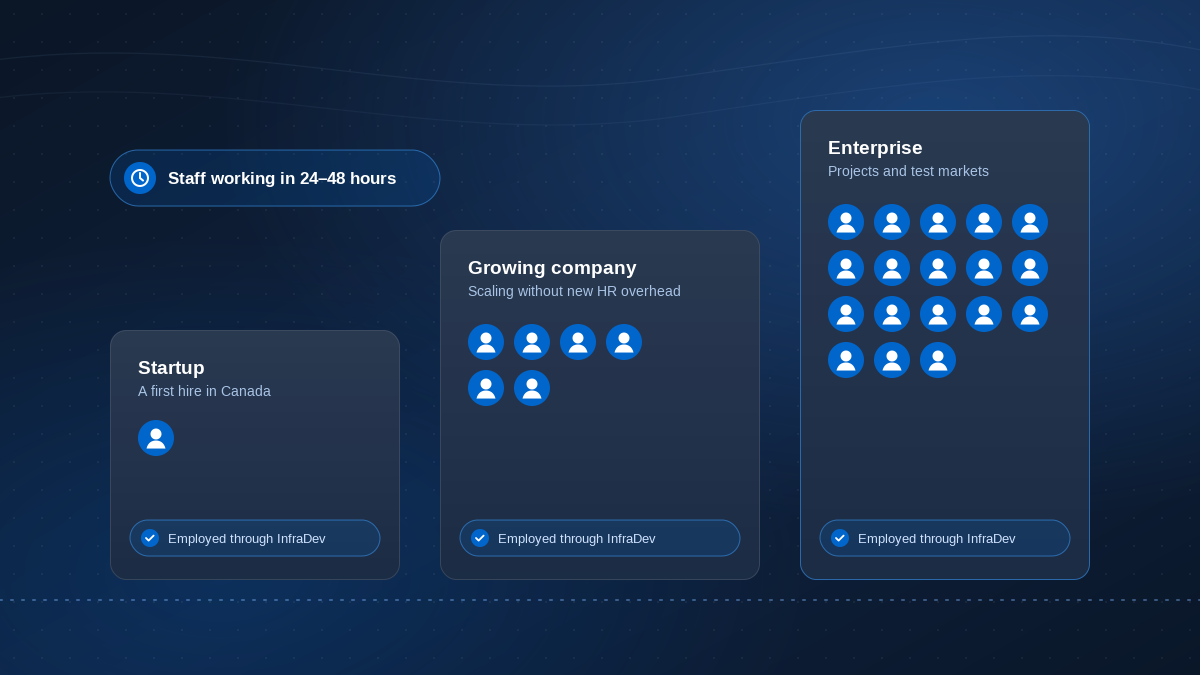
An employer of record (EOR) is the legal employer of a person you choose, in a country where you have no company of your own. For a U.S. company hiring in Canada, that means no Canadian entity to form or run, a start within 24–48 hours of agreeing terms, payroll and employment law carried by the employer, and one monthly invoice. The benefits are the same for one hire or twenty. What changes with company size is which one matters most.
Six reasons U.S. companies choose an employer of record
1. No Canadian entity to set up or run
Hiring directly means incorporating, registering for a CRA business number and payroll account, registering with the provincial workers’ compensation board and, in Québec, with Revenu Québec, then keeping all of it current. Through an employer of record, those registrations belong to the employer. You sign one agreement and start hiring.
2. A hire can start this week
Forming an entity and getting payroll running takes weeks to months. Through an employer of record, a hire can usually start within 24–48 hours of terms being agreed. When a strong candidate is weighing competing offers, that gap decides the hire.
3. Compliance carried by the legal employer
Canadian employment is governed largely by provincial law, and payroll rates and maximums change every January. As the legal employer, the EOR applies them:
- Income tax, CPP or QPP and EI withheld and remitted on schedule
- Vacation, statutory holidays, overtime and leave as the province requires
- Employment contracts, probation and termination to provincial standards
- Workers’ compensation registration and premiums
- T4 slips, Records of Employment and payroll records
The person is an employee, so there is no contractor misclassification risk to carry.
4. Costs you can predict
An entity has fixed costs whether it employs one person or twenty: incorporation and legal fees, accounting, a payroll provider and the internal time to manage them. An employer of record charges per employee. InfraDev’s fee starts at an estimate of 10% of salary, with a minimum of US$499 a month, and statutory contributions pass through at cost. Against comparable U.S. roles, total employment costs in Canada typically run 10–40% lower, though that is not guaranteed. The employer cost calculator shows the contributions for a salary and province.
5. One invoice
Instead of running Canadian payroll accounts, remittances and benefits vendors, you receive one monthly invoice covering salary, employer contributions and the EOR’s fee, normally in U.S. dollars.
6. Room to change course
You can add people as the work grows, test the Canadian market before committing to an entity, or staff a fixed-term project, without changing your corporate structure. If you later open your own Canadian entity, the employment can move across to it.
What matters most at each company size
| Company | The benefit that usually decides it | Where to read more |
|---|---|---|
| Startup, first hire in Canada | Speed, and no entity costs while headcount is small. Employment agreements assign work product and inventions to you, which is what investors review | Employer of record for startups |
| Growing company, a few hires becoming a team | One contract, onboarding and payroll process for every hire, across provinces, on one invoice | Employer of record for mid-market companies |
| Enterprise | Hires that need to start before an entity exists, sit outside an existing one, or meet strict security requirements, including office-only access | Employer of record for enterprise teams |
There is no minimum headcount. A single key hire is one of the most common starting points.
Common situations
- A startup’s first Canadian engineer, employed in days instead of after incorporation.
- A company testing a Canadian team before deciding whether to open an entity.
- A contractor whose role has become employment, converted to an employee without changing the working relationship.
- A U.S. hire blocked by the visa process, employed in Canada instead. See H-1B alternatives.
- A project team needed for a defined period.
When your own entity is the better choice
If an employer of record fits, the next decision is which one. How to choose an employer of record sets out the questions to ask, with a scorecard.
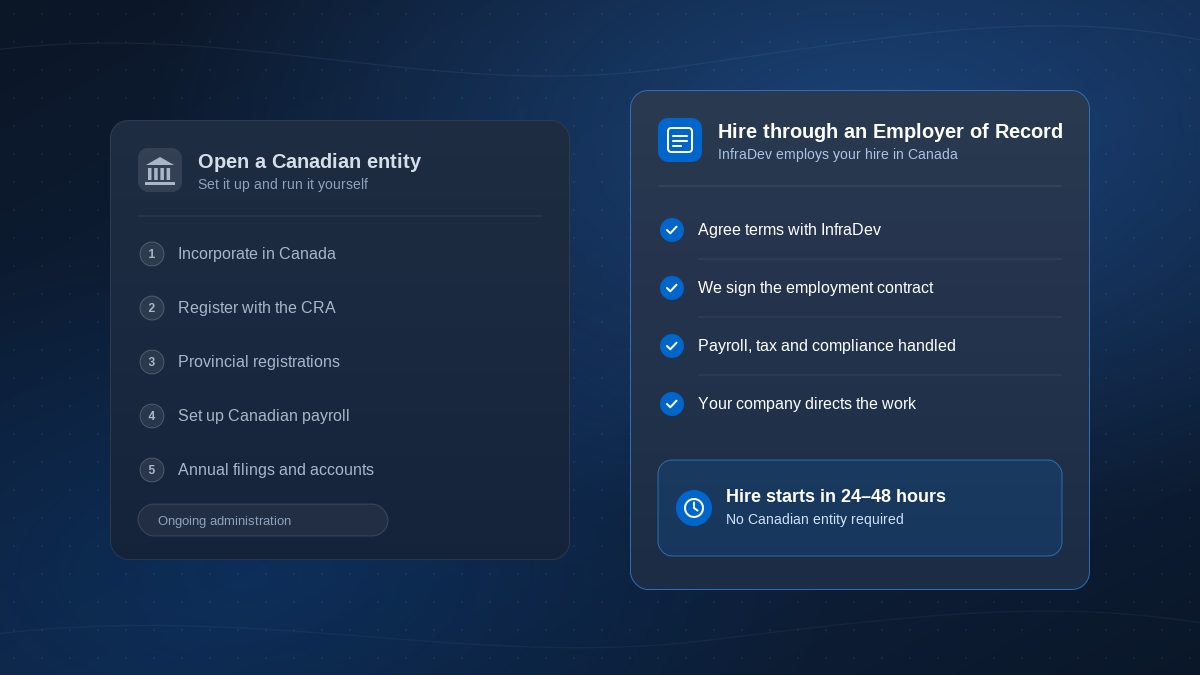
Consider opening your own Canadian entity when:
- The Canadian team will be large and permanent
- You need a Canadian presence to contract with customers or hold assets
- You are investing in Canadian operations beyond employment
- Your tax or corporate structure calls for it
EOR vs Canadian entity shows the headcount where an entity starts to pay off. Starting with an employer of record and opening an entity later is a common path.
Industries we serve
InfraDev employs people in Canada for U.S. companies across sectors, from a single key hire to teams of twenty or more.
| Industry | Typical roles |
|---|---|
| Technology and software | Developers, product managers, engineers |
| Professional services and consulting | Consultants and analysts |
| Healthcare and life sciences | Clinical, research and operations staff |
| Financial services and fintech | Analysts, developers, operations |
| Manufacturing and supply chain | Specialists and coordinators |
| Media and creative | Designers, writers, producers |
| E-commerce and retail | Merchandising, technology and support staff |
| Energy and clean tech | Engineers and project staff |
Bring the person you have chosen, or send us the role and we will present people from our network of more than 1,000 Canadian professionals. See how hiring through InfraDev works, or book a 15-minute call to price a specific hire.
Frequently asked questions
What are the benefits of an employer of record for a U.S. company hiring in Canada?
An employer of record lets a U.S. company hire in Canada with no Canadian entity to form or run, a start within 24–48 hours of agreeing terms, payroll and employment compliance carried by the legal employer, and one monthly invoice. It also leaves room to open an entity later, when the Canadian team justifies one.
What are the benefits of an employer of record for a startup?
A startup can make its first Canadian hire in 24–48 hours instead of incorporating first, with no fixed entity costs while headcount is small. InfraDev's employment agreements assign work product and inventions to the startup, which is what investors review, and funded startups get 20% off the first 12 months.
Can a U.S. company use an employer of record for just one person in Canada?
A single key hire is one of the most common ways U.S. companies start with an employer of record. The same agreement then covers each person added, from one to twenty and beyond, with every employee on one monthly invoice and no change to your corporate structure.
What does an employer of record cost in Canada?
InfraDev's employer of record fee starts as an estimate of 10% of salary (15% above US$200,000), with a minimum of US$499 a month per employee. Salary, statutory deductions and employer contributions are billed at cost on the same monthly invoice. The final fee is agreed with each client.
Who stays in charge of the work when a U.S. company uses an employer of record?
The U.S. company does. It chooses the person, sets the role and pay, and directs the day-to-day work, priorities and performance. The employer of record holds the employment contract and runs payroll, benefits and compliance in Canada underneath.
When is a Canadian entity better than an employer of record?
A Canadian entity becomes worth its setup when the Canadian team is large and permanent, when you need a Canadian presence to contract with customers or hold assets, or when you are investing in Canadian operations beyond employment. Many companies start with an employer of record and move the employment across later.
Related reading
-
Converting a Canadian contractor to an employee: a guide for U.S. companies
A U.S. company can convert a Canadian contractor to an employee without opening a Canadian entity: an employer of record employs them, or the company registers as an employer with the CRA. The work is in six steps: review the history, set the salary, settle the service date, sign a provincial agreement, close the contract and start payroll on day one.
Read the article -
H-1B alternatives for U.S. employers: when hiring in Canada makes sense
The main alternatives to an H-1B are TN status, an L-1 transfer, an O-1, or employing the person in Canada. How each route works, who qualifies, and what to do when a U.S. visa is not an option.
Read the article -
Employee benefits in Canada: what a U.S. employer must provide and what Canadians expect
Employee benefits in Canada come in three layers. The law requires employer contributions to the Canada Pension Plan and Employment Insurance, workers' compensation, paid vacation, paid public holidays and job-protected leaves. Public programs cover doctor and hospital care and pay parental leave. Supplementary health and dental cover, a retirement plan match and extra vacation are optional, and most candidates expect them.
Read the article -
Remote work savings for employers: how much a company saves by hiring remotely
Where remote work savings for employers come from: office space, lower turnover and a wider hiring market. What the research measured, how hiring remotely in Canada typically lowers the cost of comparable roles by 10–40%, and seven ways to keep more of the saving.
Read the article
Next steps for hiring in Canada
Weighing an employer of record for your next hire?
Tell us the role, the province and how many people you plan to hire. We'll show what an employer of record would cost and how soon your hire could start.